Video ads in ecommerce: 34% conversion boost revealed
HotUGC
March 4, 2026 · 12 min read
Video ads in ecommerce: 34% conversion boost revealed

Video ads in ecommerce have become essential for driving sales. Studies show video content increases ecommerce conversion rates by 34% on average compared to static images. Yet many marketers hesitate, assuming video production is expensive and time consuming. AI-powered user-generated content (UGC) style videos solve this challenge by combining authenticity with scalability. This guide reveals how video ads boost ecommerce performance and how AI makes them accessible to brands of all sizes.
Table of Contents
- Why Video Ads Drive Ecommerce Success
- Authenticity Through UGC Style Videos
- Leveraging AI For Scalable Video Advertising
- Best Platforms For Ecommerce Video Advertising
- Optimizing Video Ads For Maximum Conversions
- Measuring Success In Ecommerce Video Advertising
- Common Misconceptions And Barriers
- Comparison Of Traditional Vs AI-Generated Video Ads
- Discover Scalable AI Video Ads With HotUGC
- Frequently Asked Questions About Ecommerce Video Ads
Key takeaways
| Point | Details |
|---|---|
| Video ads outperform static images | Video content increases ecommerce conversion rates by 34%, demonstrating superior engagement. |
| UGC-style videos drive authentic engagement | UGC formats achieve 20-50% higher engagement rates by creating relatable, trustworthy content. |
| AI reduces production costs dramatically | AI-driven tools cut video production costs by up to 70% and reduce creation time from weeks to minutes. |
| Platform selection impacts ROI | TikTok, Instagram, and Facebook each offer unique advantages for ecommerce video advertising. |
| Optimized scripts boost click-through rates | Well-crafted hooks and scripts can increase click-through rates by 18-33% when targeted properly. |
Why video ads drive ecommerce success
Video ads dominate ecommerce marketing because they show products in action. Shoppers see how items look, move, and function in real scenarios, reducing purchase hesitation. This visual clarity directly influences buying decisions.
Video content increases ecommerce conversion rates by 34% on average compared to static images. The difference stems from engagement metrics. Videos generate higher watch time, more shares, and deeper emotional connections than photos.
Psychological triggers explain this advantage:
- Motion and sound capture attention faster than static content
- Demonstrations build trust by showing real product applications
- Human faces in videos create emotional bonds with viewers
- Story-driven content makes products memorable
These factors combine to create urgency. Shoppers who watch product videos act faster because they feel more informed and confident.
“Video breaks down the barrier between browsing and buying. When customers see a product in use, they mentally own it before checkout.”
The effect amplifies on mobile devices, where video plays automatically in social feeds. This seamless experience keeps shoppers engaged without requiring extra clicks. Understanding why UGC style videos perform better helps you capitalize on these psychological advantages.
Authenticity through UGC style videos
User-generated content (UGC) style videos outperform polished corporate ads because they feel genuine. Shoppers trust recommendations from people who look and sound like them, not actors reading scripts.
UGC-style videos achieve 20-50% higher engagement rates than traditional advertisements. This boost comes from perceived authenticity. When viewers see someone casually reviewing a product in their home, it mirrors how they would use it themselves.
Successful ecommerce campaigns prove this impact:
- Fashion brands using customer testimonial videos see 28% higher add-to-cart rates
- Beauty products featured in UGC formats generate 3x more shares
- Electronics reviews from everyday users reduce return rates by reducing buyer uncertainty
The UGC style advantage lies in social proof. Shoppers believe real experiences over marketing claims. A mom reviewing baby products carries more weight than a branded announcement.
This emotional connection drives action. When viewers identify with the person on screen, they imagine themselves benefiting from the product. That visualization shortens the path to purchase.
Pro Tip: Feature diverse avatars in your UGC videos to match your target demographics. Representation increases relatability and engagement across audience segments.
Brands no longer need actual customers to create UGC-style content. AI platforms generate authentic-looking reviews that capture the casual, relatable tone shoppers trust. This approach combines UGC benefits with production control.
Leveraging AI for scalable video advertising
Traditional video production requires crews, equipment, and weeks of editing. AI-driven video production tools reduce per-ad costs by up to 70% and cut production time from weeks to minutes.

This speed transforms campaign strategies. Marketers can test multiple video variations simultaneously instead of committing to one expensive production. If a message resonates, you scale it immediately. If it underperforms, you pivot without significant loss.
AI platforms offer consistent quality across hundreds of videos:
- Avatars maintain brand-appropriate appearance and tone
- Scripts follow proven conversion frameworks automatically
- Hooks are optimized based on platform best practices
- Multi-language versions deploy simultaneously for global reach
Consistency matters for brand recognition. When shoppers see similar video styles across campaigns, they develop familiarity. That recognition builds trust over time.
“AI doesn’t just reduce costs. It removes the bottleneck between creative ideas and execution. You can launch a campaign the same day you conceive it.”
Smaller brands benefit most from this democratization. Previously, only corporations could afford frequent video releases. Now, any ecommerce business can maintain a steady content calendar.
The AI video ads guide details how to implement these tools effectively. The key is treating AI as a creative partner that handles production while you focus on strategy.
Pro Tip: Experiment with AI templates to find ideal UGC-style formats for your audience. Test different avatar types, script lengths, and hook styles to discover what drives your specific conversions.
Best platforms for ecommerce video advertising
Each social platform offers distinct advantages for ecommerce video ads. Your audience demographics and product type determine the best fit.
TikTok delivers the highest engagement rates for video content. Its algorithm prioritizes entertaining, authentic videos, making it ideal for UGC-style ads. The platform skews younger but is expanding across age groups.
Instagram Reels excels at visual storytelling and brand building. Shoppers use Instagram to discover products and follow brands they love. Reels integrate seamlessly with shopping features, creating a smooth path to purchase.
Facebook provides advanced targeting with the broadest demographic reach. Its detailed audience segmentation lets you show specific videos to precise customer segments. This precision improves conversion rates by matching content to intent.
| Platform | Best For | Key Advantage | Typical Engagement |
|---|---|---|---|
| TikTok | Trend-driven products | Viral potential and organic reach | 5-8% average |
| Instagram Reels | Lifestyle and beauty brands | Shopping integration and visual focus | 3-6% average |
| Broad demographics | Precise targeting and retargeting | 2-4% average |
Platform features influence video format:
- TikTok favors 15-30 second vertical videos with trending sounds
- Instagram Reels performs best at 30-60 seconds with polished aesthetics
- Facebook supports longer videos but mobile-first vertical format still wins
ROI varies based on your audience segment and campaign goals. A platforms comparison helps identify where your customers spend time. Testing across channels reveals which platform converts best for your specific products.
The TikTok vs Instagram platform comparison explores demographic differences in detail. Understanding these nuances prevents wasted ad spend on the wrong audience.
Optimizing video ads for maximum conversions
Creating video ads is one challenge. Making them convert is another. Scripts and hooks determine whether viewers watch through and take action.
Scripts optimized for ecommerce can increase click-through rates by 18-33%. The structure matters more than creativity. Start with the problem, introduce your product as the solution, and end with a clear call to action.
Hooks capture attention in the first three seconds:
- Ask a provocative question viewers want answered
- Show a surprising visual that creates curiosity
- State a bold claim backed by your product benefits
- Open with a relatable pain point your audience experiences
- Use pattern interrupts like unexpected sounds or movements
Customization increases relevance. Tailor messages to specific audience segments based on demographics, behaviors, and purchase history. A first-time visitor needs different messaging than a repeat customer.
A/B testing reveals what works. Create multiple versions of hooks, script structures, and calls to action. Let data guide decisions instead of assumptions. Even small changes in word choice can shift conversion rates significantly.
Pro Tip: Leverage UGC testimonials early in your video script to build trust immediately. Social proof in the first five seconds reduces skepticism and keeps viewers watching.
The effective video hooks resource demonstrates specific examples that drive engagement. Study successful patterns, then adapt them to your brand voice and product category.
Measuring success in ecommerce video advertising
Impression counts don’t reveal video ad effectiveness. You need metrics that connect views to business outcomes.
View-through rate shows how many people watched your entire video. High completion rates indicate engaging content that holds attention. Low rates signal your hook failed or the content dragged.
Engagement rate measures likes, shares, comments, and saves. These actions demonstrate emotional resonance. Shoppers who engage are more likely to remember your brand and return later.
Conversion rate links video viewers to actual purchases. This is your ultimate success metric. Track how many people who watched your ad completed checkout. Compare this to static ad conversion rates to prove video ROI.
Additional metrics to monitor:
- Click-through rate from video to product page
- Average watch time to identify drop-off points
- Cost per acquisition to calculate profitability
- Return on ad spend to justify budget allocation
Impressions alone create false confidence. A million views mean nothing if nobody buys. Focus on actions that generate revenue.
Analytics platforms specialized for ecommerce video ads provide clearer insights. They connect view data to purchase behavior, revealing which videos drive sales versus which just entertain. The video ad metrics guide explains how to set up proper tracking.
Common misconceptions and barriers
Many ecommerce marketers avoid video ads based on outdated assumptions. These misconceptions limit growth opportunities.
The biggest myth claims video production is prohibitively expensive. 65% of marketers overestimate video production costs, limiting adoption despite cost savings via AI tools. Modern platforms have eliminated this barrier.
AI video tools reduce production costs by up to 70% and simplify creation workflows. What once required $5,000 per video now costs under $100. This dramatic shift makes video accessible to brands of all sizes.
Other common barriers include:
- Believing video requires technical expertise or equipment
- Assuming ROI is too difficult to measure accurately
- Thinking static images perform just as well for less effort
- Worrying that AI-generated content looks fake or unprofessional
Each concern has a solution. AI platforms handle technical complexity. Analytics tools track ROI precisely. Performance data proves video outperforms static content. Modern AI avatars and voices sound natural and authentic.
“The barrier isn’t capability anymore. It’s mindset. Marketers who still think video is too hard are leaving conversions on the table while competitors scale with AI tools.”
Real results prove the value. The GlowLab AI UGC case study demonstrates how a skincare brand tripled return on ad spend by switching to AI-generated UGC videos. They overcame initial skepticism and transformed their marketing efficiency.
Overcoming these misconceptions unlocks significant marketing opportunities. The brands winning in 2026 are those who adapted fastest to AI video capabilities.
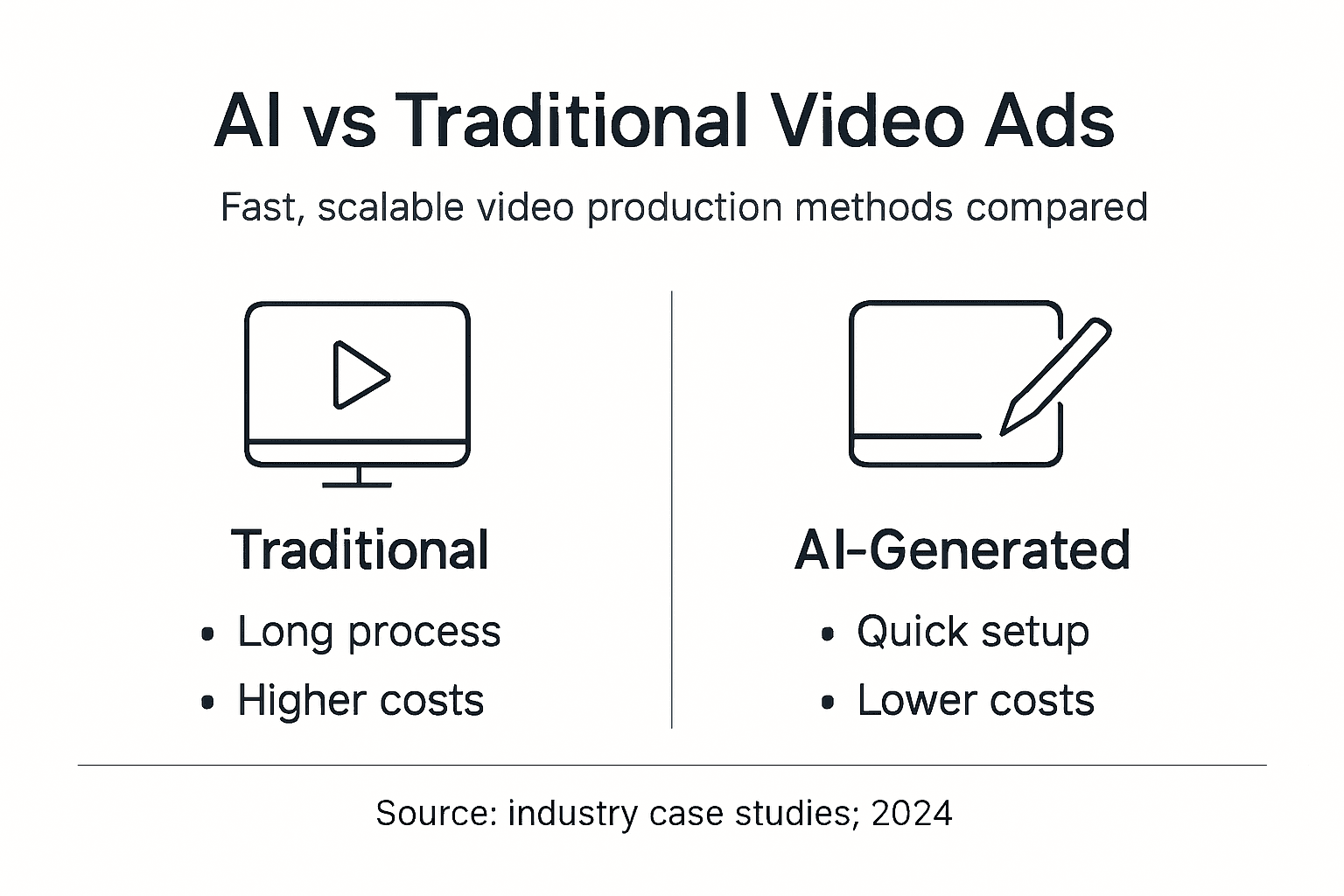
Comparison of traditional vs AI-generated video ads
Traditional filmed video ads and AI-generated UGC-style videos serve the same goal but differ dramatically in execution.
Traditional production involves hiring creators, scheduling shoots, filming multiple takes, and editing footage. This process takes two to six weeks and costs $2,000 to $10,000 per video depending on complexity.
AI-generated videos complete in minutes. You input product details and messaging preferences. The platform creates scripts, selects avatars, and renders finished videos. Costs range from $50 to $200 per video.
| Factor | Traditional Video Ads | AI-Generated UGC Videos |
|---|---|---|
| Production Time | 2-6 weeks | 5-15 minutes |
| Cost Per Video | $2,000-$10,000 | $50-$200 |
| Engagement Rate | 3-5% average | 3-6% average |
| Scalability | Limited by budget and crew availability | Unlimited, create hundreds simultaneously |
| Consistency | Varies by creator and shoot conditions | Uniform quality across all videos |
| Editing Flexibility | Requires re-shoots for changes | Instant updates to scripts or avatars |
Engagement rates remain comparable between formats. Viewers respond to messaging and relevance, not production method. Well-crafted AI videos perform as effectively as traditional shoots.
Scalability gives AI the decisive advantage:
- Launch seasonal campaigns across multiple products instantly
- Test dozens of messaging variations to find winners
- Localize content for different markets without new shoots
- Update videos when product details change
Brands can choose formats based on specific needs. High-budget brand campaigns might still use traditional production for flagship content. Daily promotional videos and product launches benefit from AI speed and cost efficiency.
The AI vs traditional video ads analysis explores when each approach makes sense. Most ecommerce brands discover AI handles 80-90% of their video needs while reserving traditional shoots for special projects.
Discover scalable AI video ads with HotUGC
Ready to transform your ecommerce advertising with video? HotUGC specializes in AI-generated UGC-style video ads built for scalability and conversions.
Create authentic product review videos in minutes using realistic avatars and conversion-optimized scripts. No filming, no editing, no hiring creators. Just input your product details and launch campaigns.

Thousands of ecommerce marketers have increased their conversion rates while reducing production costs. Access case studies, optimization guides, and platform tutorials on the HotUGC blog to master AI video advertising.
Start creating video ads that drive results today.
Frequently asked questions about ecommerce video ads
What is the average ROI of ecommerce video ads?
Ecommerce video ads typically deliver 2-5x return on ad spend when properly optimized. The exact ROI depends on product margins, targeting accuracy, and creative quality. Brands using AI-generated UGC videos often see higher returns due to lower production costs.
How quickly can I produce AI-generated video ads?
AI platforms create finished video ads in 5-15 minutes from initial input to rendered output. You can produce dozens of variations in a single day, enabling rapid testing and campaign launches that traditional production cannot match.
Can small ecommerce brands benefit from video ads?
Small brands benefit most from video ads because AI tools level the playing field. You gain the same video capabilities as large competitors at a fraction of traditional costs, making professional video advertising accessible regardless of budget size.
Are UGC-style videos better than traditional ads?
UGC-style videos achieve 20-50% higher engagement rates because they feel authentic and relatable. Shoppers trust peer recommendations over corporate messaging, making UGC formats more effective for driving conversions in most ecommerce categories.
What metrics should I track to measure ecommerce video ad success?
Focus on conversion rate, cost per acquisition, and return on ad spend as primary metrics. Secondary indicators include view-through rate, engagement rate, and click-through rate. These metrics connect video performance directly to revenue outcomes.