Why Automate Video Ads: Cut Costs 90% & Boost CTR 5x
HotUGC
March 3, 2026 · 13 min read
Why Automate Video Ads: Cut Costs 90% & Boost CTR 5x

Video ads now achieve 3-5x higher engagement than static images on social media platforms, yet most e-commerce brands still struggle with costly, slow traditional video production. User-generated content (UGC) style ads dominate TikTok and Instagram performance, but hiring creators and managing video shoots limits scalability. Automation transforms this challenge, enabling marketers to produce professional video ads in minutes instead of weeks while slashing costs by up to 90%.
Table of Contents
- The Rise of Video Ads in E-Commerce
- Why Automate Video Ads for E-Commerce?
- How Automation Optimizes Video Ad Production Speed and Scale
- Impact of Video Ads on E-Commerce Conversions
- Common Misconceptions About Automating Video Ads
- Cost-Effectiveness and ROI of Video Ad Automation
- Global Scalability and Localization Enabled by Automation
- Practical Steps for Integrating Video Ad Automation in Your Marketing
- Unlock Scalable AI-Generated UGC Videos with HotUGC
- Frequently Asked Questions
Key Takeaways
| Point | Details |
|---|---|
| Speed | Automation reduces video ad production time from weeks to minutes, enabling rapid campaign iteration. |
| Cost | AI video ads cut production costs up to 90% compared to traditional methods, making video accessible for all brands. |
| Performance | Video ads achieve 3-5x higher click-through rates and boost conversion rates from 1-2% to 4-8%. |
| Authenticity | Advanced AI preserves the authentic UGC style that builds trust and drives social media engagement. |
| Global Reach | Automation enables multi-language capabilities across 30+ languages for rapid international market expansion. |
The Rise of Video Ads in E-Commerce
Video marketing trends in 2026 show that social platforms prioritize video content in their algorithms, pushing it to more users than static posts. UGC style ads dominate TikTok and Instagram for e-commerce brands because they feel authentic rather than promotional. Consumers trust peer reviews more than polished brand content, making UGC style videos the most effective format for driving purchases.
Traditional video production creates significant barriers for small and medium businesses. Professional shoots require cameras, lighting, sound equipment, and editing software. Hiring creators, securing locations, and coordinating schedules adds weeks to production timelines. Most brands lack in-house video expertise, forcing them to outsource at premium rates.
These challenges compound when brands need multiple video variations for A/B testing. Creating five different hooks or three product angle tests traditionally means five separate shoots. The cost and time investment becomes prohibitive, leaving marketers stuck with limited creative options.
Key obstacles to scaling traditional video production include:
- High upfront costs for equipment, talent, and post-production editing
- Lengthy timelines requiring weeks from concept to finished asset
- Limited testing capability due to per-video production expenses
- Difficulty maintaining consistent quality across multiple creators
- Complex logistics coordinating schedules, locations, and talent
Automation emerges as the solution to these constraints, enabling brands to produce unlimited video variations without the traditional bottlenecks.
Why Automate Video Ads for E-Commerce?
Automation directly addresses the core pain points that restrict video advertising scalability. What previously required a two-week production cycle now takes minutes. An AI platform generates avatars, scripts, and voiceovers automatically, eliminating the need for physical shoots entirely.
Cost reduction reaches up to 90% compared to hiring creators and production teams. Small brands suddenly access the same video advertising capabilities as large competitors. The financial barrier disappears, democratizing high-quality video content creation.

Rapid A/B testing becomes practical when you can generate dozens of video variations instantly. Test different hooks, product angles, and calls to action without additional production budgets. This iterative approach identifies winning creative faster, improving overall campaign performance.
Multi-language support transforms global expansion from a major undertaking into a simple workflow. Generate the same video in Spanish, French, German, and 27+ other languages with a few clicks. Traditional dubbing or reshooting for international markets costs thousands per language.
Pro Tip: Start with template-based automation to maintain consistent branding across all videos while testing creative variations. Establish your brand voice and visual identity in the templates, then let automation handle the scaling.
The UGC ad framework for video automation structures your content for maximum impact. Following proven frameworks ensures your automated videos hit the same engagement benchmarks as manually produced content. Automation handles execution while you focus on strategy and optimization.
Key benefits that drive adoption:
- Production timelines collapse from weeks to minutes
- Costs drop 90%, making video accessible for any budget
- Unlimited testing variations without additional expense
- Global campaigns deploy simultaneously across all markets
- Consistent quality maintained across thousands of videos
How Automation Optimizes Video Ad Production Speed and Scale
AI-powered platforms replace traditional filming workflows with automated generation. Instead of booking talent, you select an AI avatar that matches your target audience. Rather than writing and rehearsing scripts, the system generates conversion-optimized copy based on your product details. Voiceovers synthesize naturally without recording studios.
The automated workflow follows these steps:
- Input product information, target audience details, and campaign objectives into the platform
- AI generates multiple script variations, selects appropriate avatars, and creates voiceovers
- System produces numerous video variations testing different hooks, angles, and calls to action
- Videos export in formats optimized for each social platform’s specifications
- Performance data feeds back to refine future generations and improve results
This process repeats indefinitely without fatigue or quality degradation. Generate ten videos or ten thousand with identical per-unit effort.
| Aspect | Traditional Production | AI Automated Creation |
|---|---|---|
| Time per video | 2-3 weeks | 2-5 minutes |
| Cost per video | $500-$5,000 | $10-$50 |
| Scalability | Linear (each video requires full process) | Exponential (unlimited simultaneous generation) |
| Testing capability | Limited by budget constraints | Unlimited variations at marginal cost |
| Consistency | Varies by creator and conditions | Uniform quality and branding |
Social media platform integration streamlines distribution. Export videos in TikTok’s vertical 9:16 format, Instagram’s square 1:1 ratio, or Facebook’s horizontal 16:9 layout automatically. Each platform receives optimized files without manual reformatting.
Brand templates ensure visual consistency even when generating thousands of videos. Define your color palette, logo placement, font choices, and overlay styles once. Every subsequent video maintains these standards automatically, protecting brand identity at scale.
The complete guide to AI video ads explains technical implementation details for marketers ready to dive deeper into platform capabilities and optimization strategies.
Impact of Video Ads on E-Commerce Conversions
Video ads increase conversion rates to 4-8% compared to 1-2% for static image ads. Click-through rates run 3-5x higher for video, meaning more qualified traffic reaches your product pages. These improvements compound, delivering significantly better returns on ad spend.
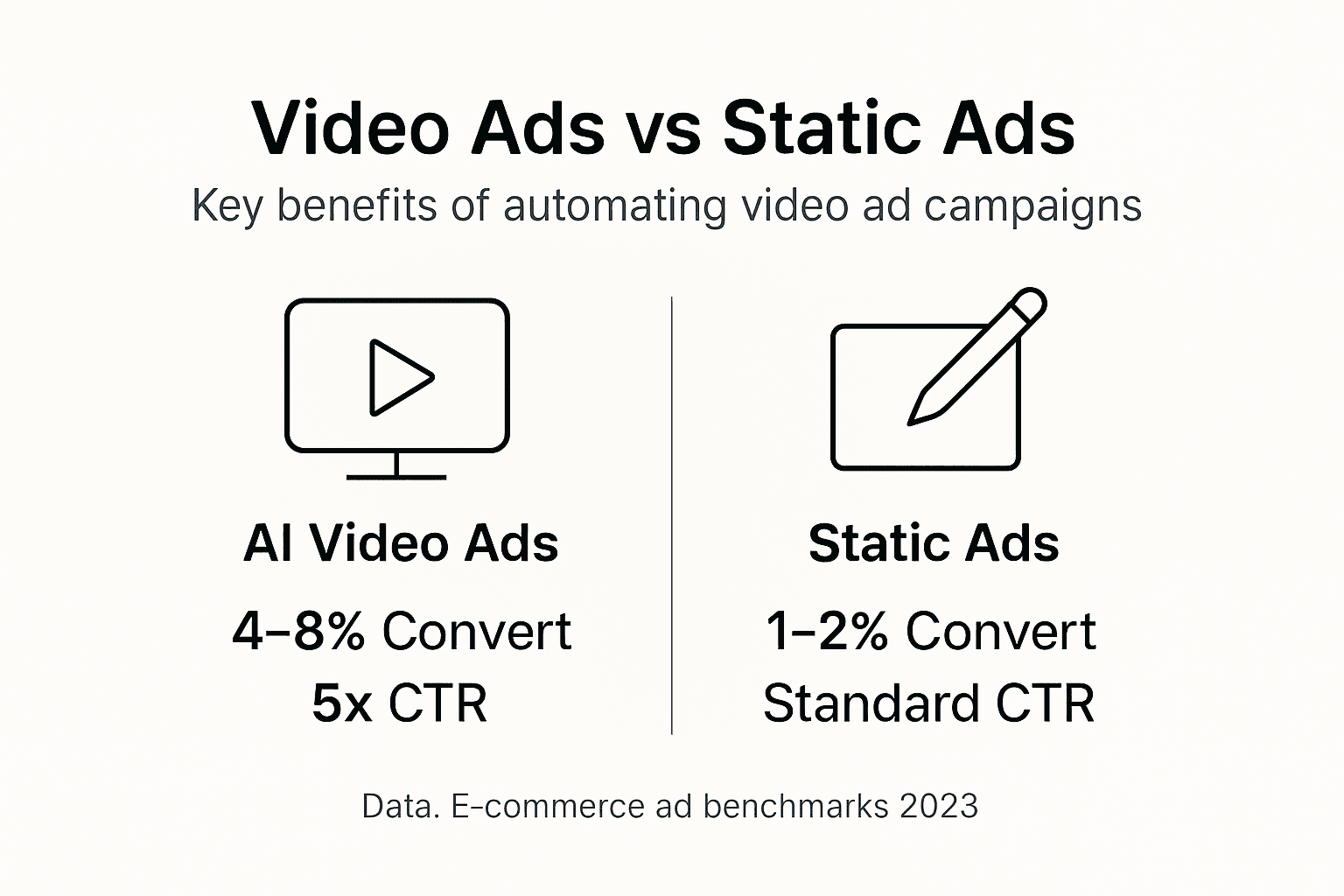
UGC style videos feel authentic because they mirror content consumers already trust. A realistic avatar sharing genuine product benefits resonates more than polished brand messaging. This authenticity reduces skepticism and accelerates purchase decisions.
Engagement metrics improve across all platforms when switching from static to video. Higher engagement signals platform algorithms to show your ads to more users, reducing your cost per click by 50-70%. Better organic reach stretches advertising budgets further.
Customer acquisition costs drop substantially when combining higher conversion rates with lower CPCs. Brands report 30-60% reductions in CAC after implementing video advertising strategies. These savings fund expanded testing and accelerated growth.
Video ads transform e-commerce performance by combining authentic UGC styling with superior engagement metrics, delivering 3-5x higher click-through rates, 2-4x better conversion rates, and 50-70% lower cost per click compared to static alternatives.
The performance gap between video and static ads continues widening as platforms prioritize video content. Early adopters of automation gain competitive advantages that compound over time. Brands still relying on static creative fall further behind in auction dynamics and audience attention.
Video ad performance stats demonstrate these trends across industries and market segments. The data proves video automation isn’t experimental; it’s essential for competitive e-commerce marketing.
Common Misconceptions About Automating Video Ads
Many marketers worry automation kills creativity, but the opposite proves true. Removing repetitive production tasks frees strategic thinking time. You focus on testing hooks, angles, and messaging while automation handles execution. Automation frees marketers from repetitive tasks, allowing focus on creative strategy rather than technical production.
Concerns about losing authentic UGC feel miss how modern AI preserves that style. AI-generated videos maintain authentic UGC style through realistic avatars, natural speech patterns, and casual presentation formats. Viewers can’t distinguish well-executed AI videos from creator-filmed content.
The belief that automation only suits enterprise budgets ignores the democratizing effect. Small brands gain the most because they previously couldn’t afford any video production. A solo entrepreneur now produces the same volume and quality as Fortune 500 marketing teams.
Three persistent myths about video automation:
- Myth: Automated videos look robotic and fake. Reality: Modern AI avatars and voice synthesis achieve photorealistic quality indistinguishable from real creators.
- Myth: Automation removes human creativity from marketing. Reality: Automation executes creative concepts faster, enabling more experimentation and strategic iteration.
- Myth: Only large brands benefit from video automation. Reality: Small businesses gain proportionally larger advantages due to previously prohibitive production costs.
Pro Tip: Combine human creativity with automation for optimal results. Use your marketing expertise to develop strategic concepts and messaging frameworks, then let AI handle scaling and production execution.
AI marketing creativity facts show that brands using automation test 5-10x more creative variations than manual production allows. More testing leads to better-performing campaigns through continuous optimization.
Cost-Effectiveness and ROI of Video Ad Automation
AI video ads achieve 30-50% lower CPM than static alternatives due to superior engagement rates. Platform algorithms reward high-engagement content with better reach and lower costs. Your advertising budget delivers more impressions and clicks automatically.
Production cost reduction reaches up to 90% when comparing AI automation to traditional creator-based production. A $2,000 traditional video costs $50-$200 through automation. This savings multiplies across dozens or hundreds of videos in your testing matrix.
Customer acquisition cost improvements compound these savings. Lower CPM plus higher conversion rates dramatically reduce CAC. Brands report breakeven ROAS targets dropping from 3.0x to 1.5x after implementing video automation, enabling more aggressive scaling.
| Metric | Traditional Video | AI Automated Video |
|---|---|---|
| Production cost per video | $500-$5,000 | $10-$50 |
| CPM (cost per thousand impressions) | $8-$15 | $4-$8 |
| Conversion rate | 1-2% | 4-8% |
| Customer acquisition cost | $45-$80 | $15-$35 |
| ROI timeline to positive | 60-90 days | 14-30 days |
Return on investment accelerates because testing cycles compress. Identify winning creative in days instead of months. Faster iteration means profitable campaigns scale sooner, improving cash flow and growth trajectories.
View automation as infrastructure investment rather than expense. The platform enables capabilities previously unavailable at any price point. Unlimited testing, instant localization, and rapid scaling create competitive moats that compound over time.
Cost and ROI data for AI video ads continues improving as AI technology advances. Early adopters establish advantages that later entrants struggle to overcome.
Global Scalability and Localization Enabled by Automation
Automated AI video platforms support 30+ languages, enabling global reach without additional production costs. Generate your English video, then create German, Spanish, and Japanese versions simultaneously. Traditional dubbing costs $1,000-$3,000 per language per video.
Voiceover synthesis in native languages sounds natural, not robotic. Accent matching ensures regional authenticity. A French video features a French accent, not English-accented French. This attention to detail maintains the authentic feel crucial for UGC style content.
Subtitle generation happens automatically in all supported languages. Accessibility improves engagement even for viewers watching with sound off. Many social media users browse silently, making subtitles essential for capturing attention.
Benefits of automated localization:
- Expand into international markets without hiring regional production teams
- Maintain perfect brand consistency across all languages and regions
- Accelerate market entry from months of preparation to days of execution
- Test market viability in new regions with minimal upfront investment
- Scale successful campaigns globally once local performance validates product-market fit
Small and medium brands access global opportunities previously reserved for multinationals. A three-person team launches in fifteen countries simultaneously. Geographic boundaries dissolve when language barriers disappear.
Global e-commerce strategy requires localized content that resonates culturally while maintaining brand identity. Automation balances these competing demands through templated consistency and linguistic flexibility. Your brand voice translates authentically without losing core messaging.
Video marketing globalization trends show international expansion driving 40-60% of growth for e-commerce brands. Automation removes the primary barrier preventing smaller players from capturing this opportunity.
Practical Steps for Integrating Video Ad Automation in Your Marketing
Starting with video automation requires strategic planning rather than technical expertise. Follow these steps to implement successfully:
- Select a platform offering customization options matching your brand identity and multi-language support for target markets. Evaluate avatar variety, voice quality, and script flexibility.
- Prepare product information including features, benefits, and unique selling propositions. Gather high-quality product images and existing brand assets for consistency.
- Develop brand-aligned script frameworks defining your messaging hierarchy, tone, and calls to action. Create templates for different campaign objectives like awareness, consideration, and conversion.
- Generate multivariate video sets testing hooks, product angles, and presentation styles. Start with 10-15 variations to identify patterns in performance data.
- Distribute campaigns across social platforms with format optimization for each channel’s specifications. TikTok, Instagram, Facebook, and YouTube each require different approaches.
- Track performance metrics including CTR, conversion rate, CPM, and ROAS. Identify top performers and iterate on successful patterns.
- Implement quality control reviews even with automation. Spot-check videos for brand alignment and message accuracy before large-scale deployment.
The complete guide to AI video ads provides detailed implementation frameworks for each step. The decision framework for AI avatars helps select avatar styles that resonate with your target audience.
Start small with a single product or campaign objective. Learn platform capabilities and optimization strategies before scaling. Early wins build confidence and organizational buy-in for broader adoption.
The UGC ad framework guide structures your content for maximum engagement. Following proven frameworks accelerates results by avoiding common mistakes.
Ongoing optimization matters more than perfect initial execution. Treat automation as an iterative learning system. Each campaign generates data informing better creative decisions, compounding performance improvements over time.
Unlock Scalable AI-Generated UGC Videos with HotUGC
HotUGC streamlines everything we’ve discussed into one powerful platform. Generate authentic UGC style video ads in minutes, not weeks. Our AI avatars, conversion-optimized scripts, and multi-language voiceovers deliver the performance metrics your campaigns need.

Scale globally with support for 30+ languages without hiring international production teams. Test unlimited creative variations to identify your highest-performing hooks and angles. The six-scene UGC ad framework guides your content structure for maximum impact.
See real results like the GlowLab AI UGC case study, where a skincare brand achieved 3x ROAS improvement using automated video ads. Explore HotUGC to transform your e-commerce video marketing with AI-powered automation.
Frequently Asked Questions
How does AI automation maintain video authenticity?
Modern AI avatars use photorealistic rendering and natural speech patterns that mirror real creators. The casual presentation style, genuine product interactions, and conversational tone preserve the authentic UGC feel viewers trust. Platform algorithms and human viewers cannot reliably distinguish well-executed AI videos from creator-filmed content.
What are cost implications for small and medium brands?
Small brands gain the largest proportional advantages because video production previously consumed entire marketing budgets. Costs drop from $500-$5,000 per traditional video to $10-$50 per automated video, making unlimited testing affordable. This democratization allows solo entrepreneurs to compete with enterprise marketing teams on creative volume and quality.
How do automated videos integrate with social media platforms?
Automation platforms export videos in each platform’s optimal format specifications automatically. TikTok receives vertical 9:16 videos, Instagram gets square 1:1 or vertical formats, and Facebook receives horizontal 16:9 layouts. Native formatting improves algorithm performance and user experience without manual reformatting work.
What are best practices for creative testing with automated video?
Start by testing hooks first since they determine whether viewers watch beyond three seconds. Generate 10-15 hook variations while keeping other elements constant. Once you identify winning hooks, test product angles and calls to action systematically. The complete guide to AI video ads provides detailed testing frameworks and optimization strategies.
How can I ensure brand consistency in automated videos?
Define brand templates including color palettes, logo placement, fonts, and overlay styles before generating videos. All subsequent creations inherit these standards automatically. Implement spot-check quality reviews for the first 20-30 videos to verify template accuracy, then scale confidently knowing consistency is maintained across thousands of videos.