Video Ad Engagement: Driving Results for Marketers
HotUGC
February 27, 2026 · 14 min read
Video Ad Engagement: Driving Results for Marketers

Every e-commerce marketer in the United States and Canada knows the sting of sinking hours and budget into video ads that rack up views but drive few real actions. Video engagement goes far beyond just counting eyeballs—it measures how your audience interacts, shares, and converts after seeing your content. Backed by research from global campaigns, this article uncovers the real drivers behind measurable video ad engagement and exposes common myths, equipping you to focus your efforts where results truly matter.
Table of Contents
- Video Ad Engagement Defined and Debunked
- Metrics That Gauge Video Ad Engagement
- Types of Video Content That Boost Engagement
- Key Traits and Psychology Behind Engaging Ads
- Practical Risks and Mistakes to Avoid
Key Takeaways
| Point | Details |
|---|---|
| Engagement Metrics Matter | Track various engagement metrics like completion rates and click-through rates to determine viewer interaction, not just views. |
| Authenticity Over Polish | Real, user-generated content often outperforms highly polished ads, fostering stronger connections with your audience. |
| Platform-Specific Strategies | Tailor your video strategies to each platform’s unique engagement signals for better results. |
| Testing is Crucial | Always test ads on a smaller scale before scaling up to identify effective strategies and avoid wasting budget. |
Video Ad Engagement Defined and Debunked
Video ad engagement isn’t about vanity metrics. It’s the measurable interaction between your audience and your video content—clicks, views, comments, shares, and ultimately conversions.
Most marketers conflate engagement with views alone. You could rack up thousands of impressions and still miss the sale. Real engagement happens when viewers take action: pausing to read your copy, rewatching key moments, or clicking through to your product page.
Research analyzing video ad features and their impact on audience interaction across 90,000+ campaigns worldwide reveals several misconceptions about what actually drives results.
What Engagement Actually Measures
Engagement encompasses multiple signals working together:
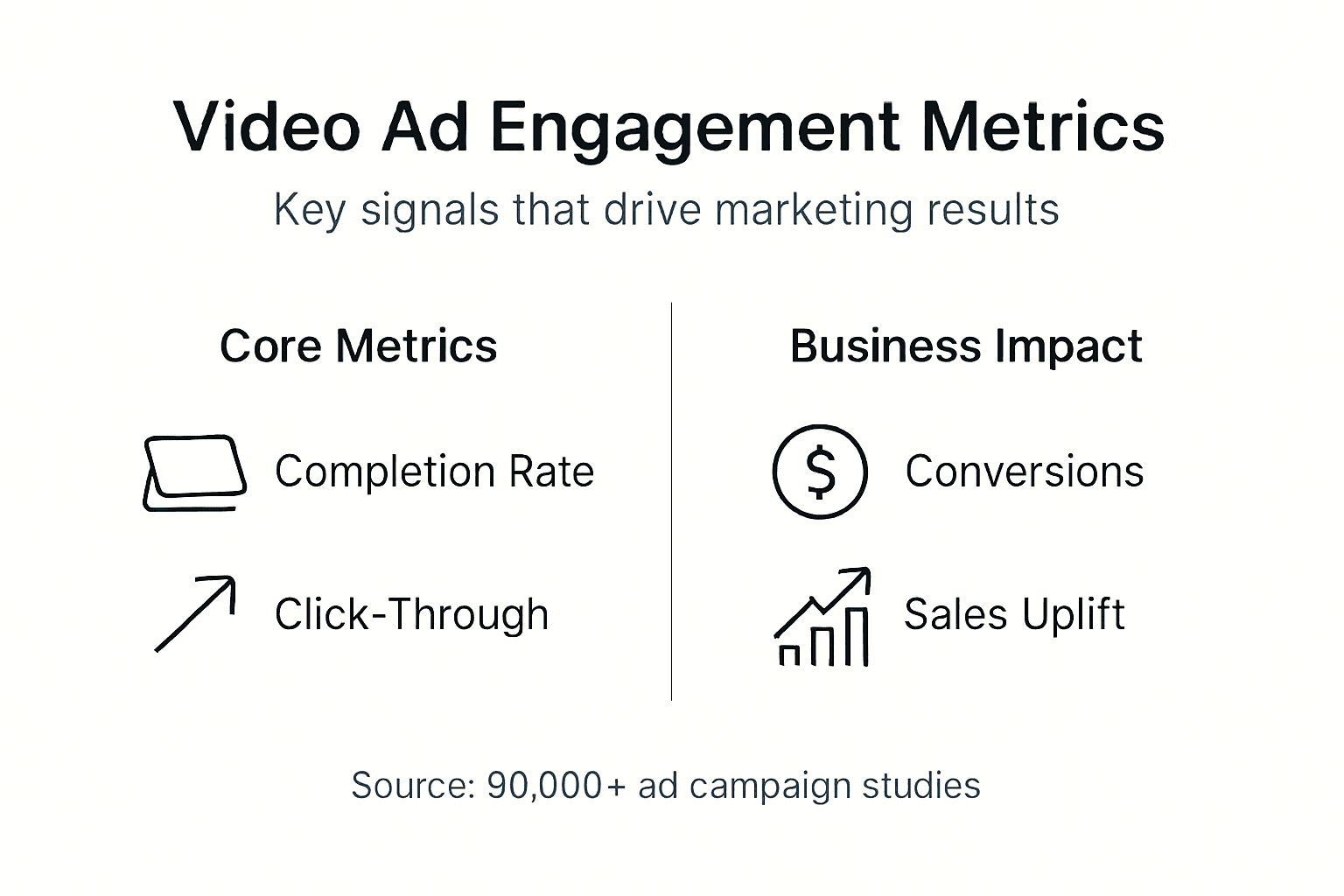
- Completion rate: How far viewers watch before dropping off
- Click-through rate: Percentage moving from ad to landing page
- Social signals: Shares, comments, and saves on social platforms
- Conversion rate: Actual purchases or desired actions completed
- Watch time: Total seconds of active viewing per user
Each metric tells a different story. A video with high completion rate but low click-through means your content resonates—but your call-to-action might need work.
Common Misconceptions Debunked
Misconception one: longer videos always perform worse. False. Video length influences engagement differently depending on your story and audience. A 30-second product demo might underperform compared to a 90-second genuine review that builds trust.
Misconception two: polished, professional production always wins. Your audience craves authenticity. User-generated content style videos—featuring real people, natural language, and genuine product demonstrations—consistently outperform overly edited, corporate messaging.
Misconception three: engagement metrics matter equally across platforms. They don’t. TikTok prioritizes completion rate and shares. Instagram Reels reward watch time and replays. Facebook values click-throughs and conversions. Your strategy must shift per platform.
Why This Matters for Your Bottom Line
Engagement directly impacts your ad costs and returns. Platforms reward high-engagement content with lower CPM rates. This means you spend less to reach your target customers while reaching people more likely to buy.
For e-commerce brands specifically, engagement metrics predict conversion probability better than raw impression counts. A video with 5,000 engaged viewers beats 50,000 passive scrollers every single time.
Authentic, audience-focused engagement beats polished production and high view counts when driving actual sales for e-commerce brands.
Pro tip: Test your video against competitors’ ads in your category to benchmark engagement rates—this reveals whether your messaging resonates or needs repositioning before scaling spend.
Metrics That Gauge Video Ad Engagement
Not all metrics matter equally. The ones you track determine whether you’re chasing vanity or actual business results.
Engagement metrics fall into three buckets: behavioral (what people do), cognitive (what they understand), and affective (how they feel). Most marketers ignore the cognitive and affective layers, missing crucial signals about whether their message resonates.
Understanding how to measure consumer engagement in interactive advertising reveals that single metrics fail to capture the full picture. You need multiple measures working together.
Primary Engagement Metrics
These are the foundation. Track them across every campaign:
- Click-through rate (CTR): Percentage of viewers clicking your link or call-to-action
- View completion rate: How many viewers watch to the end versus dropping off
- Watch time: Total seconds watched, averaged across viewers
- Cost per view: How much you pay for each completed view
- Cost per engagement: Total spend divided by actions taken (clicks, shares, comments)
Each tells you something different. High CTR with low completion means your hook works but your middle section loses people. Low CTR with high completion means viewers enjoy the content but don’t feel motivated to act.
Here’s a comparison of video ad engagement metrics and their business impact:
| Metric Type | Core Metric | What It Reveals | Business Impact |
|---|---|---|---|
| Behavioral | Click-through Rate (CTR) | Effectiveness of call-to-action | Predicts site visits and sales lift |
| Cognitive | Completion Rate | Viewer understanding and interest | Indicates message clarity |
| Affective | Shares and Comments | Emotional resonance with viewers | Drives organic reach and trust |
| Financial | Cost per Engagement | Budget efficiency | Guides ad spend decisions |
Secondary Signals Worth Monitoring
These metrics predict deeper engagement and conversion probability:
- Shares and saves: Viewers found your content valuable enough to redistribute or reference later
- Comments and replies: Audiences actively engaging with your message, not passively scrolling
- Rewatch rate: Percentage rewatching the video, indicating high relevance or confusion needing clarity
- Average play rate: How many times the video plays per unique viewer
Platform-specific engagement indicators like likes, comments, and shares work as aggregated signals. A video with 1,000 views and 50 comments beats 10,000 views with zero comments for predicting sales.
Why Platform Matters
TikTok rewards completion rate and share velocity. Instagram Reels prioritize watch time and saves. Facebook values click-through and conversion tracking. Your metrics dashboard should reflect these platform differences, not lump everything together.
Tracking the wrong metric at scale wastes budget fast—define success metrics before launching, not after analyzing results.
For e-commerce, conversion rate ultimately matters most. But the metrics above predict conversion probability before sales happen, letting you optimize in real-time rather than waiting weeks for ROI data.
Pro tip: Set up separate tracking for each platform and video format, then benchmark your completion rate against industry averages in your product category—this reveals if your creative needs repositioning before scaling spend.
The chart below compares engagement priorities by major social platforms:
| Platform | Top Engagement Signal | Optimization Focus | Typical Video Style |
|---|---|---|---|
| TikTok | Completion Rate, Shares | Virality and retention | Authentic, fast-paced |
| Watch Time, Saves | View duration | Visually dynamic, brief | |
| CTR, Conversion Rate | Clicks and purchases | Informational, direct | |
| YouTube | View Duration, Comments | Long-form retention | Storytelling, in-depth demos |
Types of Video Content That Boost Engagement
Not all video styles perform equally. Your content type determines whether viewers stay or scroll past in seconds.

The biggest mistake e-commerce marketers make is confusing polished production with engagement. A highly edited, corporate-style video often underperforms a raw, authentic product review shot on a phone.
Storytelling Versus Direct Arguments
Narrative-driven ads hook viewers better than argumentative approaches. Storytelling creates emotional connection. Direct arguments feel like a sales pitch people want to skip.
Story-based videos work because they show context. Instead of saying “this product is durable,” you show someone using it daily for months. Instead of claiming “saves time,” you demonstrate a before-and-after scenario.
For social media, storytelling holds attention through completion. Viewers watch longer when they’re invested in an outcome rather than being sold to directly.
Content Types That Drive Results
Research on social platforms identifies specific formats that consistently boost engagement:
- User-generated content style: Real people, natural language, authentic settings
- Product demonstrations: Hands-on showing how the product works in real scenarios
- Emotional storytelling: Content that connects on feeling level, not just features
- Visually colorful and dynamic: Bold colors, movement, quick cuts that grab attention
- Colloquial content: Conversational tone, relatable language, casual delivery
Short-form video content types on platforms like TikTok perform best when they combine multiple elements. A 15-30 second video featuring someone speaking naturally while demonstrating your product creates higher engagement than a 60-second polished commercial.
The Authenticity Advantage
Audiences respond to realness. A video showing actual customer reviews with minimal editing beats professionally filmed testimonials. Unscripted moments create trust faster than perfectly rehearsed messaging.
For e-commerce, this means featuring real product use cases. Show the product in natural lighting. Use casual language. Let imperfections show—they signal honesty.
Authentic, relatable content consistently outperforms expensive production, especially for driving conversions in e-commerce.
The common thread across high-engagement videos: they feel like a friend sharing honest experience, not a brand pushing something. Your audience knows when they’re being sold to. They respond when they feel like someone’s helping them make a decision.
Pro tip: Test three content formats with your product: a raw demo, a customer story, and an emotionally-driven narrative—then scale the format with highest completion rate and lowest cost per click.
Key Traits and Psychology Behind Engaging Ads
Engaging ads trigger specific psychological responses. Understanding what activates these responses lets you design videos that hold attention and drive action.
Your brain processes video ads through two parallel pathways: emotional and cognitive. Ads that activate both pathways create stronger engagement than those targeting only one.
Emotional and Psychological Triggers
Emotional appeal, visual complexity, and speech cadence directly influence how viewers cognitively and emotionally respond to short-form video content. Emotions come first—they grab attention before logic engages.
Emotional resonance doesn’t require manipulation. It means showing relatable struggles. A video acknowledging “I tried ten products before finding this one” creates connection faster than “This product solves everything.”
Visual complexity matters too. Too simple feels boring. Too chaotic overwhelms viewers. The sweet spot: enough movement and color to maintain attention without sensory overload.
Product Placement and Feature Saliency
Where your product appears and how prominently it features drives measurable engagement differences.
Research reveals that attention to product placement and feature prominence activate psychological processes that determine engagement effectiveness. Viewers must clearly see your product being used, not just mentioned.
Show the product early. Use it throughout. Make it the hero, not a background detail. When viewers see the product solving a real problem on screen, they connect usage to outcome.
The Speed and Pacing Element
Speech cadence influences cognitive load. Fast, breathless delivery overwhelms. Slow, measured pacing loses attention.
Optimal pacing for social media ads:
- First 2-3 seconds: Hook with problem recognition
- Middle section: Show product in action with natural narration
- Final seconds: Clear call-to-action without rushed delivery
When someone speaks at natural conversation pace while demonstrating your product, viewers process information more effectively than scripted, fast-paced messaging.
Building Trust Through Authenticity
Authenticity triggers psychological safety. When viewers see genuine use cases and real reactions, they lower skepticism defenses.
Inauthentic markers—overacting, scripted smiles, unnatural product presentation—activate skepticism circuits. Your audience’s brain flags these as sales tactics to resist.
Psychological engagement peaks when viewers feel like they’re watching someone solve a real problem, not listening to a sales pitch.
The most engaging ads feel conversational. They address a specific frustration. They show honest product demonstration. They avoid hype language that triggers buyer resistance.
Pro tip: Create ads featuring authentic speech patterns, natural pauses, and genuine reaction moments—these psychological markers signal honesty and increase both engagement and conversion likelihood.
Practical Risks and Mistakes to Avoid
One wrong move tanks your ad performance. Common mistakes drain budget while teaching your audience to ignore your content.
The biggest risk? Assuming engagement always equals conversion. You can rack up views and clicks while losing money on every sale. Focus matters more than volume.
Overcomplicating Ads with Too Much Interactivity
Overloading ads with interactivity decreases comprehension and engagement instead of boosting it. When viewers must click multiple buttons, swipe between sections, or navigate complex menus, cognitive load spikes and interest drops.
Simplicity wins. A straightforward 15-second video with one clear call-to-action outperforms a fancy interactive experience that confuses viewers. Your audience has three seconds to decide whether to continue watching. Don’t waste that window on navigation tutorials.
For social media ads specifically, the friction should be zero. One tap to learn more. One action to purchase. Anything else causes abandonment.
Neglecting Narrative Coherence
Design mistakes include overlooking narrative coherence and overusing interactive features that frustrate users and damage brand perception. Your ad must tell a clear story from start to finish.
Disjointed messaging kills engagement. If your first three seconds show one problem, but your middle section pivots to something unrelated, viewers check out. Your narrative must flow logically: problem, solution, proof, action.
Misalignment between your hook and your payoff creates distrust. Someone clicks expecting X but finds Y. That friction becomes negative brand association.
Common Pitfalls in Video Ad Creation
These mistakes appear repeatedly across failing campaigns:
- Poor ad relevance: Targeting broad audiences instead of specific buyer segments
- Confusing messaging: Multiple claims competing for attention instead of one clear benefit
- Weak call-to-action: Vague instructions like “Learn more” instead of “Buy now with 20% off”
- Neglecting platform specifics: Using the same ad across TikTok, Instagram, and Facebook without adaptation
- Ignoring completion data: Scaling ads that lose 70% of viewers by the 10-second mark
- Ethical corners: Misleading claims that create refund requests and damaged reputation
Testing Before Scaling
Scaling a broken ad multiplies losses. Test first with small budgets. Watch where viewers drop off. Listen to what feedback says.
Most e-commerce marketers launch at full budget, see mediocre results, and blame the concept. The actual culprit: insufficient testing. You need 50-100 views before making optimization decisions.
Scaling unproven ads wastes budget exponentially—test with micro-budgets first, then increase spend only on high-performing creatives.
Track completion rates by video section. If 80% watch the first five seconds but only 20% finish, your middle section needs work. Adjust and retest before scaling.
Pro tip: Launch new ads at 10-15% of your normal daily budget for 3-5 days, then analyze completion rate and cost per click before increasing spend beyond test amounts.
Unlock Higher Video Ad Engagement with AI-Powered UGC Solutions
The article highlights the struggle marketers face in creating authentic video ads that truly engage audiences and drive conversions across platforms like TikTok, Instagram, and Facebook. It points out that polished production is often less effective than genuine user-generated content style videos. For e-commerce brands aiming to boost completion rates, click-through rates, and ultimately conversion rates, crafting relatable and emotionally resonant content quickly and affordably is a constant challenge.
HotUGC offers a powerful solution by using advanced artificial intelligence to produce authentic, high-converting product review videos complete with realistic avatars and engaging, optimized scripts. This eliminates the costly and time-consuming traditional video creation process and helps you achieve better engagement metrics as outlined in the article, such as watch time and shares, without sacrificing quality or speed. With features like multi-language support and customization tailored for social media formats, HotUGC lets brands scale authentic video ads that connect with real buyer emotions every single time.
Are you ready to stop guessing what drives real engagement and start creating compelling, story-driven video ads that convert at scale?
Explore how HotUGC can transform your video marketing strategy today. Visit HotUGC to learn more and start producing your first video in minutes. Take control of your ad performance with AI now and finally deliver the authentic content your audience craves. Don’t wait to turn insights into action—visit HotUGC AI Platform and discover your winning creative formula.
Frequently Asked Questions
What makes video ad engagement different from just video views?
Video ad engagement measures the actual interactions your audience has with your video, such as clicks, shares, comments, and conversions, rather than just counting views, which may not indicate genuine interest or action.
What are the most important metrics to track for video ad engagement?
Key metrics include click-through rate (CTR), completion rate, watch time, cost per view, and cost per engagement, as each reveals different aspects of how viewers interact with your content and its effectiveness.
How can I increase the chances of my video ad leading to conversions?
Focus on creating authentic content that tells a story and demonstrates product use. Tailor your message to the platform’s preferences, and ensure your call-to-action is clear and compelling to encourage viewer action.
Why is platform-specific optimization important for video ads?
Different platforms prioritize various engagement metrics; for example, TikTok values completion rates and shares, while Facebook emphasizes click-throughs. Tailoring your content and strategy to each platform helps improve overall performance and engagement.