
Step by step video ad workflow for e-commerce success 2026
HotUGC
March 19, 2026 · 13 min read
Step by step video ad workflow for e-commerce success 2026

Creating high-converting video ads at scale remains one of the biggest challenges for e-commerce marketers in 2026. Traditional production methods involving filming, editing, and coordinating with creators can take weeks and drain budgets quickly. Meanwhile, social media platforms demand fresh, authentic content constantly to maintain audience engagement and drive sales. This guide walks you through a proven, AI-powered workflow that transforms video ad production from a bottleneck into a streamlined, repeatable process. You’ll learn exactly how to prepare, execute, and optimize video campaigns that deliver measurable results while cutting production time by up to 90%.
Table of Contents
- Preparing For Your AI-Driven Video Ad Workflow
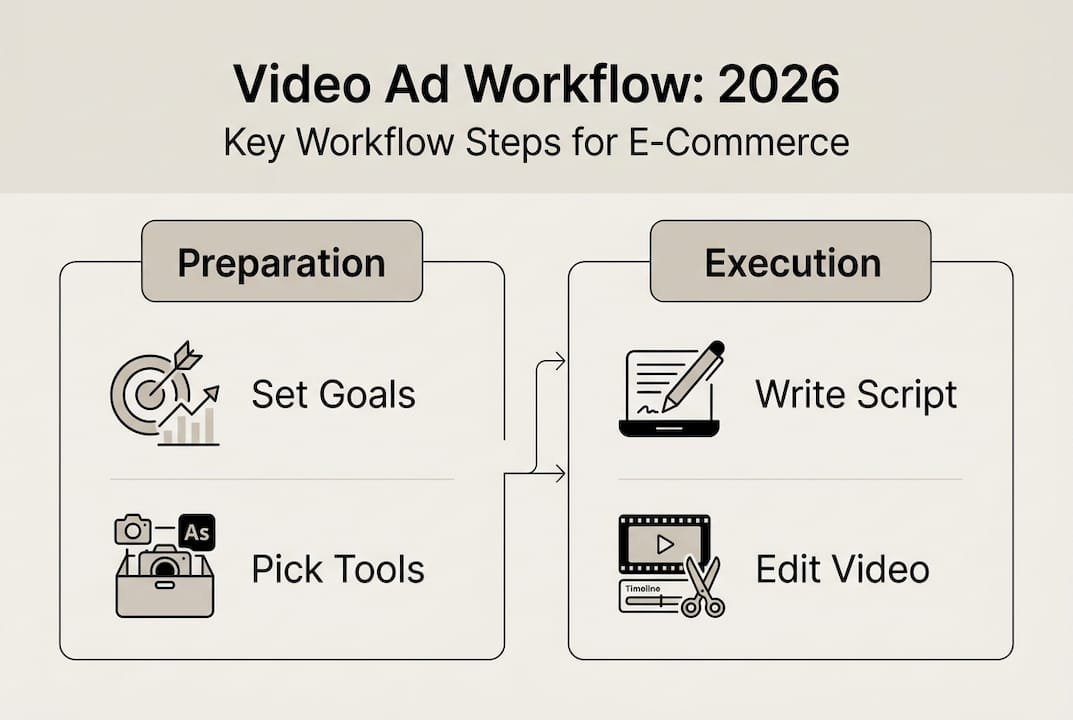
- Step-By-Step Execution Of The Video Ad Workflow
- Verifying And Optimizing Your Video Ad Performance
- How Hotugc Powers Your AI Video Ad Workflow
- Frequently Asked Questions
Key takeaways
| Point | Details |
|---|---|
| Structured workflows accelerate production | Following a systematic approach reduces video ad creation time from weeks to hours while maintaining quality and consistency. |
| AI tools eliminate traditional bottlenecks | Automated script generation, avatar-based filming, and instant editing remove the need for expensive crews and lengthy post-production. |
| Proper preparation ensures campaign success | Defining goals, gathering assets, and understanding platform requirements before starting prevents costly revisions and wasted effort. |
| Continuous optimization maximizes ROI | Tracking engagement metrics and A/B testing video variants leads to conversion improvements of 30% or higher. |
| Scalability becomes achievable | Once the workflow is established, producing dozens of video variations for different audiences and platforms becomes straightforward. |
Preparing for your AI-driven video ad workflow
Before diving into video creation, laying the groundwork determines whether your campaign succeeds or struggles. Successful AI-generated UGC video ads start with proper preparation including clear goals and assets. Skipping this phase leads to unfocused content that fails to resonate with your target audience or meet platform specifications.
Start by defining specific, measurable campaign objectives. Are you aiming to increase product awareness, drive direct sales, or build brand credibility? Each goal requires different video styles, messaging approaches, and calls to action. Document your target audience demographics, pain points, and preferred social platforms. Understanding whether you’re reaching Gen Z on TikTok or professionals on LinkedIn shapes every creative decision.
Gather all existing brand materials before production begins. This includes product photos, logos, brand guidelines, previous successful ad creative, and any user-generated content you have rights to use. Create a centralized folder with high-resolution assets organized by product category. Having everything accessible prevents workflow interruptions when you need specific elements.
Research platform-specific requirements thoroughly. Each social media channel has unique video specifications:
- TikTok prefers vertical 9:16 format, 15 to 60 seconds, with captions and trending audio
- Instagram Reels work best at 15 to 30 seconds with strong visual hooks in the first 3 seconds
- Facebook video ads perform well in square 1:1 or vertical formats with silent-friendly captions
- YouTube Shorts require vertical content under 60 seconds optimized for watch time
Pro Tip: Create a simple spreadsheet tracking video specifications, character limits for text overlays, and optimal posting times for each platform you’ll target. This reference document saves hours of research during production.
Select AI tools that align with your workflow needs and technical skill level. Evaluate platforms based on avatar realism, script quality, customization options, rendering speed, and commercial usage rights. Most AI video generators offer free trials, so test 2 to 3 options with your actual product before committing. Pay attention to how natural the avatars appear and whether the generated scripts match your brand voice.
Develop a pre-production checklist to ensure nothing gets overlooked:
| Preparation Item | Details | Status Check |
|---|---|---|
| Campaign objectives | Specific KPIs and success metrics defined | Document goals numerically |
| Target audience profiles | Demographics, pain points, platform preferences mapped | Create detailed personas |
| Brand asset library | All logos, images, guidelines centralized and accessible | Organize in shared folder |
| Platform specifications | Video formats, lengths, caption requirements documented | Build reference spreadsheet |
| AI tool selection | Platform tested and account set up with proper permissions | Complete trial evaluation |
| Legal clearances | Usage rights for any existing content or music confirmed | Verify licensing agreements |
This preparation phase typically takes 2 to 4 hours but prevents days of revisions later. Marketers who skip straight to production often discover missing assets, unclear messaging, or format mismatches that require starting over. Investing time upfront creates a foundation for rapid, repeatable video ad creation.
Step-by-step execution of the video ad workflow
With preparation complete, the actual production process becomes surprisingly straightforward when following a systematic approach. Automating video ad creation cuts costs by up to 90% and boosts click-through rates significantly. Breaking the workflow into discrete steps ensures consistency across multiple video variants while maintaining creative quality.
-
Develop your core script and messaging framework. Begin by outlining the key product benefits you want to communicate and the specific action you want viewers to take. Write 3 to 5 script variations testing different angles: problem-solution, social proof, feature highlight, or lifestyle integration. Keep scripts between 75 and 150 words for videos under 60 seconds. Each script should follow the proven structure of hook, value proposition, proof point, and clear call to action.
-
Create attention-grabbing hooks for the first 3 seconds. This critical window determines whether viewers keep watching or scroll past. Test hooks that ask provocative questions, make bold claims with statistics, show surprising product demonstrations, or present relatable problems your audience faces daily. Avoid generic openings like “Check out this amazing product” that blend into the content flood.
-
Generate your video content using AI tools or creator platforms. Input your script, select avatar styles that match your target demographic, and choose appropriate backgrounds and settings. Most AI platforms let you customize avatar appearance, voice tone, pacing, and gestures. Generate multiple takes with slight variations in delivery style. This gives you options during the editing phase without additional production costs.
-
Edit and optimize for platform-specific performance. Add captions that appear word-by-word synced to the audio, since 85% of social video is watched without sound initially. Insert product shots, lifestyle imagery, or b-roll footage at strategic moments to maintain visual interest. Apply subtle transitions and effects that enhance rather than distract from the message. Ensure your brand logo appears clearly but not obtrusively.
-
Integrate compelling calls to action that drive measurable results. Place your CTA both verbally in the script and visually as text overlay in the final 5 seconds. Be specific about the action: “Shop now and save 20%” outperforms vague prompts like “Learn more.” Include urgency elements when authentic, such as limited-time offers or low stock alerts.
-
Create multiple video variants for A/B testing. Produce at least 3 to 5 versions testing different hooks, script angles, avatar styles, or visual treatments. Keep one variable constant across variants so you can identify what specifically drives performance differences. This systematic testing approach reveals insights about your audience preferences that inform future campaigns.
Pro Tip: Batch your video production by creating all script variations first, then generating all videos in one session, followed by editing all variants together. This assembly line approach is far more efficient than completing one video fully before starting the next.
The entire execution phase, from final script to rendered videos ready for upload, typically takes 2 to 4 hours for a batch of 5 to 8 video variants. Traditional production requiring filming, editing, and revisions would consume days or weeks for the same output. This time compression allows marketers to test more creative approaches and respond quickly to market trends or competitor moves.

Document your workflow steps in a shared document or project management tool. Include specific settings, tool preferences, and decision points that worked well. This documentation enables team members to replicate successful processes and maintains consistency as you scale production.
Verifying and optimizing your video ad performance
Launching videos marks the beginning of the optimization cycle, not the end of your workflow. Video ad engagement metrics guide improvements, often yielding up to 34% conversion boosts when optimized properly. Systematic performance tracking separates successful campaigns from wasted ad spend.
Establish which key performance indicators matter most for your specific campaign goals. Track these metrics consistently:
- View-through rate measures how many people watch past the first 3 seconds, indicating hook effectiveness
- Engagement rate including likes, comments, shares, and saves shows content resonance
- Click-through rate reveals how compelling your call to action is
- Conversion rate tracks actual purchases or sign-ups from video viewers
- Cost per acquisition determines overall campaign profitability
- Watch time percentage shows where viewers drop off, highlighting weak script sections
Analyze performance data within 24 to 48 hours of launch to identify early trends. Compare metrics across your video variants to determine which hooks, scripts, or visual styles resonate best. Don’t wait for statistical significance if one variant is dramatically underperforming. Pause low performers and reallocate budget to winners quickly.
Address common video ad mistakes proactively. Slow loading times or poor mobile optimization kill engagement before viewers see your content. Audio quality issues or hard-to-read captions frustrate audiences and damage brand perception. Mismatched messaging between the video content and landing page creates confusion that tanks conversion rates. Review each element systematically when performance disappoints.
Compare manual versus AI-automated optimization approaches:
| Optimization Method | Speed | Cost | Scalability | Best For |
|---|---|---|---|---|
| Manual analysis and editing | Slow, days per cycle | High labor costs | Limited by team capacity | Small campaigns needing custom touches |
| AI-automated testing and iteration | Fast, hours per cycle | Low platform fees | Unlimited variants possible | Large-scale campaigns requiring rapid testing |
| Hybrid approach | Moderate, 1-2 days | Medium combined costs | Good for growing teams | Mid-size campaigns balancing control and efficiency |
Leverage viewer feedback and platform analytics for continuous refinement. Read comments on your videos to understand audience reactions, questions, and objections. Use this qualitative data to inform script improvements. Platform analytics reveal demographic breakdowns showing whether you’re reaching your intended audience or attracting unexpected viewer segments.
Pro Tip: Create a performance dashboard tracking your core metrics across all video variants in one view. Update it weekly to spot trends and make data-driven decisions about which creative directions to pursue or abandon.
Scale successful campaigns systematically once you identify winning formulas. Increase ad spend on top performers gradually while monitoring for audience fatigue. Develop new variants that build on successful elements rather than starting from scratch. Test expanding to additional platforms or audience segments using your proven creative approach.
Common optimization pitfalls to avoid include changing too many variables simultaneously, making it impossible to identify what drove performance changes. Stopping tests too early before gathering sufficient data leads to false conclusions. Ignoring platform-specific best practices in favor of a one-size-fits-all approach limits results. Failing to refresh creative regularly causes audience fatigue and declining performance over time.
Document your optimization insights in a knowledge base accessible to your entire team. Record which hooks, script structures, visual styles, and CTAs performed best for different products, audiences, and platforms. This institutional knowledge accelerates future campaign development and prevents repeating past mistakes.
How HotUGC powers your AI video ad workflow
Implementing this comprehensive workflow becomes significantly easier with the right technology partner. HotUGC transforms the entire process from concept to optimized video ads through AI-powered automation that maintains the authentic, user-generated feel audiences trust.
The platform handles script generation, realistic avatar creation, and professional editing in minutes rather than weeks. You maintain full creative control while eliminating the logistical headaches of coordinating with creators, managing filming schedules, and handling endless revision requests. Generate dozens of video variants for A/B testing without multiplying your production costs or timeline.
HotUGC’s AI avatars deliver natural performances that viewers perceive as genuine user reviews, not corporate advertising. The platform optimizes videos automatically for every major social platform’s specifications, ensuring your content looks professional whether viewers find it on TikTok, Instagram, or Facebook. Commercial usage rights come standard, so you can deploy winning videos across all your marketing channels without legal concerns.
E-commerce brands using HotUGC’s AI-generated UGC videos report dramatic improvements in production efficiency and campaign performance. The platform integrates seamlessly into the workflow outlined in this guide, handling the technical execution while you focus on strategy and optimization. Explore how HotUGC can transform your video ad production from a bottleneck into a competitive advantage.
Frequently asked questions
What is a step by step video ad workflow?
A step by step video ad workflow is a systematic process for creating, launching, and optimizing video advertisements efficiently. It typically includes preparation phases like goal setting and asset gathering, execution phases covering scripting and production, and optimization phases focused on performance analysis and refinement. Following a structured workflow ensures consistency, reduces production time, and improves campaign results by making the process repeatable and scalable.
How does AI improve the video ad creation process?
AI dramatically accelerates video production by automating script writing, generating realistic avatars for filming, and handling editing tasks that traditionally required specialized skills. This technology eliminates the need to coordinate with creators, book filming locations, or manage lengthy post-production cycles. AI tools also enable rapid A/B testing by producing multiple video variants quickly, helping marketers identify winning creative approaches faster than manual methods allow.
What are the biggest challenges in video ad workflows?
The most common challenges include maintaining consistent quality across multiple videos, producing content fast enough to keep up with platform demands, and managing production costs that can quickly spiral out of control. Many marketers also struggle with measuring performance effectively and knowing which creative elements to test or optimize. Coordinating between creative teams, approval processes, and platform specifications creates additional bottlenecks that slow campaign launches.
How long should e-commerce video ads be in 2026?
Optimal video ad length varies by platform but generally ranges from 15 to 60 seconds for social media. TikTok and Instagram Reels perform best between 15 and 30 seconds, while Facebook allows slightly longer formats up to 60 seconds. The critical factor is delivering your core message and call to action within the first 10 seconds, since most viewers decide whether to keep watching in that window. Shorter videos with focused messaging typically outperform longer content.
What metrics indicate a successful video ad campaign?
Key success metrics include view-through rates above 25%, click-through rates exceeding 2%, and conversion rates that justify your cost per acquisition targets. Engagement signals like shares, saves, and positive comments indicate content resonance beyond immediate sales. Watch time percentage reveals whether your script maintains interest throughout, with successful ads keeping 60% or more of viewers until the call to action. Compare performance across video variants to identify which creative elements drive the best results for your specific audience and goals.
Can small e-commerce businesses benefit from AI video workflows?
Small businesses often benefit most from AI-powered video workflows because they lack the budgets and teams for traditional production. AI video ad platforms democratize access to professional-quality content that previously required significant investment. The ability to produce and test multiple video variants quickly levels the playing field against larger competitors. Small brands can maintain consistent social media presence and run sophisticated A/B tests without hiring agencies or building in-house production capabilities.


