
Video ads optimization guide: boost conversions with AI-powered UGC in 2026
HotUGC
March 18, 2026 · 11 min read
Video ads optimization guide: boost conversions with AI-powered UGC in 2026

Digital marketers face a persistent challenge: video ad performance declines as audiences grow fatigued with repetitive content. Traditional user-generated content creation is slow and expensive, while purely AI-generated videos often lack the authenticity needed to drive conversions. The solution lies in hybrid AI-powered UGC strategies that combine automation efficiency with human authenticity. This guide explores proven techniques to optimize video ads using AI-driven approaches, helping you achieve higher click-through rates, lower acquisition costs, and sustained engagement across social media platforms in 2026.
Table of Contents
- Understanding AI-driven User-generated Video Ads
- Preparing Your Video Ad Assets for AI Optimization
- Executing AI-powered Video Ad Optimization Strategies
- Measuring, Verifying, and Iterating for Sustained Performance
- Enhance Your Video Ads With Hotugc AI Solutions
- Frequently Asked Questions
Key takeaways
| Point | Details |
|---|---|
| Hybrid AI-human content | Combining 70% AI with 30% human input optimizes authenticity and performance metrics |
| Personalized AI videos | Personalized AI video ads deliver +9.4% CTR lift but require careful privacy considerations |
| Optimal video format | Vertical 9:16 aspect ratio with captions performs best since 80% of viewers watch muted |
| Creative refresh cycle | Rotate video creatives every 7-14 days to prevent audience fatigue and maintain engagement |
| Platform-specific optimization | TikTok creator ads achieve 70% higher CTR compared to standard video formats |
Understanding AI-driven user-generated video ads
AI-generated user-generated content represents a paradigm shift in video advertising. These videos use artificial intelligence to create content that mimics the authentic, relatable style of traditional UGC while eliminating the time and cost barriers of working with human creators. The technology generates realistic avatars, writes conversion-optimized scripts, and produces professional-looking product reviews in minutes.
Research reveals nuanced performance differences between AI and human-created content. While AI video ads engagement vs human videos study shows AI videos can underperform human content in raw engagement metrics, the gap narrows significantly when AI tools are used strategically. Interestingly, AI-generated images often outperform human-created visuals, suggesting the technology excels in certain formats while requiring refinement in others.
The benefits of AI in video advertising include rapid production cycles, consistent quality control, unlimited scalability, and dramatic cost reduction compared to traditional creator partnerships. You can produce dozens of creative variations in the time it takes to brief a single human creator. However, drawbacks exist: purely AI-generated videos sometimes feel overly polished or lack the spontaneous imperfections that signal authenticity to viewers.
Ethical considerations matter significantly in this space. Transparency about AI involvement builds trust rather than eroding it. Disclose when content uses AI-generated avatars or scripts, particularly in regulated industries. Privacy concerns emerge with personalized AI content, as personalized AI video ads deliver +9.4% CTR lift but can feel intrusive when personalization becomes too specific or uses data without clear consent.
Pro Tip: Test transparency levels in your campaigns by creating identical videos with and without AI disclosure statements, then measure performance differences to find your audience’s comfort threshold.
“The most effective AI video strategies don’t try to hide the technology; they leverage it openly while maintaining human creative direction and emotional resonance.”
For deeper insights into balancing automation with authenticity, explore our AI video ads complete guide 2026 and compare approaches in AI avatars vs real creators.
Preparing your video ad assets for AI optimization
Successful AI-optimized video ads start with proper asset preparation. Technical specifications matter enormously for social media performance. Best e-commerce video ads examples and practices confirms that vertical 9:16 videos with captions perform best since 80% watch muted. This format dominates mobile viewing and aligns with how users naturally hold their phones.
Your UGC video structure should follow a proven three-part framework:
- Intro hook (3-5 seconds): Grab attention with a surprising statement, visual, or question that stops the scroll
- Product demonstration (15-20 seconds): Show the product solving a specific problem with clear before/after or usage scenarios
- Outro with call-to-action (3-5 seconds): Direct viewers to take the next step with specific, actionable language
Platform-specific formats require different approaches because algorithms and user behaviors vary. TikTok prioritizes native-feeling content that blends seamlessly with organic posts. Instagram Reels rewards high-energy editing and trending audio. Facebook video ads perform better with longer storytelling formats. Understanding these nuances prevents wasted ad spend on poorly optimized creative.
The data supports platform-specific optimization strategies:
| Platform | Average CTR | Average CPA | Optimal Length | Key Feature |
|---|---|---|---|---|
| TikTok | 2.8% | $18 | 9-15 seconds | Native creator style |
| Instagram Reels | 2.1% | $22 | 7-12 seconds | Trending audio integration |
| Facebook Feed | 1.4% | $28 | 15-30 seconds | Longer storytelling |
| YouTube Shorts | 1.9% | $25 | 15-30 seconds | Educational angles |
Notice how TikTok creator ads CTR benchmark data shows 70% higher click-through rates compared to standard video formats. This performance gap exists because creator-style content feels less like advertising and more like authentic recommendations from trusted sources.
Pro Tip: Always produce at least three creative variations for every campaign launch, testing different hooks, product angles, and calls-to-action to identify your highest-performing combination before scaling budget.
Learn more about format optimization in UGC video formats boost engagement conversions and discover broader strategies in video content best practices boost ecommerce sales.
Executing AI-powered video ad optimization strategies
Implementing AI-powered optimization requires a systematic approach that balances automation efficiency with human creative judgment. Follow this step-by-step process:
- Audit existing video performance to establish baseline metrics and identify patterns in your top and bottom performers
- Select AI tools that integrate with your existing tech stack and support your specific platform requirements
- Develop creative briefs that give AI systems clear direction while leaving room for variation and testing
- Generate multiple AI variations of each core concept, producing 5-10 versions with different hooks, scripts, and visual styles
- Add human refinement by reviewing AI output, adjusting tone, fixing awkward phrasing, and ensuring brand alignment
- Deploy A/B tests across platforms with proper tracking to measure performance differences objectively
- Analyze results and feed learnings back into your next creative cycle
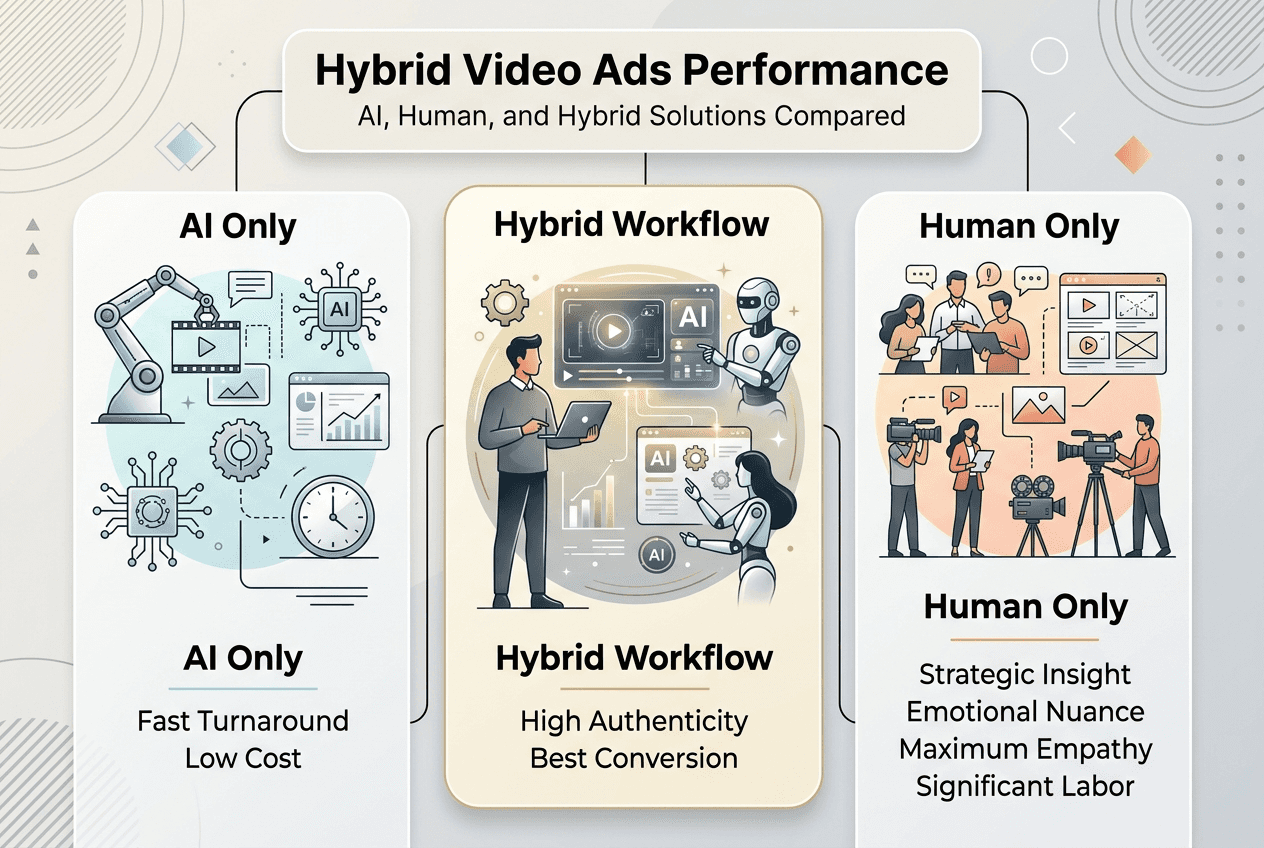
The hybrid approach delivers superior results compared to purely AI or purely human workflows. Research on common mistakes in UGC ads and hybrid approach efficacy demonstrates that a 70/30 human-AI content ratio optimizes authenticity and performance. This means using AI for initial generation, scripting, and variation creation while applying human judgment for final creative decisions, emotional resonance checks, and brand voice consistency.
Creative refresh timing critically impacts sustained performance. Audiences develop fatigue with repeated exposure to identical creative, causing engagement rates to decline within 7-14 days. Set calendar reminders to review performance weekly and prepare new creative variations before fatigue sets in. This proactive approach maintains momentum rather than reacting to performance drops.
Compare the performance profiles across different content creation approaches:
| Approach | Production Time | Cost per Video | Authenticity Score | Scalability | Best Use Case |
|---|---|---|---|---|---|
| Fully AI | 5-10 minutes | $10-30 | 6/10 | Unlimited | Rapid testing, high volume |
| Hybrid 70/30 | 1-2 hours | $50-150 | 8/10 | High | Performance campaigns |
| Fully Human | 1-2 weeks | $500-2000 | 9/10 | Limited | Premium brand content |
The data reveals why hybrid approaches dominate performance marketing. You achieve near-human authenticity at a fraction of the cost and time investment. Meta Advantage+ AI campaign performance shows campaigns achieve 32% lower CPA with AI optimization compared to manual campaign management, demonstrating the compounding benefits of AI across both creative production and media buying.
Pro Tip: Use AI personalization features strategically by limiting data points to broadly observable behaviors like product category interest rather than deeply personal attributes that might feel invasive or creepy.
Explore automation benefits in why automate video ads boost conversions and see real-world results in video ads ecommerce 34 percent conversion boost.
Measuring, verifying, and iterating for sustained performance
Effective measurement starts with tracking the right metrics. Focus on these key performance indicators:
- Click-through rate (CTR): Measures how compelling your creative is at driving action from impressions
- Cost per acquisition (CPA): Reveals the efficiency of your entire funnel from ad view to conversion
- Return on ad spend (ROAS): Shows the revenue generated for every dollar invested in advertising
- Engagement duration: Indicates how long viewers watch before scrolling, signaling content relevance
- Hook retention rate: Tracks what percentage of viewers watch past the first 3 seconds
Common performance issues have identifiable patterns. Declining CTR despite stable impressions signals creative fatigue. Rising CPA with consistent CTR suggests landing page or offer problems rather than ad creative issues. Dropping engagement duration indicates your hook remains effective but body content fails to deliver on the promise.
Audience fatigue and optimal refresh cycles for video ads confirms that regular creative refresh prevents audience fatigue observed within 7-14 days. When you notice performance declining, don’t immediately increase budget. Instead, refresh creative first, test new hooks second, and only scale budget after confirming the new creative maintains or improves efficiency metrics.
A/B testing reveals what actually drives performance rather than what you assume works. Test one variable at a time: hook style, product angle, call-to-action language, or visual style. Run tests until you reach statistical significance, typically requiring at least 1000 impressions per variation. Document learnings in a shared database so your entire team builds institutional knowledge over time.
Recommended analytics tools include native platform dashboards for real-time monitoring, Google Analytics for cross-platform attribution, and specialized tools like Triple Whale or Northbeam for advanced multi-touch attribution. The sophistication of your analytics should match your ad spend; companies spending under $10,000 monthly can rely on platform-native tools, while larger budgets justify investment in advanced attribution.
Interpreting data requires understanding context. A 2% CTR might be excellent for cold traffic prospecting but poor for warm retargeting audiences. Compare your metrics against platform benchmarks and your own historical performance rather than arbitrary targets. When performance dips below your baseline, investigate systematically: check for creative fatigue first, audience saturation second, and external factors like seasonality or competitive changes third.
Decide when to refresh versus pivot by examining the magnitude and duration of performance changes. Temporary dips lasting 2-3 days often resolve naturally. Sustained declines over 7+ days require action. Refresh creative when engagement metrics drop but audience targeting remains sound. Pivot strategy entirely when multiple metrics decline simultaneously, suggesting fundamental misalignment between your offer and audience.
For ongoing optimization insights, review video ad engagement marketers results and master hook strategies in increase conversions effective video ad hooks 2026.
Enhance your video ads with HotUGC AI solutions
Implementing these optimization strategies becomes dramatically simpler with the right tools. HotUGC AI-generated UGC videos streamlines the entire process from concept to published ad, eliminating the traditional bottlenecks of creator recruitment, filming schedules, and editing workflows. The platform generates professional UGC-style videos in minutes rather than weeks, letting you test more creative variations and refresh content before audience fatigue impacts performance.
The hybrid human-AI workflows available through HotUGC implement the 70/30 approach discussed earlier. You provide creative direction and brand guidelines while AI handles avatar generation, script optimization, and video production. This combination delivers the authenticity viewers expect with the speed and scalability modern campaigns demand. Multi-language support extends your reach globally without managing international creator networks.
Leverage AI for continuous creative refresh by producing new variations weekly, testing different hooks and product angles systematically. The platform’s commercial rights grant you full ownership for marketing campaigns across all channels. Integrated analytics tools help you track performance and identify winning combinations quickly.
Pro Tip: Start with three core product benefits and generate five video variations for each benefit, creating a 15-video test matrix that reveals which messages resonate strongest with your audience.
Explore how automation transforms campaign efficiency in automate video ads boost conversions and discover format optimization in UGC video formats boost engagement conversions.
Frequently asked questions
How often should I refresh my video ads to avoid audience fatigue?
Refresh video ads every 7-14 days to minimize fatigue and engagement drop. Common mistakes in UGC ads and fatigue timeline shows audience fatigue emerges around this window, causing CTR to decline as viewers see the same creative repeatedly. Monitor your specific performance metrics to adjust the refresh cycle; high-frequency campaigns may need refreshes every 7 days while lower-frequency campaigns can extend to 14 days. Set up automated alerts when CTR drops 20% below baseline to catch fatigue early.
Can AI-generated video ads match the authenticity of human-created content?
Pure AI videos can feel over-polished, reducing authenticity and emotional connection with viewers. However, hybrid AI-human video content effectiveness demonstrates that combining AI with human input in a 70/30 ratio optimizes trust and performance. Use AI for initial generation and variations while applying human judgment for final creative decisions, emotional tone, and brand voice consistency. This approach delivers near-human authenticity at a fraction of the cost and time investment.
What are the privacy considerations when using AI personalized videos?
Use personalization carefully to avoid privacy infringement and viewer discomfort. Privacy risks in AI personalized video ads reveals personalized AI videos increase CTR but risk user privacy and feelings of intrusion when personalization becomes too specific. Disclose AI use transparently and respect user consent wherever feasible. Limit personalization to broadly observable behaviors like product category interest rather than deeply personal attributes. Always comply with platform policies and regional privacy regulations like GDPR and CCPA.
Which video format performs best across social media platforms?
Vertical 9:16 aspect ratio with captions consistently outperforms other formats across major platforms. This format aligns with mobile viewing habits and accommodates the 80% of users who watch with sound off. Keep videos short, typically 9-15 seconds for TikTok and 7-12 seconds for Instagram Reels, with the most critical message in the first 3 seconds. Platform-native features like trending audio on TikTok or interactive stickers on Instagram further boost performance when used strategically.


