
What is a review video? Guide to effective product reviews in 2026
HotUGC
March 15, 2026 · 11 min read
What is a review video? Guide to effective product reviews in 2026

Most marketers still pour budgets into polished brand advertisements, assuming production quality drives trust. The reality flips this assumption completely. 92% of consumers trust word-of-mouth and user-generated content over traditional advertising, making review videos the most powerful conversion tool in your 2026 marketing arsenal. This guide explains what review videos are, why they outperform conventional ads, and how to create compelling product reviews that drive measurable results across social media platforms.
Table of Contents
- What Is A Review Video And Why It Matters For E-Commerce
- How Review Videos Influence Purchasing Behavior And Digital Ad Success
- Optimizing Review Videos For Meta Ad Performance In 2026
- Creating Engaging Review Videos: Best Practices And Content Ideas
- Discover AI-Generated UGC Videos For Your Ads
Key takeaways
| Point | Details |
|---|---|
| Review videos build consumer trust | Authentic user evaluations consistently outperform polished brand advertisements in credibility and engagement |
| Video reviews drive purchase decisions | 89% of consumers say watching a product video convinces them to buy |
| Performance benchmarks guide optimization | Understanding Meta ad metrics like CPA and ROAS helps maximize review video campaign effectiveness |
| Authentic content beats production value | Raw, genuine testimonials generate higher conversion rates than overly produced marketing materials |
What is a review video and why it matters for e-commerce
A review video is a visual product evaluation created by actual users, influencers, or brand advocates who share their genuine experience with an item. Unlike traditional commercials that showcase products through scripted scenarios and professional actors, review videos capture real people demonstrating, testing, and offering honest opinions about purchases. This format has exploded across TikTok, Instagram Reels, and Facebook because it delivers the authenticity modern consumers demand.
The distinction matters enormously for your marketing strategy. Polished advertisements trigger skepticism because viewers recognize paid promotional content instantly. Review videos bypass this resistance by presenting information through a trusted peer perspective. When someone watches a real customer unbox a product, test its features, and share results, the psychological impact mirrors asking a friend for advice rather than hearing a sales pitch.
Consumer behavior in 2026 reflects this preference dramatically. 92% of consumers trust user-generated content and word-of-mouth over traditional brand advertising. This shift fundamentally changes how e-commerce businesses should allocate marketing budgets and creative resources.
Review videos deliver multiple strategic advantages:
- Build immediate trust through authentic storytelling and real user experiences
- Influence purchasing decisions by addressing actual customer concerns and questions
- Boost engagement rates significantly higher than standard product photography or text descriptions
- Provide social proof that validates product quality and brand reliability
- Generate shareable content that extends organic reach across social platforms
For e-commerce managers, integrating review videos into your advertising mix isn’t optional anymore. It’s the difference between campaigns that convert and budgets that drain without returns. The format works because it solves the fundamental challenge every online retailer faces: helping customers evaluate products they can’t physically touch or test. Authentic UGC video ads bridge this gap by showing real-world usage and honest reactions.
How review videos influence purchasing behavior and digital ad success
The conversion power of review videos isn’t anecdotal. 89% of people say watching a video about a product convinces them to buy. This statistic reveals why video content dominates social media advertising strategies and why brands that ignore this format consistently underperform competitors who embrace it.
Review videos create psychological triggers that static images and text descriptions cannot replicate. When viewers watch someone demonstrate a product, mirror neurons activate in their brains, creating a vicarious experience of ownership. This neurological response makes the purchase feel less risky and more familiar, directly addressing the hesitation that kills conversions in e-commerce.
Nearly 9 out of 10 consumers are convinced to purchase after watching a product video review, making it the most influential content format in digital marketing.
The conversion impact of video ads extends beyond individual purchase decisions. Review videos improve key advertising metrics across the funnel. Click-through rates increase because thumbnails featuring real people outperform product-only images. Time on page extends as viewers engage with video content. Cart abandonment decreases when customers feel confident about product quality and functionality.
Marketers can leverage review videos in multiple strategic ways:
- Social proof campaigns that showcase customer satisfaction and product popularity
- Product demonstrations revealing features and benefits through real-world usage scenarios
- Storytelling approaches that connect emotional benefits to practical applications
- Problem-solving content that addresses specific pain points and shows tangible solutions
The relationship between review videos and advertising benchmarks like cost per acquisition and return on ad spend becomes clear when you examine video ad engagement metrics. Campaigns featuring authentic review content consistently achieve lower acquisition costs because higher engagement rates improve ad relevance scores on platforms like Meta. Better relevance scores reduce costs per impression and click, stretching budgets further while maintaining or improving conversion volumes.
This performance advantage compounds over time. As review video campaigns generate positive results, you accumulate creative assets that can be repurposed, tested, and optimized. Each successful review video becomes a template for future content, creating a library of proven messaging and presentation styles that reduce creative risk and accelerate campaign launches.

Optimizing review videos for Meta ad performance in 2026
Understanding current advertising benchmarks helps you set realistic goals and identify optimization opportunities for review video campaigns. Meta Ads benchmarks analyzing nearly 35,000 brands in 2025 provide crucial context for planning your 2026 strategy.
| Metric | 2025 Median | Significance |
|---|---|---|
| Cost Per Acquisition | $38.17 | Average cost to convert one customer across Meta platforms |
| Return on Ad Spend | 1.93 | Revenue generated per dollar spent on advertising |
| Cost Per Mille | $11.50 | Cost to reach 1,000 impressions |
| Click-Through Rate | 1.2% | Percentage of viewers who click after seeing an ad |
| Conversion Rate | 3.1% | Percentage of clicks that result in purchases |
These numbers represent median performance across industries, meaning half of advertisers perform better and half perform worse. Your review video campaigns should target beating these medians by leveraging the authenticity advantage that user-generated content provides.
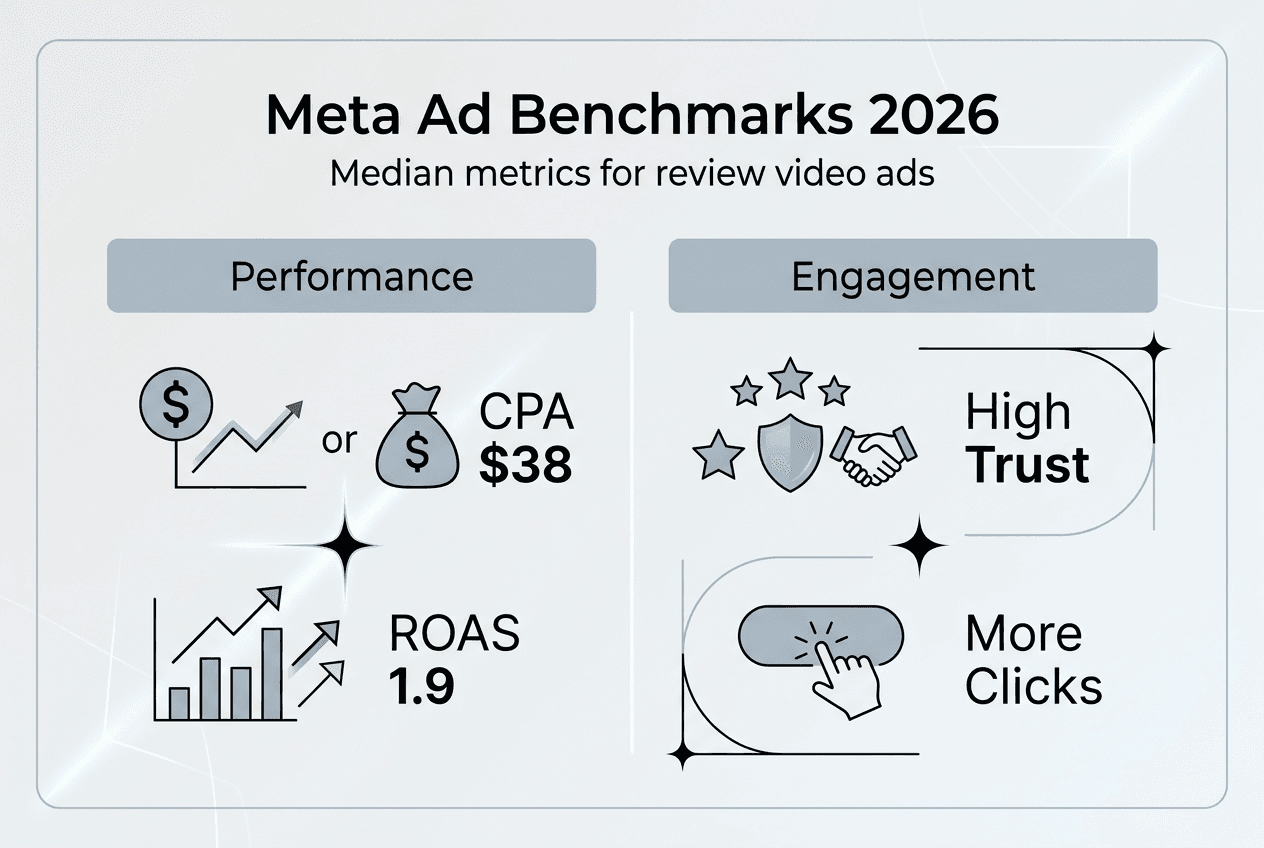
The median CPA of $38.17 with ROAS of 1.93 in 2025 establishes a baseline, but these figures vary dramatically by industry, product price point, and creative quality. E-commerce brands selling higher-ticket items typically see elevated CPAs but stronger ROAS. Review videos help optimize both metrics by improving conversion rates through enhanced trust and credibility.
Meta ad costs continue rising due to increased competition and platform algorithm changes favoring engaging content. This trend makes creative quality more critical than ever. Review videos that capture attention in the first three seconds, deliver clear value propositions, and include authentic testimonials consistently outperform generic product showcases.
Pro Tip: Test multiple review video variations against your current Meta ad benchmarks by running split tests with identical targeting but different creative approaches. Track which review styles generate the lowest CPA and highest ROAS, then double down on those formats. This data-driven approach eliminates guesswork and builds a performance baseline specific to your products and audience.
Continuous optimization using these Meta ad engagement benchmarks requires systematic testing and measurement. Allocate 20% of your budget to experimental review video formats while maintaining 80% on proven performers. This balance lets you discover breakthrough creative approaches without risking campaign stability. The benefits of UGC advertising become most apparent when you compare performance data over quarterly periods, revealing trends that inform strategic budget allocation.
Creating engaging review videos: best practices and content ideas
Producing effective review videos requires balancing authenticity with strategic messaging. Consumers trust genuine user content more than overly polished marketing ads, but poorly executed reviews fail to convert regardless of authenticity.
Start with these foundational best practices:
- Script natural talking points rather than word-for-word dialogue to maintain conversational flow
- Feature real product benefits and honest limitations to build credibility
- Demonstrate actual usage scenarios that viewers can relate to their own needs
- Keep videos concise, typically 30 to 90 seconds for social media platforms
- Include clear calls to action that guide viewers toward purchase decisions
- Optimize for mobile viewing with vertical formats and readable text overlays
Follow this step-by-step process to create compelling review video content:
- Identify your product’s primary value proposition and the specific problem it solves for customers.
- Select review creators who match your target demographic and can speak authentically about the product.
- Provide products for testing with guidelines on key features to cover, but avoid scripting exact words.
- Capture footage showing unboxing, setup, usage, and results to tell a complete story.
- Edit for pacing and clarity while preserving authentic reactions and genuine enthusiasm.
- Add captions, brand elements, and purchase links without overwhelming the authentic content.
- Test multiple versions with different hooks, testimonials, and calls to action.
Pro Tip: Incentivize existing customers to create review videos by offering discounts on future purchases or entry into exclusive giveaways. Real customer testimonials carry more weight than paid influencer content because viewers recognize the genuine enthusiasm and unbiased perspective.
Popular UGC video formats for 2026 include:
- Unboxing videos that capture first impressions and initial reactions to packaging and product quality
- Before and after comparisons demonstrating tangible results from product usage over time
- Feature highlights focusing on specific benefits or innovative aspects that differentiate from competitors
- Problem-solving narratives showing how the product addresses real customer pain points
- Comparison reviews evaluating your product against alternatives in the market
The hook matters enormously in social media advertising where users scroll rapidly past content that doesn’t immediately grab attention. Effective video ad hooks typically pose questions, present surprising facts, or show dramatic transformations within the first three seconds. Your review videos should open with the most compelling moment rather than building slowly to a payoff.
Authenticity consistently beats production value in review video performance. A slightly shaky smartphone video of a real customer genuinely excited about your product will outperform a professionally lit studio shoot with a paid actor reading scripted lines. This reality explains why UGC outperforms polished advertisements across conversion metrics. Viewers have developed sophisticated filters for detecting inauthentic content, and any hint of artificiality triggers skepticism that kills conversion potential.
Discover AI-generated UGC videos for your ads
Creating authentic review videos at scale presents logistical challenges for most e-commerce brands. Sourcing creators, managing production timelines, and maintaining content quality across multiple campaigns consumes resources that many marketing teams lack.

HotUGC’s AI-powered platform solves this bottleneck by generating professional UGC-style review videos in minutes. The technology creates realistic avatars, writes conversion-optimized scripts, and produces authentic-looking product reviews without filming, editing, or hiring creators. This approach lets you test multiple review video variations rapidly, identify top performers, and scale successful formats across campaigns.
Pro Tip: Using AI-generated videos allows rapid testing and optimization of different review video styles. Launch five variations simultaneously, measure performance after 48 hours, then allocate budget to winners while iterating on underperformers. This velocity transforms creative development from a bottleneck into a competitive advantage.
The platform supports multi-language content creation, enabling global campaigns with localized review videos that maintain consistent messaging while adapting to regional preferences. Visit HotUGC to explore examples and start creating review videos that drive measurable results.
What is a review video? Frequently asked questions
How long should a review video be for social media?
Optimal length varies by platform but generally ranges from 30 to 90 seconds for paid social media ads. TikTok and Instagram Reels perform best with 15 to 60 second videos that deliver value quickly. Facebook allows longer content, but engagement drops significantly after 90 seconds. Test different durations to find your audience’s preference.
Can branded review videos maintain authenticity?
Yes, when executed properly. Branded review videos stay authentic by featuring real user experiences, avoiding overly scripted dialogue, and acknowledging both strengths and minor limitations. Transparency about brand involvement through proper disclosure maintains trust while still delivering persuasive content.
What platforms are best for review video ads?
Meta platforms including Facebook and Instagram deliver strong ROI for review video ads due to sophisticated targeting and large user bases. TikTok excels for reaching younger demographics with short-form review content. YouTube works well for longer, detailed product reviews targeting users actively researching purchases. Test across platforms to identify where your audience engages most.
How to measure ROI specifically for review video campaigns?
Track standard e-commerce metrics including cost per acquisition, return on ad spend, and conversion rate, but also monitor engagement signals like video completion rate and comment sentiment. Compare review video performance against other creative formats using video ad conversion optimization techniques. Calculate incremental revenue generated by review video campaigns versus baseline performance.
What are common pitfalls to avoid in review videos?
Avoid overly scripted delivery that sounds rehearsed, excessive product claims without proof, poor audio quality that frustrates viewers, and weak hooks that fail to capture attention immediately. Don’t neglect mobile optimization or forget clear calls to action. Most critically, never fake authenticity with actors pretending to be real customers, as audiences detect and reject inauthentic content instantly.


