
UGC video formats: boost engagement and conversions
HotUGC
March 13, 2026 · 12 min read
UGC video formats: boost engagement and conversions

User-generated content videos have transformed ecommerce advertising. While brands pour budgets into polished productions, shoppers are 240% more likely to say UGC is authentic compared to brand-created content. This authenticity gap drives real business results. Ecommerce marketers now prioritize UGC video formats that build trust and spark conversions across social platforms. This guide breaks down the most effective UGC video formats, explains why they outperform traditional ads, and shows you how to apply them strategically. You’ll learn pricing benchmarks, creative testing budgets, and practical steps to integrate these formats into your 2026 campaigns for measurable growth.
Table of Contents
- Why User-Generated Content Videos Outperform Branded Ads
- Popular UGC Video Formats Explained
- Pricing, Budgeting, And Creative Testing For UGC Videos
- Maximizing Impact: Applying UGC Video Formats In Your Marketing Strategy
- Get Started With AI-Powered UGC Video Creation
- Frequently Asked Questions
Key takeaways
| Point | Details |
|---|---|
| Authenticity advantage | UGC videos are perceived as 240% more authentic than branded content, driving higher trust and engagement |
| Top performing formats | Reviews, unboxings, tutorials, and testimonials each serve unique conversion goals across ecommerce categories |
| Dramatic performance lift | UGC video advertising can boost click-through rates by up to 73% compared to traditional ad creative |
| Strategic testing budget | Allocating 5-10% of ad spend to creative testing optimizes long-term ROI and campaign performance |
| Regional pricing variance | US creators charge premium rates while global markets offer cost-effective alternatives for scaling content |
Why user-generated content videos outperform branded ads
Authenticity drives purchasing decisions in 2026. Consumers scroll past polished brand messages but stop for real people sharing genuine experiences. The trust gap is staggering: 90% of people trust UGC, but only 4% trust branded messages. This massive disparity explains why savvy marketers have shifted budgets toward user-generated video content.
Real customer voices carry weight that scripted ads cannot match. When shoppers see someone like themselves unboxing a product or demonstrating results, they perceive social proof rather than sales pitches. This psychological shift translates directly to performance metrics. Platforms like TikTok and Instagram prioritize authentic content in their algorithms, giving UGC videos organic reach advantages over branded posts.
The ecommerce categories seeing the strongest UGC adoption share a common thread: they require trust. Beauty products, health supplements, and tech gadgets all benefit from UGC as the default creative format because shoppers need reassurance before buying. A creator showing actual results or demonstrating product use removes purchase friction more effectively than any brand claim.
Consider these compelling advantages:
- UGC videos generate higher engagement rates across all major social platforms
- User reviews and testimonials reduce perceived risk in the buyer journey
- Authentic content creates emotional connections that drive repeat purchases
- Social proof accelerates decision making for hesitant shoppers
- Platform algorithms reward genuine content with better organic distribution
Marketing leaders recognize this shift. As one industry expert noted:
The future of paid social is authenticity at scale. Brands that master UGC video formats will dominate their categories while competitors waste budgets on content consumers actively ignore.
This performance edge explains why UGC outperforms polished ads consistently across campaigns. The data supports strategic investment in user-generated video content as a primary creative approach rather than a supplementary tactic.
Popular UGC video formats explained
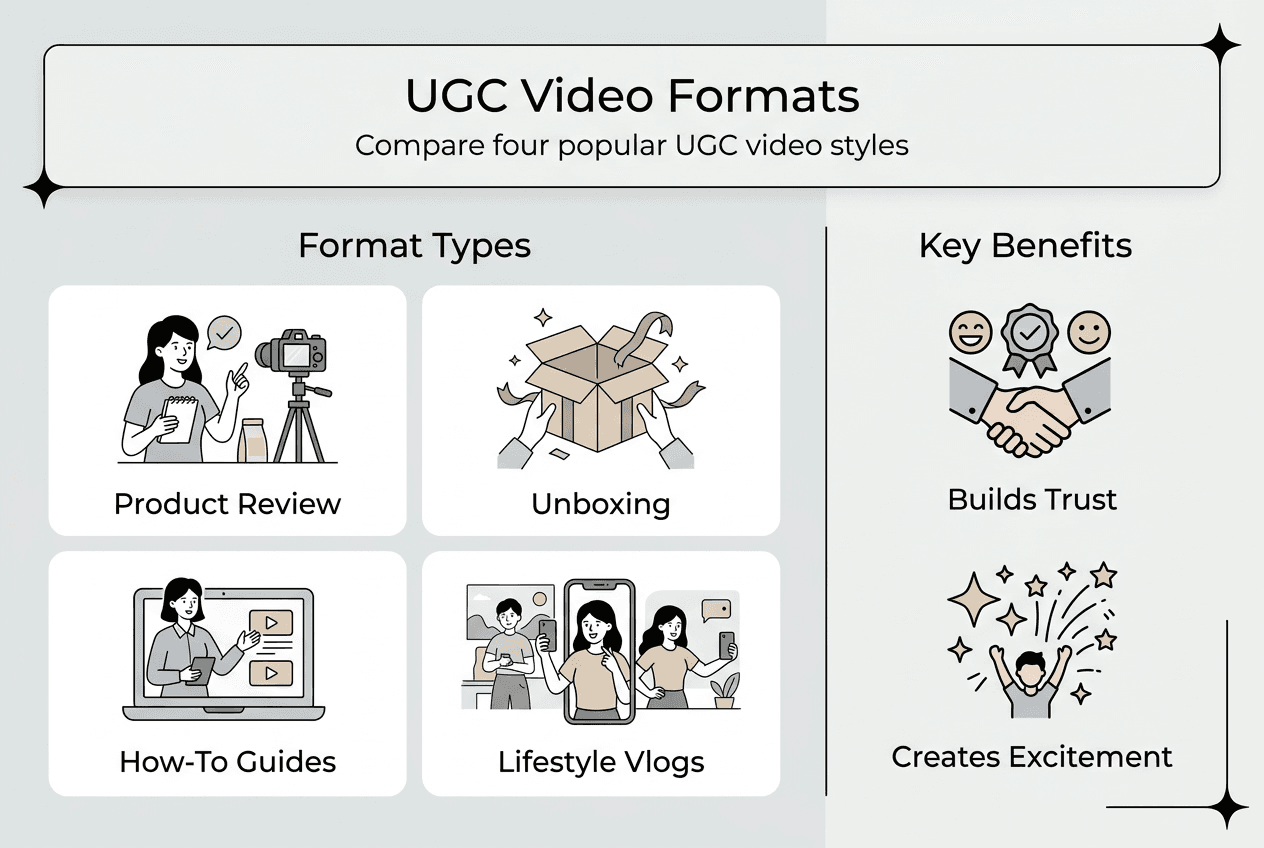
Understanding the distinct UGC video formats helps you match content style to campaign objectives. Each format serves specific purposes in the customer journey, from awareness to conversion. Choosing the right approach for your product category and audience maximizes impact.
Product review videos feature customers sharing honest opinions about their purchase experience. These videos work exceptionally well because 47% of shoppers consider user reviews the most influential content when researching products online. Reviews address common questions, highlight unexpected benefits, and acknowledge limitations, building credibility through balanced perspectives.

Unboxing videos capture the excitement of receiving and opening a product for the first time. This format taps into anticipation and discovery, showcasing packaging quality, first impressions, and initial setup. Unboxings perform particularly well for tech products, subscription boxes, and premium items where presentation matters.
Tutorial videos demonstrate how to use a product effectively, solving specific problems or achieving desired results. These educational formats provide value beyond the product itself, positioning your brand as helpful rather than purely transactional. Tutorials excel for products with learning curves or multiple use cases.
Testimonial videos focus on customer satisfaction and results achieved after using a product. Unlike reviews that may include criticisms, testimonials emphasize positive outcomes and transformations. This format builds emotional connection and aspirational appeal, especially effective for before-and-after scenarios.
Here’s how these formats compare:
| Format | Primary Benefit | Best Use Case | Typical Length |
|---|---|---|---|
| Product Review | Builds trust through honest evaluation | High-consideration purchases requiring research | 60-90 seconds |
| Unboxing | Creates excitement and showcases presentation | Premium products and subscription services | 30-60 seconds |
| Tutorial | Demonstrates value and educates buyers | Products with multiple features or uses | 45-75 seconds |
| Testimonial | Inspires action through success stories | Transformation-based products and services | 30-45 seconds |
The most successful campaigns often combine multiple formats to address different stages of the buyer journey. A prospect might discover your product through an unboxing video, research it via reviews, learn application through tutorials, and convert after watching testimonials.
Pro Tip: Match your UGC format to product complexity and price point. High-ticket items benefit from detailed reviews and tutorials, while impulse purchases convert faster with quick testimonials and unboxings.
Platform preferences also influence format selection. TikTok audiences respond well to quick unboxings and testimonials, while Instagram users engage deeply with tutorials. Understanding where your audience spends time helps you prioritize top UGC content formats for ecommerce video ads on each platform.
Pricing, budgeting, and creative testing for UGC videos
Budget planning for UGC video production requires understanding market rates and strategic allocation. Pricing varies significantly based on creator location, category expertise, and content complexity. Smart marketers balance cost efficiency with quality to build sustainable content pipelines.
Creator rates reflect regional economic differences and platform maturity. US-based creators typically command premium prices due to higher living costs and established creator economies. Global creators offer competitive alternatives without sacrificing quality, especially for brands targeting international markets.
Here’s what you can expect to pay across categories:
| Content Category | US Average | Global Average | Price Range |
|---|---|---|---|
| Beauty & Skincare | $180 | $95 | $60-$300 |
| Health & Wellness | $165 | $88 | $55-$275 |
| Fashion & Apparel | $155 | $82 | $50-$250 |
| Tech & Electronics | $195 | $105 | $70-$325 |
| Home & Lifestyle | $145 | $78 | $45-$240 |
These average prices per UGC video reflect standard deliverables including scripting, filming, and basic editing. Premium creators with larger followings or specialized expertise charge higher rates, while emerging creators offer budget-friendly options for testing.
Negotiating effectively with creators requires understanding their perspective. Consider these best practices:
- Offer package deals for multiple videos to reduce per-unit costs
- Provide clear briefs and product information to minimize revision rounds
- Build long-term relationships with top performers for consistent pricing
- Test emerging creators alongside established ones to discover hidden gems
- Negotiate usage rights upfront to avoid complications later
Beyond production costs, successful campaigns require ongoing creative testing. Market dynamics shift constantly, and ad fatigue sets in quickly on social platforms. Brands should allocate 5-10% of ad spend to new creative testing, ensuring fresh content flows into campaigns regularly.
This testing budget supports experimentation with different formats, hooks, and messaging angles. A brand spending $50,000 monthly on paid social should invest $2,500 to $5,000 in new UGC videos, producing 15 to 30 fresh assets depending on creator rates and content complexity.
Pro Tip: Calculate your testing needs by dividing monthly ad spend by 20 for minimum creative investment, or by 10 for aggressive testing. A $20,000 monthly budget needs at least $1,000 in new creative, ideally $2,000 for optimal performance.
This approach prevents creative fatigue while identifying winning combinations of format, messaging, and creator style. Brands that skimp on creative testing often see declining performance as audiences tire of repetitive content. Strategic investment in UGC production and testing delivers compounding returns through improved click-through rates and conversion efficiency.
Understanding why automated video ads cut costs and boost conversions helps you evaluate traditional creator partnerships against AI-powered alternatives for scaling content production within budget constraints.
Maximizing impact: applying UGC video formats in your marketing strategy
Integrating UGC video formats into your marketing strategy requires matching content types to specific campaign goals. Different objectives demand different approaches. Awareness campaigns benefit from entertaining unboxings and relatable testimonials, while conversion-focused campaigns perform better with detailed reviews and tutorials.
Start by mapping formats to your funnel stages:
- Awareness: Use unboxing videos and quick testimonials to capture attention and introduce your product
- Consideration: Deploy detailed reviews and comparison content to address research needs
- Decision: Leverage strong testimonials and tutorial previews to overcome final objections
- Retention: Share advanced tutorials and user success stories to maximize product value
This strategic alignment ensures your UGC content serves clear purposes rather than generic promotion. Each video should move prospects closer to purchase or existing customers toward repeat buying.
Distribution strategy matters as much as content creation. The same UGC video performs differently across platforms based on audience behavior and algorithm preferences. Tailor your approach:
- TikTok: Lead with strong hooks in the first 3 seconds, prioritize vertical format, keep videos under 60 seconds
- Instagram Reels: Focus on visually appealing content, use trending audio when appropriate, optimize for 30-45 seconds
- Facebook: Longer formats work well, add captions for sound-off viewing, test both feed and Stories placements
- YouTube Shorts: Educational content performs strongly, viewers tolerate slightly longer formats, strong calls to action convert well
Platform-specific optimization amplifies UGC performance. A tutorial video might succeed on YouTube Shorts but flop on TikTok if it lacks the fast-paced editing style that platform rewards. Adapt your content or choose formats that naturally align with each platform’s culture.
Measurement drives continuous improvement. Track these key performance indicators:
- Click-through rate: Measures how compelling your UGC hooks and messaging are
- Conversion rate: Shows how effectively content drives actual purchases
- Cost per acquisition: Reveals efficiency relative to other creative approaches
- Engagement rate: Indicates content resonance and potential for organic reach
- Return on ad spend: Demonstrates overall campaign profitability
The performance lift can be dramatic. Campaigns using UGC videos see up to a 73% increase in click-through rates compared to traditional creative, translating directly to lower customer acquisition costs and improved campaign economics.
Pro Tip: Run A/B tests comparing different UGC formats for the same product to identify your highest performers, then double down on winning combinations while retiring underperformers.
Consistent UGC integration builds long-term brand advantages beyond immediate campaign results. Audiences develop familiarity with your products through repeated exposure to authentic content. This sustained presence increases brand recall and consideration when purchase intent emerges.
Implementing these strategies requires operational discipline. Create content calendars mapping UGC formats to promotional periods, product launches, and seasonal opportunities. Build creator relationships that support ongoing production rather than one-off projects. Develop testing frameworks that systematically evaluate new formats and approaches.
Success comes from treating UGC as a core marketing capability rather than a tactical experiment. Brands that master video content best practices to boost ecommerce sales and consistently apply video ads that deliver a 34 percent conversion boost gain sustainable competitive advantages in increasingly crowded digital markets.
Get started with AI-powered UGC video creation
Producing high-quality UGC videos at scale presents logistical challenges. Coordinating with multiple creators, managing revisions, and maintaining consistent output strains marketing teams. AI technology now solves these bottlenecks, enabling rapid content creation without sacrificing authenticity.
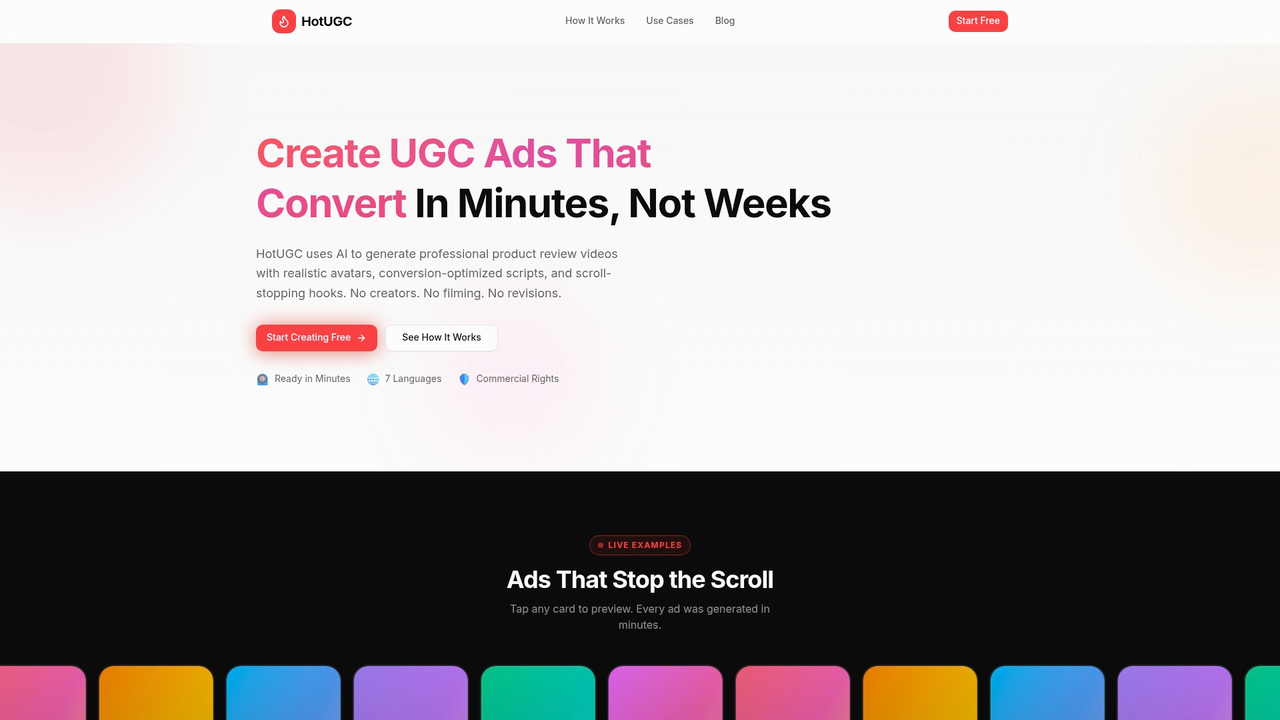
HotUGC streamlines UGC video production through artificial intelligence. The platform generates professional product review videos featuring realistic avatars, conversion-optimized scripts, and attention-grabbing hooks in minutes rather than weeks. You can test multiple formats, messaging angles, and creative approaches without the traditional delays and costs of creator partnerships.
This approach aligns perfectly with the creative testing budgets discussed earlier. Instead of producing 10 videos per month at $150 each, you can generate 50 variations for comprehensive testing. The ability to iterate quickly helps you discover winning combinations faster, applying insights across campaigns for improved performance. AI-generated UGC videos offer the authenticity audiences trust with the scalability modern marketing demands.
Frequently asked questions
What is a UGC video format?
A UGC video format is a specific style or type of user-created video content designed to promote products authentically. Common formats include reviews, unboxings, tutorials, and testimonials, each serving distinct purposes in the customer journey. These formats leverage real people sharing genuine experiences rather than scripted brand messages.
How do UGC video formats differ from traditional ads?
UGC video formats feature real customers or creators speaking authentically about products, while traditional ads use professional actors and polished production. This authenticity makes UGC 240% more trustworthy to consumers. UGC formats also perform better algorithmically on social platforms that prioritize genuine content over obvious advertising.
Which UGC video format works best for ecommerce?
Product review videos consistently deliver strong results across ecommerce categories because they address shopper research needs directly. However, the optimal format depends on your product type and campaign goal. High-consideration purchases benefit from detailed reviews and tutorials, while impulse buys convert faster with quick testimonials and unboxings.
How much should I budget for UGC video production?
Allocate 5-10% of your total ad spend to creative testing and UGC production. Individual video costs range from $45 to $325 depending on creator location and category expertise. A sustainable approach combines traditional creator partnerships for premium content with AI-powered tools for high-volume testing and iteration.
Can AI-generated videos replace real creator content?
AI-generated UGC videos offer authentic-looking content at scale, ideal for rapid testing and high-volume campaigns. They work exceptionally well for product reviews and testimonials where script quality and presentation matter most. Many brands use AI videos for initial testing, then invest in traditional creators for top-performing concepts, creating an efficient hybrid approach.


