
Harnessing UGC to drive conversions on social media ads
HotUGC
April 5, 2026 · 10 min read
Harnessing UGC to drive conversions on social media ads

TL;DR:
- User-generated content significantly increases conversions and lowers cost-per-acquisition in social ads.
- UGC builds trust through authenticity, making it more effective than polished studio creative.
- Systematic scaling and leveraging AI tools can optimize UGC production for sustained marketing success.
User-generated content (UGC) ads drive up to 4x higher conversions compared to traditional creative, yet most e-commerce marketing managers still treat UGC as a secondary tactic. That gap is a real competitive opportunity. This article breaks down exactly why UGC outperforms polished studio ads, how it works at every stage of the buyer funnel, and the step-by-step process you need to implement it at scale. Whether you’re running campaigns on TikTok, Instagram, or Facebook, the frameworks here are built to help you move faster and convert more.
Table of Contents
- Understanding UGC and its impact on conversions
- UGC vs. traditional ad creative: What converts best?
- How UGC influences the buyer journey on social platforms
- Implementing UGC for higher ad conversions: Step-by-step
- A fresh perspective: Most brands miss the real power of UGC
- Level up your UGC ad strategy with the right tools
- Frequently asked questions
Key Takeaways
| Point | Details |
|---|---|
| UGC outperforms traditional ads | User-generated content consistently drives higher conversion rates than studio-produced creative for e-commerce social campaigns. |
| Authenticity boosts buyer trust | Customers are more likely to purchase when they see real people sharing honest product experiences. |
| Strategic deployment matters | Matching UGC formats to each funnel stage and platform yields the best results. |
| Implementation is straightforward | A clear process for sourcing, briefing, and testing UGC can quickly elevate your ad conversion rates. |
Understanding UGC and its impact on conversions
UGC, or user-generated content, refers to any content created by real customers, fans, or community members rather than a brand’s internal team. In the e-commerce ad context, UGC typically appears as video testimonials, product review clips, unboxing videos, social posts, and customer demos. What separates UGC from branded creative is not just the production style. It’s the perceived authenticity behind it.
When a shopper sees a real person talking about a product in a natural setting, their guard drops. There’s no polished lighting or scripted corporate tone to signal “this is an ad.” That psychological shift is what makes authentic UGC video ads so effective at increasing engagement and boosting sales for e-commerce brands.
For social platforms specifically, authenticity is currency. Algorithms on TikTok and Instagram reward content that feels native to the feed, and UGC fits that mold naturally. You can also explore UGC video basics to understand how different formats perform across platforms.
Top UGC formats that work for social ads:
- Video testimonials (customers speaking directly to camera)
- Unboxing and first-impression clips
- Before-and-after demonstration videos
- Screenshot reviews repurposed as ad overlays
- User-created social posts featuring your product
Here’s a key insight most marketers overlook: UGC lowers purchase resistance at the exact moment a potential buyer is deciding whether to trust your brand. That’s not a soft benefit. It’s a measurable conversion driver. The more your ads feel like peer recommendations rather than corporate broadcasts, the more likely viewers are to click through and buy.
“Consumers trust peer content far more than branded messaging, and that trust translates directly into purchase behavior on social platforms.”
Building UGC into your ad mix is not about replacing all creative. It’s about placing the right format in front of the right audience at the right moment in their journey.
UGC vs. traditional ad creative: What converts best?
With the basics established, let’s directly compare the performance of UGC versus more familiar ad creative. The numbers tell a clear story.
UGC-based creatives deliver an average of 62% higher conversion rates compared to studio-shot ads. That’s not a marginal gain. That’s a structural performance advantage that compounds across every dollar you spend on paid social.

| Metric | UGC creative | Traditional studio ad |
|---|---|---|
| Average conversion rate lift | +62% | Baseline |
| Cost per acquisition | Lower by 30-50% | Higher |
| Engagement rate | 4x higher | Standard |
| Production time | Days to weeks | Weeks to months |
| Production cost | Low to moderate | High |
| Platform algorithm favorability | High (native feel) | Moderate |
The gap widens when you look at specific campaign goals. For direct response campaigns where you need clicks and purchases, UGC testimonials and review-style videos consistently outperform studio shoots. For brand awareness at the top of the funnel, UGC social posts and organic-looking clips generate more impressions at lower CPMs (cost per thousand impressions).
A real-world example: a DTC (direct-to-consumer) skincare brand running a Facebook campaign tested a polished studio ad against a customer testimonial video shot on a smartphone. The UGC version generated 58% more purchases at a 40% lower cost per acquisition. The studio ad looked better. The UGC ad performed better. That’s the distinction that matters.
You can explore the full breakdown of UGC advertising benefits to see how these numbers apply across different industries and ad formats.
“Polished doesn’t mean persuasive. Relatable does.”
Pro Tip: Don’t eliminate traditional creative entirely. Use studio ads for brand-building campaigns and UGC for conversion-focused campaigns. Running both in parallel and comparing cost per acquisition by creative type gives you the clearest signal on where to shift budget.
How UGC influences the buyer journey on social platforms
Now that you know UGC typically outperforms traditional ads, let’s see how it influences the modern buyer’s path. The buyer journey on social media moves fast, and UGC has a specific role to play at each stage.
Video ads with authentic UGC have been linked to a 34% boost in e-commerce conversions, and that lift happens because UGC speaks differently to buyers depending on where they are in the funnel.
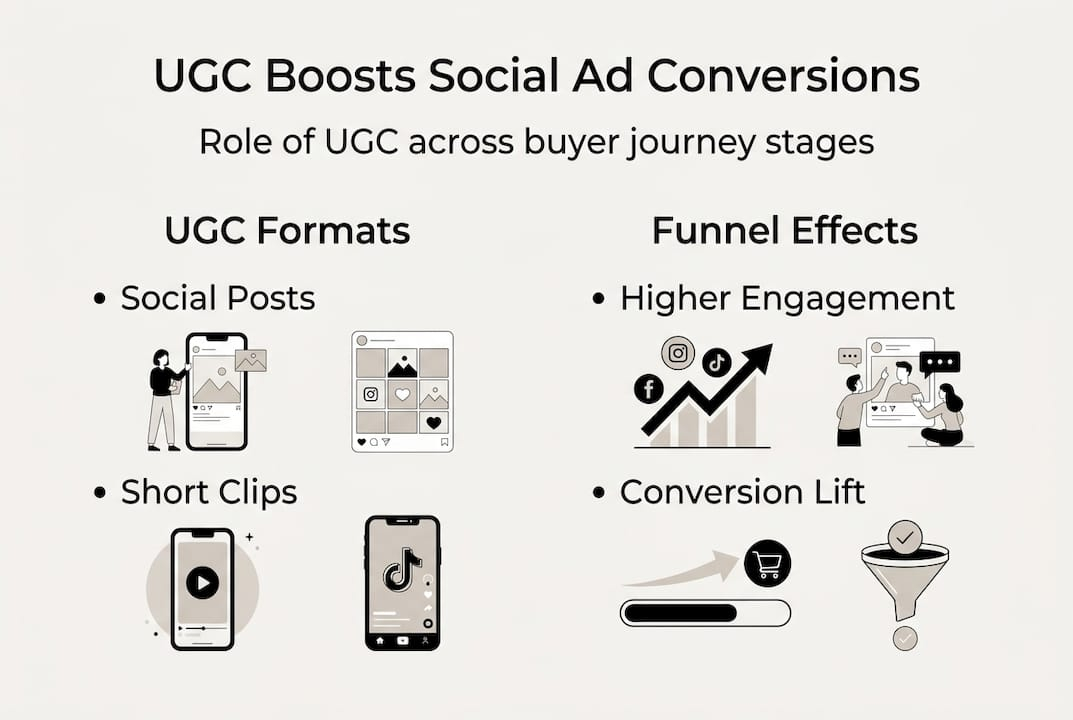
| Funnel stage | UGC format | Primary effect |
|---|---|---|
| Awareness | Social posts, short clips | Stops the scroll, builds familiarity |
| Consideration | Video testimonials, demos | Builds trust, answers objections |
| Conversion | Review videos, before/after | Removes final hesitation, drives purchase |
| Retention | Customer success stories | Reinforces loyalty, encourages repeat buy |
At the awareness stage, UGC content blends into the feed naturally, which means viewers engage with it before they realize it’s an ad. That’s a critical window. Once a potential customer pauses on your content, you’ve earned attention without interrupting their experience.
At the consideration stage, social proof (the psychological tendency to follow the actions of others) becomes the dominant force. Seeing real customers explain why they chose your product and what results they got answers objections faster than any product description page.
Types of UGC that drive decisions at each step:
- Awareness: Short-form clips under 15 seconds, lifestyle shots featuring your product
- Consideration: 30 to 60 second testimonials, FAQ-style customer videos
- Conversion: Side-by-side comparisons, unboxing with clear product benefits
- Retention: Long-form success stories, community content featuring loyal customers
You can align these formats with your social media ad strategies to build a full-funnel UGC plan that keeps content relevant at every touchpoint. The key is not using the same UGC asset everywhere. Match the format and message to where the buyer actually is.
Implementing UGC for higher ad conversions: Step-by-step
Understanding influence is one thing. Here’s how to actually put UGC to work in your ad strategy. A structured approach to UGC implementation is crucial for consistent conversion gains, not just a one-time spike.
Step-by-step UGC implementation process:
- Define your creative brief. Specify the product, the key benefit to highlight, the target audience, and the call to action. Real creators and AI-generated avatars both need clear direction to produce content that converts.
- Identify your UGC sources. Options include reaching out to existing customers via email, running a social media campaign asking for reviews, partnering with micro-creators, or using an AI-powered UGC platform to generate content at scale.
- Match format to platform. TikTok favors vertical video with fast hooks in the first two seconds. Instagram Reels reward polished-but-authentic clips. Facebook ads perform well with testimonial-style videos that include captions.
- Edit for ad specs. Trim content to platform-recommended lengths. Add subtitles since most social video is watched without sound. Include a clear call to action in the final three seconds.
- Launch and track. Set up separate ad sets for UGC and non-UGC creative using the same targeting. Track conversion rate, cost per acquisition, and click-through rate separately for each.
- Iterate based on data. Identify which UGC hooks, formats, and calls to action perform best. Double down on winners and replace underperformers within two weeks.
Staying current with UGC trends for 2026 also helps you anticipate what formats are gaining traction before your competitors catch on.
Pro Tip: When A/B testing UGC against non-UGC creative, keep all other variables identical, same audience, same budget, same placement. The only difference should be the creative. This isolates the UGC effect and gives you clean data to justify scaling your investment.
A fresh perspective: Most brands miss the real power of UGC
After seeing how to implement UGC, let’s consider how most brands actually approach it, and what they miss. The honest truth is that the majority of e-commerce marketing teams treat UGC as a campaign tactic rather than a content infrastructure. They run one UGC test, see a lift, and then move on to the next initiative.
That’s the wrong model. UGC’s true value is its scalability and ongoing authenticity, not just a one-off boost. Brands that win with UGC long-term build systematic pipelines: they collect content continuously, refresh creatives monthly, and use customer feedback embedded in UGC as live market research.
Think about it this way. Every UGC video is also a data point. What objections does the customer mention? What benefits do they emphasize? That language feeds directly back into your ad copy, product pages, and email sequences. The brands that understand why UGC works treat it as a feedback loop, not just a creative format.
Scaling UGC systematically beats inconsistent bursts every time. Build the pipeline first. The conversions follow.
Level up your UGC ad strategy with the right tools
If you’re ready to scale your UGC efforts and maximize conversions, the right partner makes it possible without the usual bottlenecks. Sourcing, filming, editing, and managing creators takes weeks and significant budget. That’s time and money most marketing teams can’t afford to lose on every campaign cycle.

HotUGC removes those barriers entirely. The platform uses advanced AI to generate AI-generated UGC videos featuring realistic avatars, conversion-optimized scripts, and attention-grabbing hooks in minutes, not weeks. You get full commercial rights, multi-language support, and the ability to test dozens of creative variations at a fraction of traditional production costs. For e-commerce marketing managers who need to move fast and scale consistently, HotUGC is built exactly for that workflow.
Frequently asked questions
Why does UGC outperform traditional ads in conversions?
Authentic UGC video ads build trust and reduce purchase resistance, making audiences far more likely to convert than they would from polished studio creative that signals a hard sell.
What types of UGC work best for social ad conversions?
Video testimonials, unboxing clips, and customer reviews consistently yield the highest results, with UGC-based creatives delivering an average of 62% higher conversion rates compared to studio-shot alternatives.
How can I start sourcing UGC quickly for my ad campaigns?
Reach out to existing customers for video reviews, run a social media content challenge, or use a platform that produces structured UGC content at scale without the delays of traditional creator outreach.
Is UGC effective at all stages of the funnel?
Yes. Authentic UGC video ads drive awareness, build consideration-stage trust, and have been linked to a 34% boost in e-commerce conversions at the purchase stage.


