
Social media advertising: strategies for higher e-commerce conversions
HotUGC
April 3, 2026 · 10 min read
Social media advertising: strategies for higher e-commerce conversions

TL;DR:
- User-generated content significantly outperforms polished ads, increasing engagement and reducing costs.
- Targeting alone is less impactful than creative quality, with continuous testing essential for success.
- Starting with a budget of $850-2000 per month helps gather data before scaling social media ad campaigns.
Most e-commerce brands pour money into social ads and still miss the metrics that actually move revenue. The real gap isn’t budget or platform choice. It’s understanding which levers drive performance and how to pull them in the right order. UGC outperforms polished ads by 40% higher CTR and 26% lower CPA, yet most brands still default to expensive studio content. This guide breaks down what social media advertising really is, how it works for e-commerce, why user-generated content is your highest-leverage creative asset, and how to benchmark and scale without burning your budget.
Table of Contents
- What is social media advertising?
- How social media advertising works for e-commerce
- User-generated content: The performance multiplier
- Benchmarks, budgets, and pitfalls: What to know before you scale
- Why creative is king and UGC is its crown
- Accelerate your UGC ads with HotUGC
- Frequently asked questions
Key Takeaways
| Point | Details |
|---|---|
| Paid social drives growth | E-commerce brands use social media advertising to control reach and accelerate sales through paid placements. |
| UGC supercharges performance | Authentic user-generated content delivers higher click-through and conversion rates than standard studio ads. |
| Test and optimize weekly | Rapid creative testing and smart use of AI outperform over-complicated targeting or one-time campaigns. |
| Know your numbers | Use updated 2026 benchmarks for Meta and TikTok to plan budget, measure success, and avoid costly pitfalls. |
| Creative beats targeting | The best results come from improving ad creative, especially UGC, rather than micro-managing audience segments. |
What is social media advertising?
Social media advertising means paying platforms directly for ad placement, rather than waiting for organic reach to do the work. You’re buying guaranteed visibility in front of a specific audience, on your timeline, with measurable outcomes. That’s a fundamentally different model from posting content and hoping the algorithm rewards you.
Social media advertising uses paid ads on platforms like Facebook, Instagram, and TikTok for precise targeting and direct audience control. Each platform has its own ad ecosystem:
- Facebook and Instagram (Meta): Mature ad infrastructure, deep behavioral data, strong for retargeting and conversion campaigns.
- TikTok: Rapidly growing, lower CPMs, skews younger but expanding fast across demographics.
- Pinterest and YouTube: Niche but powerful for specific product categories and longer consideration cycles.
For e-commerce, the appeal is direct. You control who sees your ad, when they see it, and what action you want them to take. Organic reach on most platforms has declined significantly over the past several years, making paid placement a practical necessity rather than an optional add-on.
“74% of marketers find paid social effective, but the main barrier is understanding the investment required to see results.”
Most e-commerce brands allocate 11-25% of their digital marketing budget to social ads. That range reflects both the opportunity and the learning curve. If you’re new to paid social, the steps in social media marketing matter as much as the spend level. Starting with clear objectives, platform selection, and creative strategy prevents wasted budget from day one.
The core value proposition of social media advertising for e-commerce is simple: immediate, measurable reach to buyers who match your customer profile, without relying on organic momentum that takes months to build.
How social media advertising works for e-commerce
With a working definition in hand, let’s unpack how social media advertising actually operates for e-commerce brands, from targeting to ad delivery.
The mechanics break down into four main components: audience targeting, bidding, creative testing, and campaign structure.
Audience targeting options include:
- Demographic targeting: Age, gender, location, language.
- Interest targeting: Hobbies, pages followed, content consumed.
- Behavioral targeting: Purchase history, device usage, online activity.
- Lookalike audiences: Algorithmically matched users who resemble your best customers.
Key mechanics include targeting, retargeting, bidding models such as CPC (cost per click), CPM (cost per thousand impressions), and CPE (cost per engagement), along with creative testing and AI-driven optimization. Each bidding model serves a different goal. CPM works for awareness. CPC works for traffic. CPE works for engagement-focused campaigns.
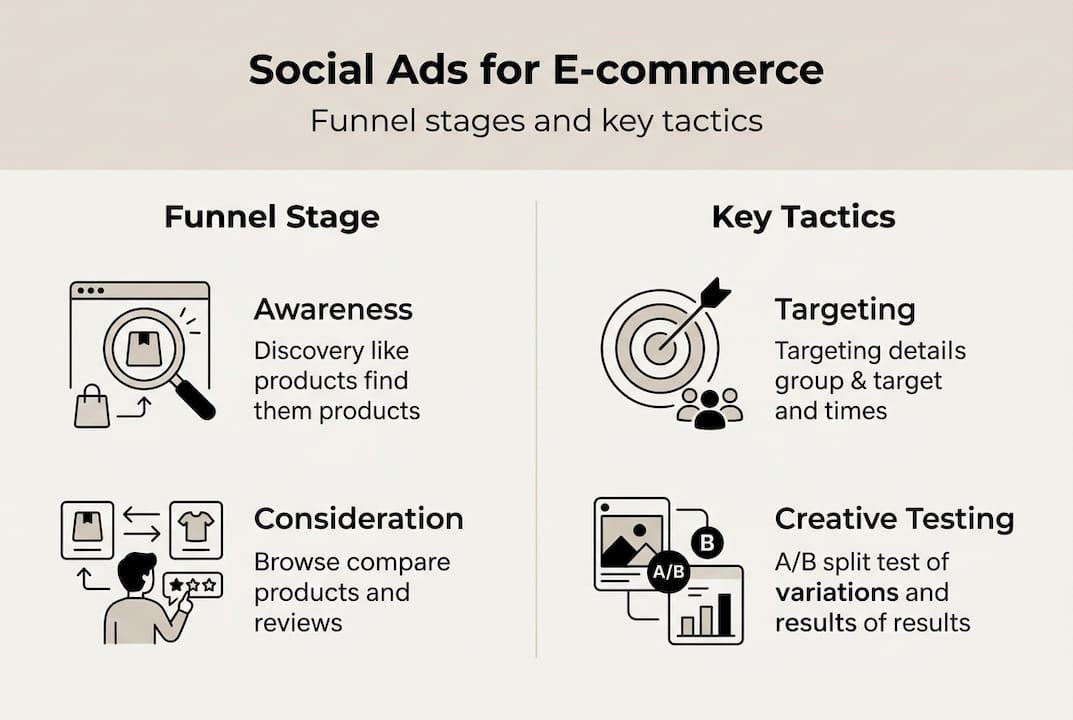
| Funnel stage | Objective | Recommended budget share | Bidding model |
|---|---|---|---|
| Top of funnel | Awareness, reach | 20-30% | CPM |
| Middle of funnel | Consideration, traffic | 30-40% | CPC |
| Bottom of funnel | Conversions, ROAS | 40-50% | CPA/ROAS target |
Creative testing is where most brands underinvest. Running 10-20 ad variations weekly, testing different hooks, visuals, and calls to action, gives the algorithm enough signal to identify winners fast. Platforms like Meta’s Advantage+ use AI to dynamically allocate budget toward top performers, reducing manual optimization time.

For platform differences between Instagram and TikTok, the targeting logic differs significantly. TikTok’s algorithm is more interest-driven and discovery-based, while Meta’s relies more heavily on behavioral data and purchase signals.
Pro Tip: Start with broad audiences and let the AI optimize. Over-segmenting your audience early limits the algorithm’s ability to find buyers you wouldn’t have predicted, and it shrinks your potential reach unnecessarily.
User-generated content: The performance multiplier
Now that you understand the mechanics, let’s reveal the real variable that separates good from great campaign performance: user-generated content.
UGC refers to content created by real customers, reviewers, or creators that reflects authentic product experiences. In paid social, it means using that raw, relatable content as your ad creative instead of polished studio productions.
Why does it work so well? Three reasons:
- It bypasses ad blindness. Polished ads look like ads. UGC looks like a friend’s recommendation.
- It builds trust faster. Buyers trust peer reviews more than brand messaging.
- It performs better at scale. UGC outperforms polished ads by 40% CTR and 26% lower CPA, with strategies like product seeding, content remixing, and partnership ads amplifying those gains.
| Metric | UGC ads | Studio ads |
|---|---|---|
| Average CTR | Up 40% | Baseline |
| CPA | Down 26% | Baseline |
| ROAS | Up 65% | Baseline |
| Marketer preference | 81% prefer UGC | 19% |
The most effective UGC tactics for e-commerce include:
- Product seeding: Send products to micro-creators or loyal customers and use their authentic reviews as ad content.
- Content remixing: Take existing organic UGC and repurpose it into paid ad formats.
- Partnership ads: Run creator content directly from their handles to increase authenticity signals.
- Hook testing: Test multiple opening lines against the same body content to find what stops the scroll.
For ecommerce video ad ideas that convert, the hook is everything. The first two seconds determine whether a viewer keeps watching or scrolls past. Beyond CTR, track Hook Rate (percentage who watch past the first 3 seconds) and Hold Rate (percentage who watch past 50%). These metrics tell you whether your creative is actually engaging, not just getting clicked.
For more on why video ads for ecommerce outperform static formats, the data consistently points to motion, authenticity, and narrative as the three performance drivers.
Pro Tip: Don’t wait for the perfect UGC video. Test 5-10 rough hook variations first. A 2x improvement in Hook Rate from rapid iteration beats a single polished video every time.
Benchmarks, budgets, and pitfalls: What to know before you scale
With UGC as a critical driver, it’s crucial to understand how to measure success and avoid costly mistakes while scaling your campaigns.
Here are the 2026 performance benchmarks you should use as reference points:
| Platform | CPM | CPC | CTR | CPA | ROAS |
|---|---|---|---|---|---|
| Meta (Facebook/Instagram) | $8-14 | $0.60-1.20 | 1-2% | $18-35 | 3-4.5x |
| TikTok | $4-8 | Lower | Variable | Variable | 3-4x |
Meta blended ROAS of 3-4.5x, CPM $8-14, CPC $0.60-1.20 and TikTok CPM $4-8 with ROAS 3-4x represent realistic 2026 targets for e-commerce brands running optimized campaigns. UGC specifically boosts CTR by 48% and ROAS by 65% compared to non-UGC creative.
For budget planning, most brands start with $850-2,000 per month for initial testing. That range gives you enough data to identify winning creatives and audiences before scaling spend.
“Measure ROAS and POAS (profit on ad spend), not just CTR or CPM. Shallow metrics feel good but don’t tell you whether your ads are actually profitable.”
Common pitfalls to avoid before scaling:
- Killing ads too soon. Ending campaigns before 7 days prevents the algorithm from completing its learning phase, which typically requires 50 optimization events.
- Over-segmenting audiences. Too many narrow ad sets split your budget and reduce algorithmic efficiency.
- Skipping pixel and CAPI setup. Without proper attribution via Meta Pixel or Conversions API, you’re flying blind on which ads drive actual purchases.
- Ignoring creative fatigue. Ads that performed well in week one often decline sharply by week three. Refresh creative regularly.
- Chasing vanity metrics. High impressions with low ROAS means you’re paying for attention, not revenue.
For a deeper look at how video ads drive a 34% conversion boost, the data reinforces why creative quality and format matter as much as targeting precision. And if you want to understand video ad conversion optimization at a technical level, start with your landing page alignment before touching your ad settings.
Why creative is king and UGC is its crown
Once you know the numbers and common missteps, it’s time for a reality check: what really moves the needle in 2026 social media advertising.
Most brands spend the majority of their optimization time on targeting tweaks, audience exclusions, and bid adjustments. These matter, but they’re not where the real gains live. Creative outperforms targeting as the primary performance lever, especially with Meta’s Andromeda and GEM AI systems now doing much of the targeting work automatically. Measure ROAS and POAS, not just CTR or CPM.
The honest truth is that targeting has become commoditized. Every brand has access to the same demographic and behavioral data. What you can’t copy is a great creative that resonates with your specific audience.
UGC is the most consistent way to optimize UGC ads with AI and generate that resonance at scale. In a world where AI-generated content is everywhere, authentic human voices stand out. Rapid creative iteration, testing new hooks weekly, refreshing scripts monthly, and cycling in new creator voices beats any static funnel strategy. The brands winning in 2026 are the ones treating creative like a product: constantly testing, learning, and improving.
Accelerate your UGC ads with HotUGC
If you’re ready to put UGC at the center of your 2026 social ad strategy, here’s how to start quickly.
HotUGC is an AI-powered platform built specifically for e-commerce brands that need high-performing UGC video ads without the traditional production bottleneck. You get realistic avatars, conversion-optimized scripts, and attention-grabbing hooks, all generated in minutes rather than weeks. No filming, no hiring creators, no editing delays.
HotUGC supports multi-language campaigns, avatar customization, and commercial usage rights, making it a practical solution for brands scaling across TikTok, Instagram, and Facebook simultaneously. If rapid creative iteration is the real performance lever, HotUGC gives you the infrastructure to pull it consistently.
Frequently asked questions
What is the main goal of social media advertising for e-commerce?
The main goal is to drive targeted traffic and sales using paid ads that reach buyers with personalized, data-driven content. Social media ads allow precise targeting and direct audience control, making them far more efficient than organic reach alone.
Why is user-generated content so effective in paid social media ads?
UGC builds trust, reduces ad blindness, and significantly increases click-through and conversion rates compared to polished studio ads. UGC outperforms polished ads by 40% CTR and 26% lower CPA on average.
How much should an e-commerce brand budget for social media advertising in 2026?
Most brands start with $850-2,000 per month or 11-25% of their digital marketing budget for initial social ad tests. 74% of marketers find social ads effective, and that starting range gives you enough data to identify winners before scaling.
What are common mistakes to avoid in social media ads for e-commerce?
Avoid over-segmenting audiences, ending campaigns too soon, and skipping proper attribution or pixel setup. Over-segmenting, ending campaigns early, and neglecting pixel or CAPI integration all reduce algorithmic efficiency and distort your performance data.
How do Meta and TikTok ad results compare for e-commerce in 2026?
In 2026, Meta typically offers higher ROAS and spend scale, while TikTok delivers lower CPMs and cost-effective top-of-funnel traffic. Meta blended ROAS of 3-4.5x with CPM $8-14 versus TikTok’s CPM $4-8 and ROAS 3-4x reflects the current platform landscape for e-commerce advertisers.


