
Why invest in social video ads for ecommerce in 2026
HotUGC
March 20, 2026 · 11 min read
Why invest in social video ads for ecommerce in 2026

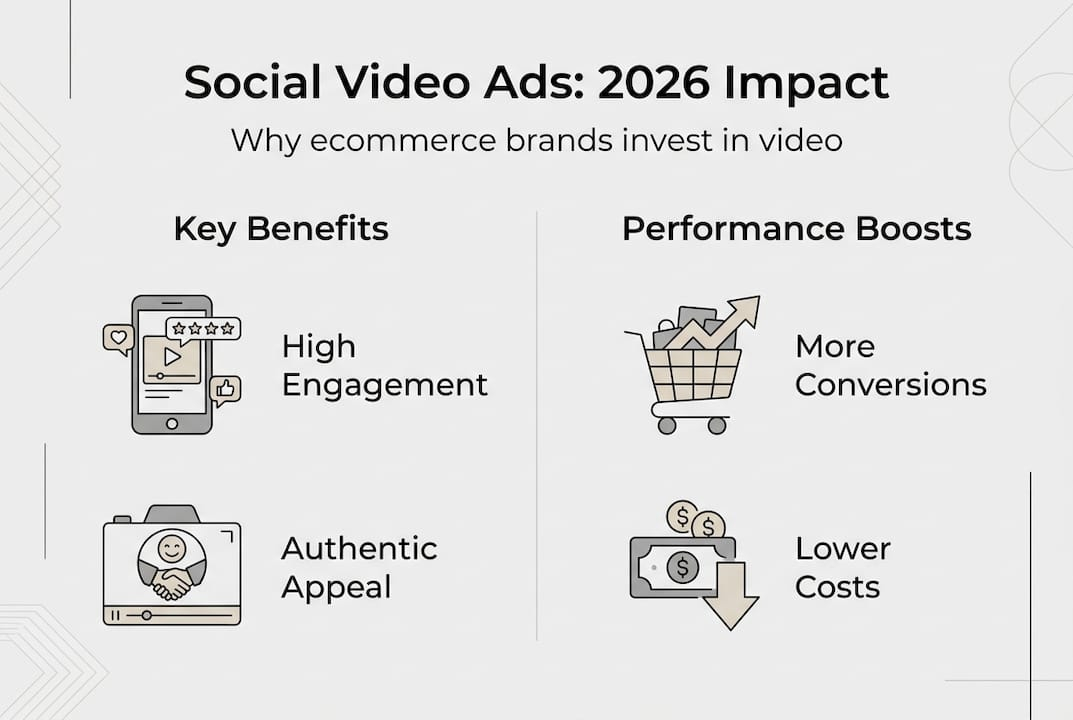
Many ecommerce marketing managers assume social video ads require massive budgets and complex production workflows, creating a barrier to entry that keeps brands stuck with static image campaigns. The reality contradicts this misconception entirely. Video ads in ecommerce deliver a 34% conversion boost, demonstrating measurable impact on bottom-line results. User-generated content formats have transformed the video advertising landscape, making authentic, high-performing campaigns accessible to brands of all sizes. This article explores why social video ads represent a critical investment for ecommerce success in 2026, focusing on engagement strategies, conversion optimization, and cost-effective implementation approaches that deliver tangible ROI.
Table of Contents
- Understanding The Power Of Social Video Ads In Ecommerce
- Why User-Generated Content Is A Game Changer In Social Video Ads
- Optimizing Your Social Video Ad Campaigns With Proven Strategies And Formats
- Measuring Success And Scaling Your Social Video Ad Investment
- Enhance Your Ecommerce Video Ads With Hotugc
- FAQ
Key takeaways
| Point | Details |
|---|---|
| Higher conversion rates | Social video ads outperform static formats by 34% in ecommerce conversion metrics. |
| Authenticity drives trust | User-generated content creates relatable experiences that build customer confidence and loyalty. |
| Cost efficiency through automation | AI-powered tools reduce production expenses by 90% while maintaining professional quality standards. |
| Attention-grabbing hooks | Strategic video openings capture viewer interest within the first three seconds, reducing scroll-past rates. |
| Format diversity matters | Multiple UGC video styles allow brands to test and optimize campaigns for specific audience segments. |
Understanding the power of social video ads in ecommerce
Social video ads represent short-form video content designed specifically for social media platforms like TikTok, Instagram, and Facebook. User-generated content refers to authentic videos created by real customers or designed to mimic genuine customer experiences, contrasting sharply with traditional polished advertising. Ecommerce brands face persistent challenges in breaking through saturated digital markets where consumers scroll past hundreds of static ads daily without meaningful engagement.
The data supporting video advertising effectiveness tells a compelling story. Research shows video content generates 1200% more shares than text and images combined, creating organic reach that extends far beyond initial ad spend. Engagement metrics reveal users spend 88% more time on websites featuring video content, translating directly to increased product exploration and purchase consideration. Click-through rates for video ads average 1.84%, significantly outperforming display ads at 0.35%.
“Video advertising has evolved from a nice-to-have luxury to an essential component of competitive ecommerce strategy, with platforms prioritizing video content in their algorithms and consumers demanding more interactive shopping experiences.”
User-generated content amplifies these advantages by introducing authenticity that resonates with skeptical modern consumers. When potential customers see real people using products in everyday contexts, trust barriers dissolve more effectively than through any branded messaging. Video ad engagement for marketers demonstrates how UGC-style videos consistently outperform traditional advertising across key performance indicators.
The psychological impact of video cannot be overstated. Moving images trigger emotional responses that static content simply cannot match, creating memorable brand associations that influence purchase decisions long after initial exposure. Video formats also accommodate storytelling techniques that guide viewers through product benefits, usage scenarios, and social proof elements within seconds. For ecommerce brands competing in crowded markets, this combination of engagement, authenticity, and conversion power makes social video ads indispensable.
Why user-generated content is a game changer in social video ads
User-generated content videos possess an unpolished, genuine quality that immediately signals authenticity to viewers. Unlike glossy brand productions that feel like obvious advertisements, UGC videos mirror the content consumers already watch and trust from friends, influencers, and fellow shoppers. This stylistic alignment reduces psychological resistance, allowing marketing messages to penetrate defenses that typically block traditional advertising.
The financial and performance case for UGC proves equally compelling. UGC advertising yields 4x higher conversions and 60% cost savings compared to conventional video production methods. These statistics reflect both reduced production expenses and superior audience response rates. Brands eliminate costs associated with professional videographers, studios, actors, and extensive post-production editing while simultaneously achieving better campaign results.
Community trust represents another critical advantage of user-generated video content. When customers see others like themselves endorsing products, social proof mechanisms activate powerfully. Consumers trust peer recommendations 92% more than brand messaging, making UGC videos exceptionally effective at overcoming purchase hesitation. This trust factor builds brand loyalty that extends beyond individual transactions, creating repeat customers and organic advocacy.
Diverse UGC video formats allow brands to match content styles with specific campaign objectives:
- Product unboxing videos that showcase packaging and first impressions
- Tutorial demonstrations explaining product features and usage techniques
- Before and after transformations highlighting tangible results
- Lifestyle integration clips showing products in everyday contexts
- Customer testimonial videos featuring genuine satisfaction and recommendations
Pro Tip: Incentivize existing customers to create video reviews and testimonials by offering discounts, loyalty points, or featuring their content on brand channels, building a sustainable pipeline of authentic advertising material.
The UGC video formats available today provide flexibility that traditional advertising cannot match. Brands can rapidly test multiple content angles, identifying which resonates most strongly with target audiences without significant financial risk. This iterative approach accelerates learning cycles, allowing marketing teams to optimize campaigns based on real performance data rather than assumptions.
Authenticity in UGC extends beyond visual style to encompass emotional resonance. Viewers perceive these videos as helpful recommendations rather than sales pitches, fundamentally changing the relationship between brand and consumer. This shift from interruption marketing to value-driven content creates positive associations that compound over time, building brand equity alongside immediate conversion results.
Optimizing your social video ad campaigns with proven strategies and formats
Selecting the right UGC video format directly impacts campaign performance, with each style offering distinct advantages for specific marketing objectives.

| Format | Best Use Case | Pros | Cons |
|---|---|---|---|
| Product Reviews | Building trust and credibility | High authenticity, addresses objections | Requires genuine customer participation |
| Tutorials | Demonstrating complex products | Educational value, extended engagement | Longer production time |
| Testimonials | Converting hesitant buyers | Strong social proof, emotional appeal | May feel repetitive if overused |
| Unboxing Videos | Generating excitement | Captures anticipation, shows packaging | Limited depth on product functionality |
| Lifestyle Content | Building brand identity | Aspirational appeal, broad reach | Less direct product focus |
Creating high-converting social video ad campaigns requires systematic execution across multiple phases:
- Define clear campaign objectives tied to specific KPIs like conversion rate, click-through rate, or cost per acquisition
- Identify target audience segments and research their content consumption preferences on each platform
- Develop multiple video concepts testing different hooks, messaging angles, and calls to action
- Produce or source authentic UGC-style videos that align with platform best practices and audience expectations
- Launch campaigns with controlled budgets, monitoring performance metrics closely during initial phases
- Analyze results to identify top-performing videos, then reallocate budget toward winning creative assets
- Iterate continuously by testing new variations based on data insights and emerging platform trends
Automation and AI tools revolutionize the economics and scalability of video advertising. Automating video ads cuts costs by 90% and boosts click-through rates by 5x, enabling brands to produce professional-quality content at unprecedented speed and volume. These platforms eliminate traditional bottlenecks like scheduling shoots, coordinating talent, and managing extensive editing workflows.
Pro Tip: Create five to seven different video hooks for each campaign and run them simultaneously with small budgets to identify which opening seconds generate the highest engagement before scaling successful variants.
Video hooks represent the most critical three seconds of any social video ad. Platform algorithms and user behavior both prioritize immediate engagement, meaning videos must capture attention instantly or face immediate scroll-past. Effective video ad hooks employ pattern interrupts, surprising statements, visual intrigue, or direct benefit promises that compel viewers to keep watching.
Strong hooks reduce ad fatigue by maintaining novelty even as audiences encounter multiple ads from the same brand. Testing various opening approaches provides data on which psychological triggers resonate most strongly with specific audience segments. Some viewers respond to problem-focused hooks highlighting pain points, while others engage more with solution-oriented openings showcasing transformation potential.
The top UGC content formats continue evolving as platforms introduce new features and audience preferences shift. Staying current with format trends ensures campaigns maintain relevance and algorithmic favor, maximizing organic reach alongside paid distribution.
Measuring success and scaling your social video ad investment
Key performance indicators provide the foundation for data-driven campaign optimization. Ecommerce brands must track metrics that directly correlate with business objectives rather than vanity metrics that look impressive but lack revenue impact. Conversion rate measures the percentage of viewers who complete desired actions, representing the ultimate success metric for performance marketing. Click-through rate indicates how effectively videos drive traffic to product pages or landing destinations. Engagement rate encompasses likes, comments, shares, and saves, signaling content resonance and potential for organic amplification.
Typical KPI benchmarks for 2026 social video ad campaigns help contextualize performance:
| Metric | Strong Performance | Average Performance | Needs Improvement |
|---|---|---|---|
| Conversion Rate | Above 3.5% | 1.5% to 3.5% | Below 1.5% |
| Click-Through Rate | Above 2.0% | 0.8% to 2.0% | Below 0.8% |
| Engagement Rate | Above 6.0% | 2.5% to 6.0% | Below 2.5% |
| Cost Per Acquisition | Below $15 | $15 to $40 | Above $40 |
| View-Through Rate | Above 50% | 25% to 50% | Below 25% |
Common pitfalls in interpreting ad data can lead to misguided optimization decisions:
- Focusing exclusively on reach or impressions without considering conversion quality and customer lifetime value
- Making campaign changes too quickly before statistical significance emerges from sufficient data samples
- Ignoring platform-specific performance variations that require tailored creative approaches for each channel
- Overlooking audience fatigue signals like declining engagement rates despite consistent impression delivery
- Failing to segment performance analysis by audience demographics, leading to averaged insights that mask segment-specific opportunities
Scaling successful campaigns requires strategic budget allocation based on proven performance data. Start by identifying videos that consistently exceed benchmark KPIs across multiple metrics, not just single indicators. Gradually increase daily budgets by 20% to 30% increments, monitoring whether performance maintains at higher spend levels. Some campaigns hit efficiency ceilings where additional budget produces diminishing returns, requiring fresh creative rather than more money behind existing assets.
Creative scaling involves producing variations of winning videos that maintain core elements while introducing novelty. Test different product angles, customer demographics in footage, background settings, music choices, and call-to-action phrasing. This approach prevents audience fatigue while capitalizing on proven formulas. Understanding video ad conversion rates is essential to optimize campaigns and identify which creative elements drive actual purchases versus superficial engagement.
Ongoing testing and iteration form the backbone of sustainable campaign growth. Markets evolve, competitors adapt, and audience preferences shift, making continuous experimentation non-negotiable for maintaining competitive advantage. Allocate 15% to 20% of advertising budgets specifically for testing new concepts, formats, and targeting approaches. This investment in learning compounds over time, building institutional knowledge about what resonates with your specific customer base.
Video content best practices evolve as platforms update algorithms and introduce new features like shoppable tags, augmented reality filters, or interactive elements. Staying informed about these developments allows brands to capitalize on early-adopter advantages before markets become saturated with competitors using identical tactics.
Enhance your ecommerce video ads with HotUGC
Transforming your social video advertising strategy from theory into execution requires tools that eliminate traditional production barriers while maintaining the authenticity that drives results. HotUGC provides AI-powered solutions specifically designed for ecommerce brands seeking to scale user-generated content video production without sacrificing quality or breaking budgets. The platform generates professional UGC-style videos featuring realistic avatars, conversion-optimized scripts, and attention-capturing hooks in minutes rather than weeks.

By automating the creative process, HotUGC enables marketing teams to test multiple video concepts simultaneously, identifying top performers through rapid iteration cycles. The platform supports multi-language campaigns, allowing brands to expand into new markets with localized content that maintains consistent messaging and visual quality. Commercial rights for all generated videos mean you can deploy content across every social platform and advertising channel without legal complications. Explore how HotUGC AI-generated UGC videos can accelerate your ecommerce growth through scalable, cost-effective video advertising that converts browsers into buyers.
FAQ
What types of ecommerce brands benefit most from social video ads?
Brands selling visually appealing products that demonstrate clear benefits or transformations see exceptional results from social video advertising. Consumer goods, fashion, beauty, home decor, and electronics categories particularly thrive with video formats that showcase products in action. Fast-moving consumer goods brands leverage video’s storytelling capacity to differentiate commoditized products through lifestyle positioning and emotional connections.
How can I ensure authenticity in my social video ads?
Prioritize real customer testimonials and unpolished footage that mirrors organic social media content rather than overproduced advertising. Avoid overly scripted dialogue, perfect lighting, and obvious studio settings that signal traditional advertising. Embrace imperfections like natural speech patterns, casual environments, and genuine emotional reactions that viewers recognize as authentic human experiences rather than manufactured marketing messages.
What metrics should I track to measure social video ad success?
Focus primarily on conversion rate, click-through rate, engagement rate, and cost per acquisition as these directly correlate with revenue impact and campaign efficiency. Additionally monitor view-through rates and average watch time for video-specific insights into content quality and audience interest. Platform-specific metrics like shares and saves indicate content resonance that can drive organic reach beyond paid distribution.
Can automation tools really reduce the cost of video ad production?
Automation platforms genuinely cut production costs by up to 90% while delivering professional-quality videos that perform comparably or better than traditionally produced content. These tools eliminate expenses associated with videographers, studios, actors, and editing teams while dramatically accelerating production timelines. The speed advantage allows brands to test multiple creative variations quickly, identifying winning concepts before competitors while maintaining budget flexibility for scaling successful campaigns.


