
Commercial rights for UGC: protect and maximize your brand
HotUGC
April 12, 2026 · 11 min read
Commercial rights for UGC: protect and maximize your brand

TL;DR:
- Securing explicit commercial rights is essential to legally use UGC in paid campaigns.
- Proper rights management prevents costly DMCA takedowns and ad account suspensions.
- Implementing structured, renewal-based rights tracking helps brands stay compliant and flexible.
Marketers who assume that reposting a glowing customer video is free and safe are sitting on a legal time bomb. A single unpermissioned ad can trigger a DMCA takedown, freeze your campaign mid-flight, and expose your brand to five-figure fines. Yet most e-commerce teams still treat UGC rights as an afterthought, buried in a DM thread or a vague verbal agreement. Commercial rights for UGC are more nuanced than a simple thumbs-up emoji in the comments. This guide breaks down what those rights actually cover, what happens when you skip the paperwork, how to negotiate smart deals, and how to keep your campaigns legally bulletproof.
Table of Contents
- What are commercial rights for UGC?
- Why commercial rights matter: Risks and rewards
- How to secure commercial rights for UGC
- Costs, pricing models, and negotiation tips
- Our take: What brands and marketers get wrong about UGC rights
- Streamline your UGC rights management with HotUGC
- Frequently asked questions
Key Takeaways
| Point | Details |
|---|---|
| Know your UGC rights | Commercial use requires specific rights beyond simply reposting content. |
| Secure and document permissions | Written agreements clarify scope, duration, and modifications to protect your brand. |
| Track expiration and scope | Effective rights management tools prevent costly mistakes and DMCA takedowns. |
| Negotiate for flexibility | Opt for renewal-based or hybrid licenses instead of defaulting to perpetual rights. |
| Pay only for what you need | Tailoring commercial rights saves costs and optimizes your e-commerce UGC investment. |
What are commercial rights for UGC?
Commercial rights give your brand the legal authority to use creator-made content in marketing and advertising, not just to share it organically. If you want to run a TikTok paid ad featuring a customer review video, or drop that Instagram Reel into a Facebook retargeting campaign, you need explicit commercial rights. Organic sharing and commercial use are two entirely different legal categories, and confusing them is where most brands get into trouble.
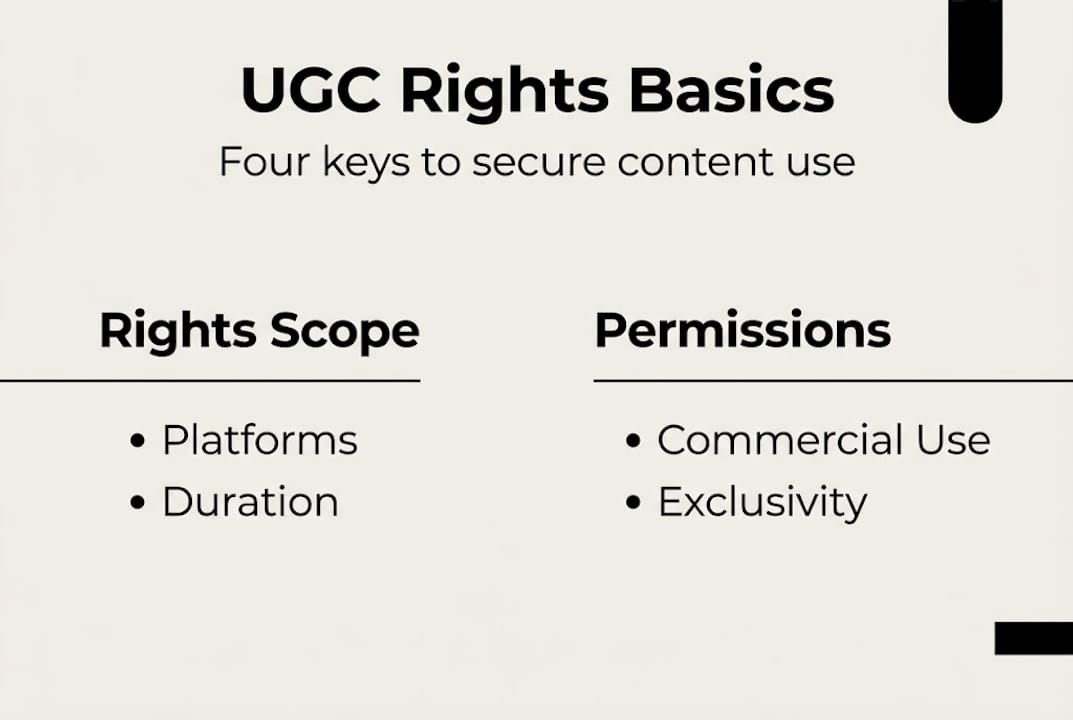
Understanding the UGC video basics is a smart starting point, but rights management goes deeper. The key mechanics of any commercial rights agreement cover five core components: scope, duration, territory, exclusivity, and modifications. Each one shapes what you can actually do with the content.
| Rights component | What it covers | Typical options |
|---|---|---|
| Scope | Platforms and channels where content can be used | Organic only, paid ads, email, website, all channels |
| Duration | How long you can use the content | 6 months, 12 months, perpetual |
| Territory | Geographic reach of the license | Local, national, worldwide |
| Exclusivity | Whether the creator can license to competitors | Non-exclusive, exclusive |
| Modifications | Right to edit, crop, add branding, or adapt | None, limited, full |
Here is a practical example. Say you get permission to post a creator’s video on your Instagram feed. That does not automatically cover using it in a paid Instagram ad, running it on Facebook, or adding your logo to it. Each of those actions requires its own rights grant. Brands routinely discover this gap only after a creator files a complaint.
Pro Tip: Always confirm in writing that you have the right to edit, crop, resize, and add brand overlays to any UGC before it goes into production. Modification rights are often forgotten in negotiations but are essential for ad creative.
Common mistakes marketers make when negotiating UGC rights:
- Accepting a verbal or DM-based agreement instead of a written contract
- Failing to specify which platforms the license covers
- Not defining whether the license is exclusive or non-exclusive
- Ignoring the right to modify or adapt the content
- Leaving out renewal terms, which forces renegotiation under pressure
Why commercial rights matter: Risks and rewards
Understanding the rights is only step one. Let’s see what is really at stake if you get it wrong or right.
The legal risks are real and escalating. DMCA takedowns and infringement fines are the most immediate threats, but the damage can go further. Platforms like Meta and TikTok can suspend ad accounts for repeated rights violations, cutting off your entire paid media operation. In serious cases, creators or their representatives can pursue civil litigation, and settlements often run into tens of thousands of dollars.
Consider this scenario: A mid-sized apparel brand repurposes a popular customer unboxing video into a paid Facebook ad without securing commercial rights. The creator notices the ad, files a DMCA complaint, and the ad is pulled within 24 hours. The brand loses the spend already deployed, scrambles to replace creative, and the campaign misses its launch window. That is a real operational and financial hit, and it happens more often than brands admit.
Fair use almost never applies to commercial advertisements. If your content appears in a paid ad, you need documented permission, full stop.
The upside of doing it right is equally significant. Secured UGC drives stronger engagement and trust because audiences respond to authentic voices. You also gain the flexibility to repurpose content across channels, test multiple formats, and iterate rapidly without legal exposure. Brands that invest in UGC advertising benefits consistently report higher conversion rates compared to polished brand-produced content.

Staying current on UGC trends 2026 shows that brands with structured rights programs are scaling their UGC libraries faster and with more confidence.
What you lose without proper rights:
- Active campaigns pulled mid-flight
- Ad account suspension risk
- Budget wasted on unusable content
- Creator relationship damage
What you gain with proper rights:
- Full cross-channel deployment flexibility
- Legal protection from takedowns and fines
- Ability to repurpose and adapt content over time
- Stronger creator partnerships built on clear expectations
How to secure commercial rights for UGC
With risks clear, let’s look at exactly how you can secure commercial rights quickly and safely.
The process does not have to be complicated, but it does have to be deliberate. Follow these steps every time you bring UGC into a paid campaign.
- Audit your needs. Before approaching a creator, define exactly how you plan to use the content. Which platforms? Paid or organic? Will you edit it? How long do you need it? Clear answers here prevent scope creep later.
- Define the scope in writing. Draft a brief but specific rights agreement that covers platforms, duration, territory, exclusivity, and modification rights. Even a one-page document is far better than a DM exchange.
- Negotiate terms. Discuss duration and exclusivity openly. Negotiate renewals over perpetuity to control costs and maintain flexibility. Hybrid licensing, such as exclusive rights on one platform but non-exclusive elsewhere, can maximize value for both sides.
- Get it in writing and signed. A countersigned agreement, even via email or a digital signature tool, creates a clear record. This protects both you and the creator.
- Track rights and expirations. Log every agreement in a centralized tracker with expiration alerts. This single step prevents the most common and costly mistake in UGC management.
- Plan for disputes. Include an escalation clause in your agreement that outlines how disagreements will be resolved, whether through mediation, arbitration, or direct negotiation.
For brands focused on driving conversions with UGC, a structured rights process also means you can scale your content library without legal risk slowing you down.
Pro Tip: Negotiate renewal options upfront rather than locking in perpetual rights. A 12-month license with a renewal clause gives you flexibility and keeps costs predictable, especially for content that may become less relevant over time.
Common mistakes and how to avoid them:
- Not tracking expiration dates: Set calendar reminders 60 days before any license expires so you can renew or retire content proactively.
- Over-broad scope requests: Only license what you actually plan to use. Paying for worldwide exclusive rights when you only run US campaigns wastes budget.
- Skipping modification rights: Always include explicit permission to edit, crop, and brand the content.
- Relying on platform terms: A creator’s agreement with TikTok or Instagram does not grant your brand commercial rights.
Costs, pricing models, and negotiation tips
Knowing how to secure rights, the next challenge is paying a fair price. Let’s break down costs and smart negotiations.
UGC commercial rights pricing varies widely based on scope, platform, duration, and exclusivity. Current pricing benchmarks show base rates of $200 to $800 per video, with paid ad rights adding 75 to 150 percent on top of that base. Perpetual rights typically cost 100 to 200 percent more than a standard 6 to 12 month license. A 3-month paid ads license, for example, usually runs 20 to 30 percent above the base rate.
| License type | Typical cost range | Best for |
|---|---|---|
| One-off organic post | $200 to $400 | Brand awareness, low-risk testing |
| 3-month paid ads | Base + 20 to 30% | Short campaign windows |
| 12-month paid ads | Base + 75 to 150% | Evergreen campaigns |
| Perpetual | Base + 100 to 200% | Long-term brand assets |
| Platform-exclusive | Negotiated | Focused channel strategies |
| Fully exclusive | Premium, case by case | Competitive differentiation |
Creators advocate for limited terms to retain reuse value, while brands often prefer perpetual rights for flexibility. The practical middle ground is tiered pricing, where you start with a 30-day base license and add on duration or platform rights as needed. This approach keeps initial costs low and scales with actual usage.
Smart negotiation strategies for marketing managers:
- Bundle multiple videos in a single deal to lower per-unit rights costs
- Offer performance bonuses instead of higher upfront rights fees
- Start with shorter license terms and negotiate renewals based on content performance
- Use platform-specific licensing to avoid paying for channels you do not use
- Build renewal options into every contract from day one
For brands evaluating why to choose UGC over traditional production, rights costs are still a fraction of what you would spend on a produced video ad. The key is avoiding over-buying. Paying for perpetual worldwide exclusive rights on a seasonal product video is a budget drain with no return.
Our take: What brands and marketers get wrong about UGC rights
Having covered the essentials, here is a hard-won lesson from our experience with dozens of UGC campaigns.
Most brands are afraid of overpaying for perpetual rights. That fear is misplaced. The real budget killer is over-buying scope you never use. Paying for worldwide exclusivity on content that only runs in one market, or licensing 10 videos when your campaign needs three, drains resources fast.
The contrarian lesson is this: flexible, renewal-based rights structures almost always outperform one-size-fits-all perpetual deals. They keep you agile, let you retire underperforming content without sunk costs, and give creators fair ongoing compensation.
The hidden risk that almost no one talks about is expiration tracking. We have seen campaigns where brands were unknowingly running content on paid ads six months past the license expiration. The contract negotiation was fine. The tracking was nonexistent. Exploring UGC content formats that fit renewal-based models can help you build a library that stays legally current without constant renegotiation.
Brands with active rights tracking systems report significantly fewer compliance incidents than those relying on manual reminders or memory alone.
The takeaway: invest less energy in negotiating the perfect contract and more in building a system that keeps every license visible, current, and actionable.
Streamline your UGC rights management with HotUGC
Ready to make UGC rights management easy and risk-free? Here is how HotUGC can help.
HotUGC is built for e-commerce marketing teams that need high-quality UGC style video ads without the legal complexity of managing creator rights. Every AI-generated video on the platform comes with full commercial rights included, so you can deploy across paid social, email, and your website without a separate licensing negotiation.
No expiration tracking. No rights disputes. No budget surprises. You get conversion-optimized video ads with realistic avatars, platform-ready scripts, and multi-language support, all cleared for commercial use from day one. If you want to streamline your UGC ad workflow and eliminate rights management friction entirely, HotUGC gives your team the speed and legal confidence to scale.
Frequently asked questions
What counts as commercial use of UGC?
Any use in paid advertising, sponsored social posts, or brand promotions is considered commercial use, requiring explicit rights beyond organic sharing. Simply posting on your feed without paid promotion may not require commercial rights, but any ad spend changes that status immediately.
Is it safe to use UGC if I tag the creator?
No. Tagging gives credit but does not grant legal permission. You need documented commercial rights to avoid DMCA takedowns and platform penalties, regardless of whether the creator is tagged or even aware of the use.
How long do commercial rights usually last?
Most agreements run for 6 to 12 months as the industry standard, with options to negotiate longer terms or perpetual use at a higher rate. Building renewal clauses into your initial contract is the most cost-effective approach.
Does fair use protect my UGC ads?
Fair use rarely applies to commercial advertisements. Courts consistently hold that using someone else’s content in a paid ad requires explicit permission, not a fair use defense.
How can I track and manage UGC rights efficiently?
Use a centralized rights tracker with automated expiration alerts. Rights tracking tools and audits are the most reliable way to stay compliant and avoid running expired content in active paid campaigns.


