
Cost-effective video marketing: strategies for better ROAS
HotUGC
April 11, 2026 · 10 min read
Cost-effective video marketing: strategies for better ROAS

TL;DR:
- Cost-effective video marketing maximizes impact and ROI through rapid testing and iteration.
- Using smartphones and AI tools enables affordable, high-volume creative production for brands on a budget.
- Continuous measurement and weekly optimization improve campaign performance and overall ROAS.
Video marketing carries a reputation for burning through budgets fast. But that assumption is costing brands real money. 93% of marketers report positive ROI from video, and short-form formats consistently deliver the highest returns. The real question isn’t whether video works. It’s whether you’re producing it efficiently. This article breaks down what cost-effective video marketing actually means, which strategies move the needle for e-commerce brands, and how to measure whether your spend is working. If you’ve been hesitant to go all-in on video because of perceived costs, what follows will change your thinking.
Table of Contents
- Defining cost-effective video marketing
- Proven strategies to create cost-effective video ads
- Metrics that matter: Measuring ROI and efficiency
- Cost-effective trends and pitfalls to avoid in 2026
- Why creative volume and speed outshine perfection
- Level up your video marketing efficiency
- Frequently asked questions
Key Takeaways
| Point | Details |
|---|---|
| Maximize ROI with smart tactics | Investing in creative volume and agile tools can create high-ROI video ads without overspending. |
| Short-form delivers results | Short-form and UGC videos are both affordable and proven to outperform static content in most campaigns. |
| Test and measure | You should prioritize rapid creative testing and use key metrics to measure and improve cost-efficiency. |
| Avoid common pitfalls | Steer clear of overproducing and focus on engagement-oriented trends for 2026. |
Defining cost-effective video marketing
Cost-effectiveness in video marketing isn’t about spending as little as possible. It’s about maximizing the impact of every dollar you put into production and distribution. A $500 video that drives $5,000 in sales beats a $10,000 production that generates $8,000. The ratio matters far more than the raw number.
Traditional video production involves scripting, filming, professional editing, talent fees, and post-production. Timelines stretch from weeks to months. Costs can run into the tens of thousands. Agile and UGC-driven approaches flip that model entirely. You produce faster, test more, and iterate based on real performance data rather than gut instinct.
Here’s how the two approaches compare:
| Factor | Traditional production | Agile/UGC-driven |
|---|---|---|
| Production time | 4 to 8 weeks | 1 to 3 days |
| Average cost per video | $5,000 to $50,000 | $50 to $500 |
| Creative testing volume | 1 to 2 per quarter | 10 to 50 per month |
| Iteration speed | Slow | Fast |
| ROAS potential | Variable | 3.5 to 6.2x |
Video ads deliver 3.5 to 6.2x ROAS, consistently outpacing static content. That performance gap is widening as algorithms on TikTok, Instagram, and Facebook increasingly favor native-looking, authentic video over polished brand productions.
The core metrics you need to track for cost-effectiveness include:
- ROAS (Return on Ad Spend): Revenue generated per dollar spent on ads
- CPA (Cost Per Acquisition): How much you pay to convert one customer
- CTR (Click-Through Rate): The percentage of viewers who click after watching
- Conversion Rate (CVR): The share of clicks that become actual purchases
“Cost-effective video marketing isn’t a shortcut. It’s a smarter system that prioritizes speed, data, and iteration over production value for its own sake.”
Brands that understand this shift are already seeing video ad engagement results that static formats simply can’t replicate. The foundation is clear: spend less per creative, produce more volume, and let performance data guide your budget allocation.
Proven strategies to create cost-effective video ads
With the concept defined, the next step is discovering the most effective and affordable ways to put it into practice. The good news is that the barriers to entry have never been lower.
DIY with smartphones and AI tools is a fully viable approach, especially for startups and growing e-commerce brands. Volume of creative matters more than perfection. Here’s a practical framework to follow:
- Start with your smartphone. Modern phones shoot 4K video. Pair that with good lighting and a simple ring light setup, and you have a production studio that costs under $100.
- Use AI tools for scripting and avatars. AI platforms generate conversion-optimized scripts and realistic on-screen presenters without hiring talent or booking studios.
- Repurpose existing content. Customer photos, product demos, and review screenshots can all be transformed into short-form video with minimal editing.
- Prioritize hooks above everything else. The first 3 seconds determine whether a viewer keeps watching. Test multiple hook variations before investing in full creative builds.
- Add a clear, direct CTA. Every video needs a single action for the viewer to take. Vague endings kill conversions.
- Test fast, not perfectly. Launch multiple creative variations simultaneously and cut spend on underperformers within 48 to 72 hours.
Exploring different UGC video formats will help you identify which styles resonate most with your specific audience. Product reviews, unboxings, and before-and-after demonstrations consistently outperform generic brand videos in direct response campaigns.

Pro Tip: Don’t wait until a video feels “finished” to launch it. Audiences respond to authenticity, and an imperfect video that goes live today will teach you more than a polished one that launches in six weeks. Pair this mindset with strong video ad features like captions and native-style framing to maximize performance from day one.
Metrics that matter: Measuring ROI and efficiency
Having explored creation strategies, it’s equally important to measure precisely what makes your video marketing cost-effective. Data without context is noise. Data with benchmarks is a roadmap.
Here are the KPIs that actually tell you whether your video spend is working:
| KPI | Industry benchmark | What it tells you |
|---|---|---|
| CTR | 1.8% to 3.2% | How compelling your hook and creative are |
| CPA | 20 to 40% lower than static | How efficiently you’re acquiring customers |
| CVR lift | 15 to 30% above static | How well your video drives purchase decisions |
| ROAS | 3.5x to 6.2x | Overall return on your ad investment |
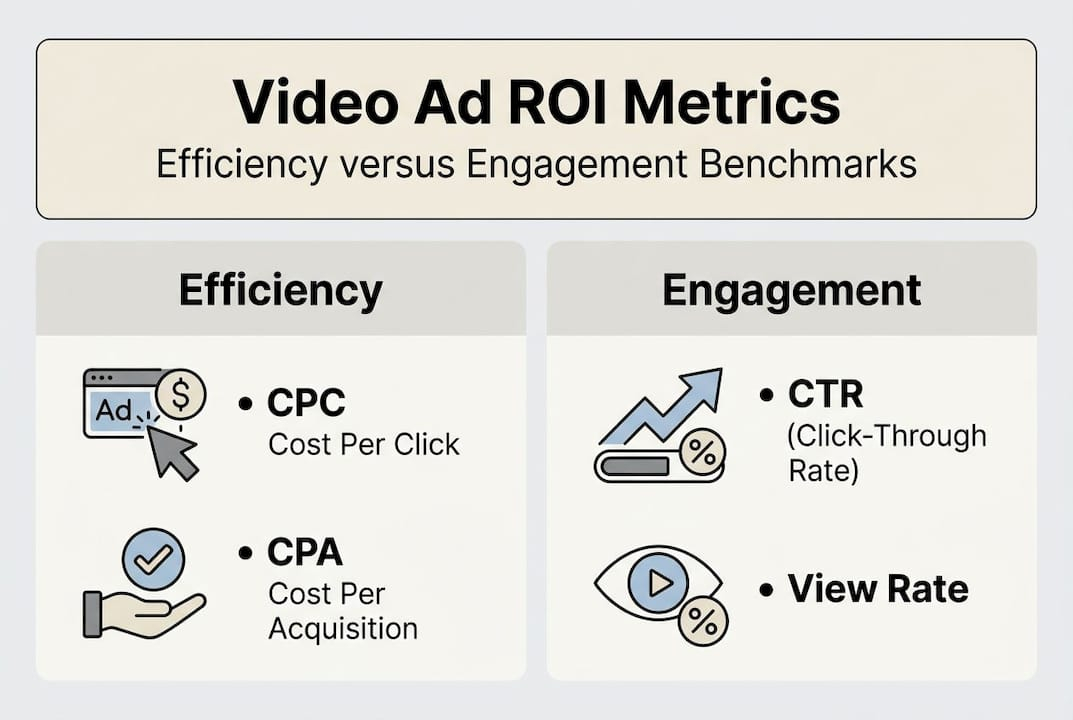
Video ads achieve CTR of 1.8 to 3.2%, with CPA running 20 to 40% lower and conversion rates lifting 15 to 30% compared to static image ads. These aren’t marginal improvements. They represent a structural advantage that compounds over time.
A practical framework for measuring and optimizing your campaigns:
- Set baseline benchmarks before launching any new creative. Know your current CPA and CTR so you have something real to compare against.
- Run A/B tests on single variables. Change one element at a time, hook, CTA, avatar, or format, so you know exactly what drove any change in performance.
- Review performance at 48 hours and 7 days. Early signals often predict long-term results, but give campaigns enough data before making cuts.
- Reallocate budget toward winners weekly. Don’t let underperforming creatives drain spend while waiting for a monthly review.
Learning how to improve video ad engagement is an ongoing process, not a one-time fix. Reviewing UGC ads performance stats against your own numbers gives you a clear picture of where you’re leaving money on the table.
Key insight: Brands that review and reallocate creative budgets weekly, rather than monthly, typically see 25 to 40% better ROAS over a quarter. Frequency of optimization matters as much as quality of creative.
Cost-effective trends and pitfalls to avoid in 2026
Beyond measuring success, keeping pace with the latest trends and avoiding pitfalls will ensure your efforts remain efficient and effective. The 2026 landscape rewards brands that move fast and stay lean.
Top cost-effective trends right now:
- Short-form video dominance. Short-form yields highest ROI for 48.6% of marketers. TikTok, Instagram Reels, and YouTube Shorts are where attention lives.
- AI-generated UGC at scale. Brands are replacing expensive creator partnerships with AI avatars that produce consistent, on-brand content across multiple languages.
- Automation in creative testing. Platforms that auto-generate variations and surface winners are cutting the manual work out of campaign management.
- Native-style video. Content that looks organic rather than produced gets better organic reach and lower CPMs on paid channels.
Exploring 2026 video ad trends shows a consistent pattern: authenticity and speed are winning over polish and perfection.
Common pitfalls that quietly drain your budget:
- Over-producing a single video instead of creating multiple testable variations
- Ignoring performance data and running creatives based on personal preference
- Lacking creative diversity, which causes ad fatigue within 7 to 14 days
- Investing in long-form content before validating short-form hooks
- Skipping captions, which reduces watch time significantly on mobile
“The brands winning in 2026 aren’t necessarily spending more. They’re producing smarter, testing faster, and cutting waste earlier.”
Knowing when to invest in expert production versus keeping things DIY is also critical. Use professional production for hero brand content and evergreen campaigns. For direct response and paid social, volume and speed win. Reviewing video marketing tips for 2026 will help you calibrate that balance for your specific category and budget.
Pro Tip: Set a creative refresh schedule. Plan to introduce at least two to three new ad variations every two weeks. This prevents audience fatigue and keeps your CPMs from climbing as the algorithm deprioritizes stale creatives.
Why creative volume and speed outshine perfection
Here’s a perspective most agencies won’t share with you: the biggest cost-saver in video marketing isn’t a cheaper tool or a lower production quote. It’s the willingness to launch imperfect content fast and learn from it in real time.
Brands that obsess over a single “perfect” video are essentially betting their entire creative budget on one horse. That’s a high-risk strategy in a market where consumer preferences shift weekly and platform algorithms reward freshness. The brands consistently generating strong ROAS are producing 20 to 30 creative variations per month and letting data pick the winners.
Perfection slows everything down. It inflates costs, delays launches, and creates a false sense of security. A video that took three weeks to produce doesn’t perform better just because more time went into it.
The smarter move is to automate video ad production wherever possible, freeing your team to focus on strategy and optimization rather than execution. Volume plus rapid iteration is the real competitive advantage. Data tells you what works. Speed lets you act on it before your competitors do.
Level up your video marketing efficiency
If this guide has made one thing clear, it’s that cost-effective video marketing is a system, not a single tactic. The brands winning right now are the ones producing more creative, testing faster, and optimizing relentlessly.

HotUGC makes that system accessible to any brand, regardless of budget or team size. With AI-generated UGC video tools, you can produce professional-quality, conversion-optimized video ads in minutes using realistic avatars, proven scripts, and attention-grabbing hooks. No filming. No editing. No hiring. Just high-volume creative output that’s ready for TikTok, Instagram, and Facebook the same day. If you’re ready to cut production costs and scale your creative output, explore what HotUGC can do for your next campaign.
Frequently asked questions
What makes a video ad cost-effective?
A cost-effective video ad generates strong engagement and conversions without requiring a large budget, relying on smart production choices and continuous optimization. Cost-effective videos can produce 3.5 to 6.2x ROAS and reduce CPA by up to 40% compared to static formats.
Which tools help keep video marketing affordable?
Smartphones, AI video generators, and template-based platforms significantly lower production costs while maintaining strong performance outcomes. DIY with smartphones and AI works well for startups and brands scaling their creative output quickly.
Is short-form video always more cost-effective?
Short-form video typically delivers the highest ROI and engagement, particularly for direct response and e-commerce campaigns. Short-form delivers highest ROI for nearly 50% of marketers surveyed in 2026.
How can I measure if my video ads are truly cost-effective?
Track ROAS, CPA, CTR, and conversion rate consistently, then benchmark those numbers against industry averages to identify gaps. Video ads show 20 to 40% lower CPA and lift conversion rates by 15 to 30% compared to static image ads.


