
7 video marketing tips for e-commerce success in 2026
HotUGC
April 8, 2026 · 10 min read
7 video marketing tips for e-commerce success in 2026

TL;DR:
- Matching video formats to each funnel stage significantly increases conversion rates.
- AI-generated videos enable scalable, personalized content that boosts engagement by 42%.
- Short-form videos under one minute deliver the highest ROI across channels.
Video marketing has never been more powerful for e-commerce, yet the sheer volume of formats, platforms, and strategies makes it genuinely hard to know where to start. AI-generated videos boost engagement by 42% and ROI by 28%, which means the opportunity is real and measurable. But opportunity without direction is just noise. This guide cuts through that noise with seven actionable, research-backed tips to help you build a video strategy that drives clicks, conversions, and loyalty. Whether you’re scaling a Shopify store or managing multi-channel campaigns, these tips give you a clear framework to move from overwhelmed to in control.
Table of Contents
- 1. Choose the right video format for each funnel stage
- 2. Leverage AI-generated content for personalization at scale
- 3. Embrace short-form video for maximum ROI
- 4. Integrate videos in listings, ads, and shoppable social posts
- 5. Track, test, and optimize your video marketing
- Our perspective: Why creative risk with AI video sets e-commerce leaders apart
- Ready to boost your results with AI-powered videos?
- Frequently asked questions
Key Takeaways
| Point | Details |
|---|---|
| Match video to funnel | Different video types work best at each customer journey stage to drive higher conversions. |
| Use AI for scale | AI-generated videos enable scalable personalization that can triple engagement. |
| Prioritize short-form content | Short-form videos under one minute deliver top ROI and longer on-page time. |
| Optimize placement | Strategic video placement on listings and social channels maximizes results. |
| Test and iterate regularly | Ongoing measurement and experimentation keep your video strategy ahead of trends. |
1. Choose the right video format for each funnel stage
Not every video serves the same purpose. Matching your video type to the buyer’s journey stage is one of the highest-leverage decisions you can make. The wrong format at the wrong moment creates friction instead of momentum.
Here’s how to map video types across the funnel:
| Funnel stage | Best video format | Primary goal |
|---|---|---|
| Awareness | Brand story, social reels | Build recognition |
| Consideration | Product demos, how-tos | Educate and compare |
| Decision | Testimonials, UGC reviews | Build trust and convert |
| Post-purchase | Tutorial, upsell videos | Retain and expand |
At the awareness stage, short social reels grab attention fast. In the consideration phase, product demos and explainer videos answer the “does this solve my problem?” question. At the decision stage, authentic UGC video formats do the heavy lifting because real customer voices reduce purchase hesitation.
The data backs this up. Shopify merchants see 34% higher conversion rates when product listings include video. That’s not a marginal gain. That’s a significant lift from a single tactic.
Key formats to prioritize:
- Short UGC clips for mid-funnel social engagement
- Product demo videos for listing pages and paid ads
- Customer testimonials for retargeting and email sequences
- Tutorial videos for post-purchase onboarding
Aligning your video choices with video content best practices ensures each asset earns its place in the funnel.
Pro Tip: Don’t stop at conversion. Place testimonial videos in your post-purchase email sequence to surface upsell opportunities while trust is at its peak.
2. Leverage AI-generated content for personalization at scale
Choosing formats is crucial, but true impact comes from how you personalize and scale those videos. Traditional video production forces you to choose between quality and volume. AI removes that trade-off entirely.
AI-powered platforms let you generate video variants tailored to specific customer segments, product categories, or geographic markets without starting from scratch each time. You can swap avatars, adjust scripts, and localize language in minutes rather than weeks.

Hyper-personalization via AI boosts engagement up to 3x compared to generic content. And because AI-generated videos boost engagement by 42%, the compounding effect of personalization plus AI production is substantial.
Practical ways to implement AI personalization:
- Segment by behavior: Create separate video creatives for first-time visitors vs. returning buyers
- Localize at scale: Use multi-language AI video generation to reach global markets without extra production costs
- Dynamic product focus: Generate videos that feature the exact product a user browsed, not a generic catalog item
- Test personas: Run different AI avatar styles to match the tone and demographic of each target segment
The AI content creation workflow collapses production timelines from weeks to minutes, which means you can respond to trends and seasonal spikes in real time.
Pro Tip: Use AI avatars to add a human face to your brand without the cost of hiring on-camera talent. Realistic avatars build viewer trust and keep production consistent across every campaign.
If you want to go deeper on execution, learning how to generate AI avatars for UGC videos is a practical starting point.
3. Embrace short-form video for maximum ROI
AI personalizes content, but delivering it in the right format amplifies results. Short-form video is the clearest winner in the current landscape, and the numbers make the case plainly.
Short-form video delivers 48.6% ROI, the highest of any video format. Beyond ROI, Amazon product pages with video see 3.6x more time on page. Longer dwell time signals relevance to algorithms and gives buyers more time to build purchase confidence.
“Short reels are the engine for 2026 social commerce success. Brands that master the 15 to 30 second format own the feed.”
Here’s how to integrate short-form video across your key channels:
- Product pages: Embed a 15 to 30 second demo above the fold to capture attention before the scroll
- Paid social ads: Use short UGC clips as top-of-funnel creatives on TikTok, Instagram Reels, and Facebook
- Email campaigns: Add a video thumbnail with a play button to lift click-through rates significantly
- Landing pages: Replace static hero images with short autoplay videos to reduce bounce rates
- Retargeting sequences: Serve short testimonial clips to cart abandoners to close the gap
| Format | Avg. length | Best channel | ROI rank |
|---|---|---|---|
| Short-form reel | Under 60 sec | TikTok, IG, FB | 1st |
| Product demo | 60 to 120 sec | Listing pages, YouTube | 2nd |
| Long-form review | 2 to 5 min | YouTube, email | 3rd |
Understanding short-form video effectiveness helps you prioritize budget and creative effort where the returns are highest. For a broader view of where the industry is heading, reviewing video ad trends 2026 gives you a competitive edge.
4. Integrate videos in listings, ads, and shoppable social posts
With the right formats and channels identified, your next step is placing those videos exactly where they drive results. Strategic placement is what separates brands that see incremental gains from those that see step-change growth.
The three highest-performing placement zones right now are product listings, paid ad creatives, and shoppable social posts. Each serves a distinct conversion purpose.
Product listings: Shopify merchants see 34% higher conversions with video in listings. Place your best product demo or UGC review in the primary image slot to capture attention immediately.
Paid ad creatives: Video ads consistently outperform static image ads for click-through rate and cost per acquisition. Use short UGC clips as your primary creative and rotate variants to prevent ad fatigue.
Shoppable social: Shoppable TikTok and IG Reels are central to 2026 social commerce strategy. Tagging products directly in video posts removes friction from the path to purchase.
| Placement | Key metric | Video type |
|---|---|---|
| Product listing | Conversion rate | Demo or UGC review |
| Paid social ad | CTR and CPA | Short UGC clip |
| Shoppable reel | Engagement and sales | Authentic UGC style |
| Email sequence | Click-through rate | Testimonial thumbnail |
Practical placement tactics:
- Audit your top five listings and add a video to any that currently use only static images
- Build a three-ad video sequence: awareness reel, product demo, and testimonial close
- Tag products in every shoppable social post to reduce steps to checkout
Pro Tip: Pull your top five converting listings and study what makes them work. Then reverse-engineer those elements into your video placements for faster wins. Reviewing video ad engagement data and the video ads optimization guide will sharpen your placement decisions further.
5. Track, test, and optimize your video marketing
Getting videos into the right spots is just the start. Ongoing measurement and iteration are where the gains compound. Brands that treat video as a set-and-forget tactic leave significant performance on the table.
91% of businesses using video report positive ROI in the 82 to 93% range. That number reflects businesses that actively measure and optimize, not just publish and hope.
Here’s a structured approach to tracking and testing:
- Set clear KPIs before launch: Define success metrics upfront. Common video KPIs include view rate, click-through rate, add-to-cart rate, and cost per conversion.
- Run A/B tests on creative variables: Test one element at a time. Hook style, avatar choice, video length, and call-to-action phrasing are all high-impact variables worth isolating.
- Analyze placement performance separately: A video that underperforms in a paid ad may excel on a product page. Segment your data by placement to avoid misleading conclusions.
- Review weekly, optimize monthly: Check performance weekly to catch early signals. Make structural changes monthly once you have statistically meaningful data.
- Document and build a playbook: Record what works. Over time, your testing history becomes a competitive asset that speeds up future campaign decisions.
The AI video ads guide covers advanced optimization frameworks that align well with this iterative approach. Treat every video campaign as a learning opportunity, not just a media buy.
Our perspective: Why creative risk with AI video sets e-commerce leaders apart
You now have formats, personalization strategies, placement tactics, and optimization frameworks. But here’s what most e-commerce brands still get wrong: they play it safe with every single creative decision.
Safe means predictable. Predictable means forgettable. The brands seeing outsized engagement and loyalty in 2026 are the ones willing to test ideas that feel uncomfortable before launch. An unusual avatar. A provocative hook. A video format that hasn’t been proven in their category yet.
AI makes this kind of creative risk far less costly. When you can generate ten video variants in the time it used to take to produce one, the downside of a failed test shrinks dramatically. You’re not betting a full production budget on a single concept. You’re running rapid experiments with real data guiding every next step.
The brands that boost e-commerce video ROI consistently are not the ones with the biggest budgets. They’re the ones with the most iterations. Market leaders use emerging platforms early, test unconventional creative angles, and treat every underperforming video as useful data rather than a failure.
Creative courage, backed by AI speed and real performance data, is the actual competitive edge in 2026.
Ready to boost your results with AI-powered videos?
You have the strategy. Now you need the tools to execute it without the traditional bottlenecks of filming, editing, or hiring creators.
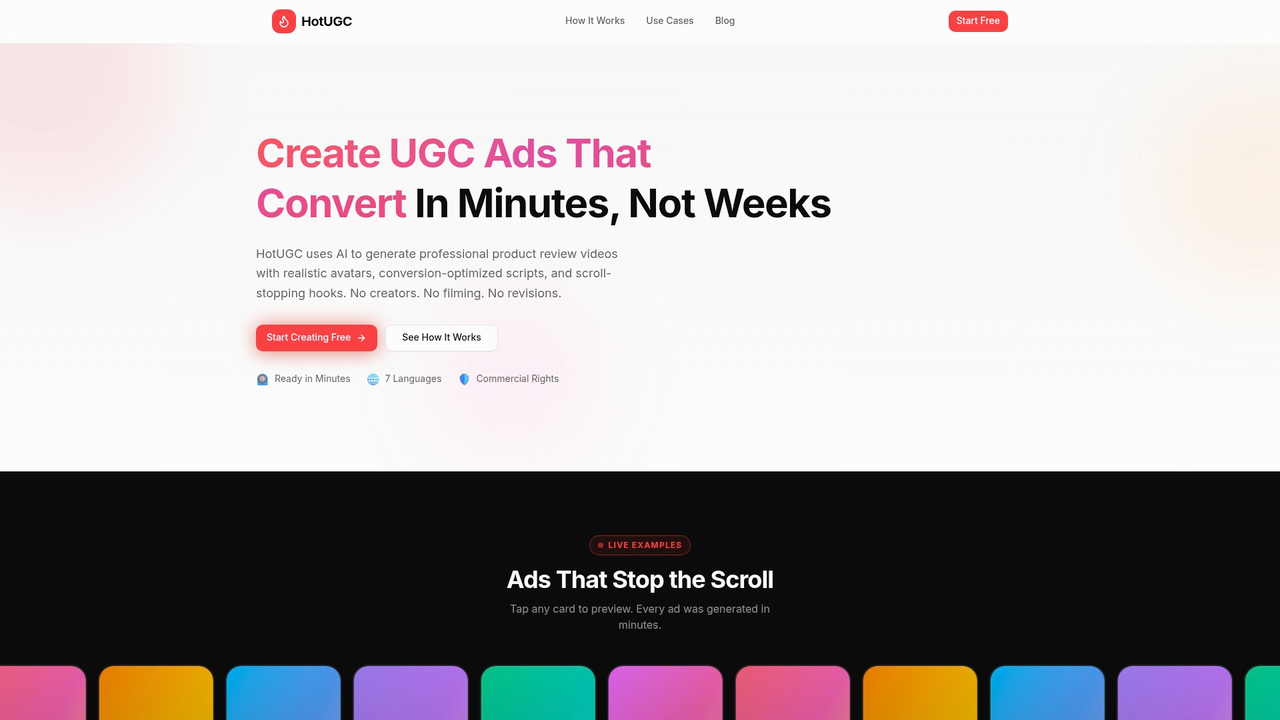
HotUGC helps e-commerce brands create high-performing, AI-generated UGC style videos in minutes. Realistic avatars, conversion-optimized scripts, multi-language support, and full commercial rights are built in. You can go from brief to finished video ad faster than most teams can schedule a production call. Explore the AI video ads guide to see how leading brands are putting these strategies into action today. The research is clear, the tools are ready, and the opportunity is now.
Frequently asked questions
What types of videos work best for e-commerce marketing in 2026?
Short-form product demos, AI-generated UGC clips, and shoppable social videos deliver the strongest results. Shopify merchants see 34% higher conversions when video is included in product listings.
How can I quickly create personalized videos for my online store?
AI tools let you generate dynamic UGC and personalized video messages for each customer segment at scale. AI-driven hyper-personalization boosts engagement up to 3x compared to generic video content.
Does adding video really increase sales?
Yes. E-commerce sites with product videos see 34% more conversions and 3.6x longer time on page compared to listings without video.
What’s the ideal video length for marketing in 2026?
Videos under one minute deliver the highest ROI and are best for capturing attention on social platforms and product pages.


