
Marketing avatars explained: boost UGC results in 2026
HotUGC
April 6, 2026 · 11 min read
Marketing avatars explained: boost UGC results in 2026

TL;DR:
- Effective marketing avatars are detailed, narrative profiles that include fears, desires, and routines.
- Avatars improve campaign relevance, guide creative direction, and enhance personalization at scale.
- Continuous updating and integration of avatar insights optimize UGC and digital marketing effectiveness.
Most e-commerce marketers treat customer avatars like a checkbox exercise. Fill in age, income, maybe a job title, and move on. But that approach leaves serious conversion potential on the table. A true marketing avatar is a narrative-driven character study that captures fears, desires, daily routines, and emotional triggers. When built correctly, avatars fuel ad relevance, sharpen UGC creator selection, and make every campaign feel like it was made specifically for the person watching it. This article breaks down what avatars really are, how they differ from personas and ICPs, and exactly how to use them to scale personalized marketing.
Table of Contents
- What is a marketing avatar and why does it matter?
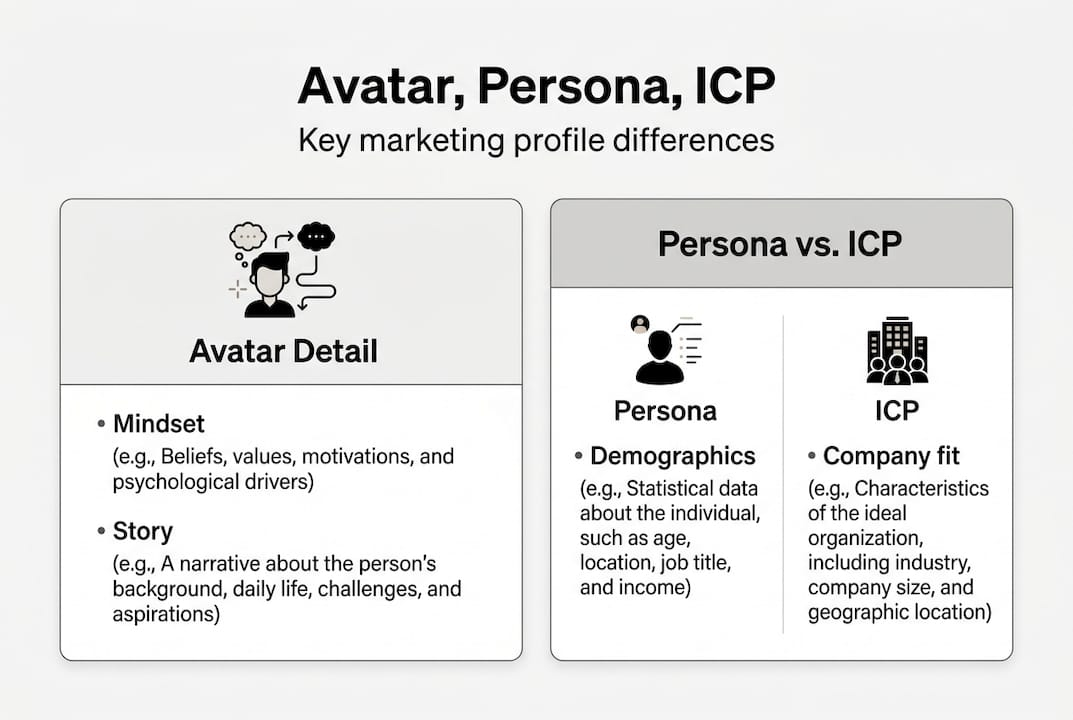
- Avatar vs. persona vs. ICP: Key differences for marketers
- How to build a marketing avatar: Research, structure, and iteration
- Applying avatars for personalized marketing and UGC at scale
- The overlooked power of avatars: More than a customer profile
- Supercharge your video marketing with avatar-driven UGC
- Frequently asked questions
Key Takeaways
| Point | Details |
|---|---|
| Avatars go beyond demographics | A true marketing avatar dives into mindset, routines, and emotional drivers—not just age or location. |
| More targeted UGC campaigns | Avatars help brands select creators and content that connect authentically with their audience. |
| Data-driven avatar creation | Effective avatars are built, validated, and refined using real customer insights and campaign results. |
| Dynamic, evolving profiles | Update your avatars regularly to reflect new market trends, data, and business goals. |
What is a marketing avatar and why does it matter?
Now that we’ve previewed the value of avatars, let’s break down what a marketing avatar truly is and how it can transform campaign success.
An avatar in marketing, specifically a customer avatar or buyer avatar, is a detailed, semi-fictional, narrative-driven profile of the ideal customer that extends beyond basic demographics into psychographics, fears, desires, daily routines, objections, and aspirations. That’s a mouthful, but the key word is narrative. Unlike a spreadsheet of data points, an avatar reads like a character profile from a story. You know what keeps this person up at night, what they scroll past, and what makes them click “buy now.”
Why does this depth matter for e-commerce marketers? Because shallow profiles produce shallow ads. When your creative team knows that your avatar is a 34-year-old mom who feels guilty about screen time but uses it to decompress after the kids go to bed, your ad copy writes itself. That emotional specificity is what separates a 2% CTR from a 6% CTR.
The avatar benefits for e-commerce are measurable. Avatars improve ad relevance scores, reduce creative iteration cycles, and give UGC campaigns a clear emotional direction. Here’s what a fully built avatar captures:
- Demographics: Age, location, income, family status
- Psychographics: Values, beliefs, lifestyle preferences
- Pain points: Specific frustrations your product solves
- Desires and aspirations: What success looks like for them
- Objections: Why they might not buy, and what overcomes those hesitations
- Daily routine: When and how they consume content
- Preferred channels: TikTok at 10pm vs. LinkedIn at 8am
“Think of a customer avatar as a character study for your marketing. The more vivid and specific the character, the more powerfully your message lands.”
Many marketers confuse avatars with general personas or ICPs (Ideal Customer Profiles). They’re related but not interchangeable. Understanding the difference, covered next, is what unlocks the real strategic value of building effective avatars for your campaigns.
Avatar vs. persona vs. ICP: Key differences for marketers
Understanding what sets an avatar apart is critical, but what about other common frameworks used by marketers? A direct comparison clarifies when and why each is valuable.
The three frameworks serve different purposes and operate at different levels of specificity. ICP defines company fit; Buyer Persona is profile-based on demographics and behaviors; Customer Avatar adds deeper psychographics and narrative for copywriting and emotional targeting. The recommended build order is ICP first, then Persona, then Avatar.
| Framework | Definition | Typical fields | Primary use case |
|---|---|---|---|
| ICP | Defines the ideal company or account fit | Industry, revenue, team size, tech stack | B2B targeting, account selection |
| Buyer persona | Semi-fictional profile based on demographics and behavior | Age, role, goals, challenges | Content strategy, sales enablement |
| Customer avatar | Narrative-driven profile with emotional and psychographic depth | Fears, desires, routines, objections, story | Ad copy, UGC direction, creative briefs |
For e-commerce, the avatar is the most actionable of the three for campaign work. A persona tells you who the customer is. An avatar tells you why they buy and how to speak to them emotionally. Check out persona examples to see how personas differ visually from the avatar format.
Here’s the recommended build sequence for e-commerce teams:
- Define your ICP: What type of customer drives the most revenue and retention?
- Build a persona: Layer in demographic and behavioral data from CRM and analytics.
- Develop the avatar: Add narrative depth using interviews, reviews, and social listening.
- Map the avatar to specific campaigns or product lines.
- Review and refine after each campaign cycle.
For customizing avatars for targeting, the avatar layer is where creative differentiation happens. It’s the difference between an ad that informs and one that converts.
Pro Tip: Most e-commerce brands need 3 to 5 distinct avatars to cover their primary customer types. B2B organizations often need even more to address different buying roles within a single account.
How to build a marketing avatar: Research, structure, and iteration
With the differences clear, the next step is translating theory into action. Here’s exactly how to build avatars that actually work in your campaigns.
The methodology to build a customer avatar follows a structured process: start with your ICP, research via interviews and CRM data, fill the avatar canvas, create before and after grids, then validate and iterate. Here’s how that plays out in practice:
- Start with your ICP. Pull your top 20% of customers by lifetime value. What do they have in common?
- Conduct qualitative research. Run 5 to 10 customer interviews. Ask about frustrations, goals, and what almost stopped them from buying.
- Mine your CRM and analytics. Identify behavioral patterns: pages visited, time to purchase, cart abandonment triggers.
- Analyze social media and reviews. Look at the exact language customers use in 1-star and 5-star reviews. This is copywriting gold.
- Fill the avatar canvas. Populate every field, including emotional and narrative layers.
- Validate with your team. Share with sales, support, and creative teams to pressure-test accuracy.
Here’s what a structured avatar looks like in practice:
| Avatar field | Example entry |
|---|---|
| Name (fictional) | “Busy Beth” |
| Age and location | 36, suburban Chicago |
| Income | $75,000/year household |
| Core frustration | No time to research purchases carefully |
| Primary desire | Trustworthy products that just work |
| Content habits | Instagram Reels, 8 to 10pm |
| Buying objection | “Is this actually worth the price?” |
| Emotional trigger | Social proof and relatable reviews |
When you customize video avatars for UGC-style ads, this level of detail directly informs which avatar style, tone, and script angle will resonate. Pair this with content best practices to ensure your creative execution matches the avatar’s media habits.
Pro Tip: Integrate the Jobs To Be Done (JTBD) framework into your avatar interviews. Ask customers, “What were you trying to accomplish when you found us?” The answers reveal motivations that no survey can capture.
Applying avatars for personalized marketing and UGC at scale
Now that you know how to build avatars, how do you apply them for maximum impact? Here’s exactly how UGC and digital campaigns benefit.
Avatars transform vague campaign briefs into precise creative direction. Instead of briefing a UGC creator with “make it feel authentic,” you hand them a one-page avatar summary. They immediately know the tone, the pain point to address, and the emotional payoff to deliver. That specificity collapses revision cycles and produces content that connects.
For UGC, avatars guide creator selection and content angles to boost authenticity and engagement. This means choosing creators who visually and tonally match your avatar, not just creators with large followings.
“UGC driven by avatar insights delivers better authenticity because it speaks directly to the emotional reality of the target customer, not just their demographics.”
Here are the key applications of avatars in UGC and campaign planning:
- Creator selection: Match creator demographics, lifestyle, and communication style to the avatar profile
- Script direction: Use the avatar’s exact language from reviews and interviews in ad scripts
- Channel prioritization: Deploy content on the platforms your avatar actually uses at the times they’re active
- Hook development: Build opening hooks around the avatar’s primary frustration or desire
- Ad testing: Use avatar segments to A/B test messaging angles and identify which emotional trigger converts best
- Campaign review: Evaluate performance through the lens of avatar alignment, not just surface metrics
For realistic avatar videos, the avatar profile also informs visual choices: skin tone, age presentation, setting, and energy level. Every detail should reflect the person your customer wants to see themselves in.

Avatars are not static documents. As campaigns generate data, feed that data back into your avatar profiles. Scaling UGC with avatars works best when the avatar evolves alongside your customer base, incorporating new behavioral signals every quarter.
The overlooked power of avatars: More than a customer profile
Conventional wisdom treats avatars as onboarding documents. Marketing teams fill them out during campaign kickoff, file them in a shared drive, and rarely revisit them. That’s a costly mistake.
The real power of an avatar is not in its creation. It’s in its continuous use as a creative and strategic lens. Winning marketing teams bring avatars into every brainstorm, every creative review, and every campaign debrief. They ask, “Would our avatar stop scrolling for this?” before any asset goes live.
There’s also a storytelling dimension that most teams ignore. Avatars contain the raw material for brand narratives that go beyond product features. When you know your avatar’s aspirations and emotional journey, you can build content that makes them feel understood, not just targeted. That’s the difference between a brand people buy from and a brand people advocate for.
Explore case studies on avatar usage to see how brands are putting this into practice at scale.
Pro Tip: Use your avatar as a springboard for quarterly creative innovation sessions. Ask your team: “What has changed in our avatar’s life in the last 90 days?” New pressures, trends, and platform behaviors create fresh angles for campaigns that feel timely and relevant.
Supercharge your video marketing with avatar-driven UGC
Ready to put avatars to work? See how leading e-commerce teams are driving results with the right tools.
Building a detailed avatar is only half the equation. The other half is executing on that insight at speed and scale. That’s where AI-generated UGC videos change the game for e-commerce marketers.

HotUGC lets you translate your avatar insights directly into high-performing video ads, without filming, editing, or hiring creators. You choose the avatar style that matches your customer profile, input the script angle informed by your avatar’s pain points, and produce professional UGC-style videos in minutes. With multi-language support and full commercial rights, you can run personalized campaigns across TikTok, Instagram, and Facebook at a fraction of traditional production costs. Learn exactly how to create AI avatars for videos and start turning avatar insights into conversions today.
Frequently asked questions
What is the difference between a marketing avatar and a persona?
A marketing avatar adds psychographic detail and narrative depth, including fears, desires, and emotional triggers, while a persona is mainly demographic and behavior-based. As noted in customer avatar research, avatars are built specifically for copywriting and emotional targeting.
Why are customer avatars important for UGC campaigns?
Avatars help marketers pick creators and messaging that resonate authentically with their target audience. Avatars guide creator selection and content angles to boost authenticity and engagement in every UGC campaign.
How often should you update your marketing avatar?
Update avatars regularly based on new campaign or customer data, ideally every 6 to 12 months. Continuous avatar updates with new data ensure your creative stays aligned with how your customer’s life and behavior evolve.
How many avatars does a typical e-commerce brand need?
Most brands should create 3 to 5 avatars to cover their primary customer types or buying roles. According to ICP and persona research, B2B organizations often need more to address different roles within a buying committee.


