
Realistic avatar videos: how brands engage and scale efficiently
HotUGC
March 29, 2026 · 10 min read
Realistic avatar videos: how brands engage and scale efficiently

Top e-commerce brands are now producing hundreds of ultra-realistic, AI-generated avatar video ads without a single camera, actor, or studio booking. Production timelines that once stretched across weeks now collapse into minutes. If you’ve assumed that realistic video ads require expensive crews and post-production budgets, the reality in 2026 looks very different. 80-90% realism is now achievable with AI-generated avatars, and the brands adopting this technology are pulling ahead fast. This guide covers what realistic avatar videos actually are, how the technology works, which pitfalls to avoid, and how to launch your first campaign.
Table of Contents
- What is a realistic avatar video?
- How do realistic avatar videos work?
- Stock avatars vs. custom avatars: Which should you choose?
- Addressing the uncanny valley: Common pitfalls and how to avoid them
- Why brands embrace realistic avatar videos in 2026
- Getting started: Steps to create your first realistic avatar video
- Drive results with ultra-realistic avatar video ads
- Frequently asked questions
Key Takeaways
| Point | Details |
|---|---|
| Avatar videos defined | Realistic avatar videos use AI to produce photorealistic digital humans for marketing without studios or actors. |
| How creation works | Natural scripts, TTS, lip-sync, and micro-expressions combine for a convincing final video. |
| Stock vs. custom | Stock avatars provide speed and scale, while custom avatars deliver authenticity and brand fit. |
| Overcoming pitfalls | Proper scripting and prompt engineering prevent the uncanny valley and boost engagement. |
| Brand adoption | Leading brands use avatars to test ads, boost engagement, and scale content efficiently. |
What is a realistic avatar video?
Now that we’ve set the stakes, let’s look at exactly what makes an avatar video ‘realistic’ and how it’s different from the animations or older digital spokespeople you may be imagining.
Realistic avatar videos are AI-generated videos featuring photorealistic digital humans that speak scripts with natural lip-sync, facial expressions, gestures, and voice synthesis. They are not cartoons or simple talking heads. They are designed to look and sound like real people presenting your product.
Here’s how they compare to traditional studio content:
| Feature | Traditional video | Realistic avatar video |
|---|---|---|
| Production time | 2-6 weeks | Minutes to hours |
| Cost per video | $2,000-$20,000+ | $10-$100 |
| Scalability | Low | High (hundreds of variants) |
| Language support | Limited | 100+ languages |
| Realism level | 100% (real human) | 80-90% |
| Revision speed | Days | Instant |
The core attributes that define a high-quality avatar video include:
- Facial realism: Skin texture, eye movement, and micro-expressions that mirror natural human behavior
- Accurate lip-sync: Mouth movements that match the spoken script precisely
- Natural gestures: Hand and body movements that reinforce the spoken message
- Voice synthesis: Emotional, context-aware audio that sounds human, not robotic
- Video resolution: 2K to 4K output suitable for paid social and display ads
Exploring the advantages of avatar videos for e-commerce makes it clear why adoption is accelerating across every product category.
How do realistic avatar videos work?
With a working definition in hand, it’s time to see how these ultra-realistic avatars come to life, step by step.
The AI avatar pipeline involves text-to-speech for emotional voice, lip-sync AI mapping, expression and motion modeling, and video rendering, all powered by GANs (generative adversarial networks), transformers, and neural voice cloning. Each stage builds on the last to produce a seamless, believable result.
Here is the step-by-step breakdown:
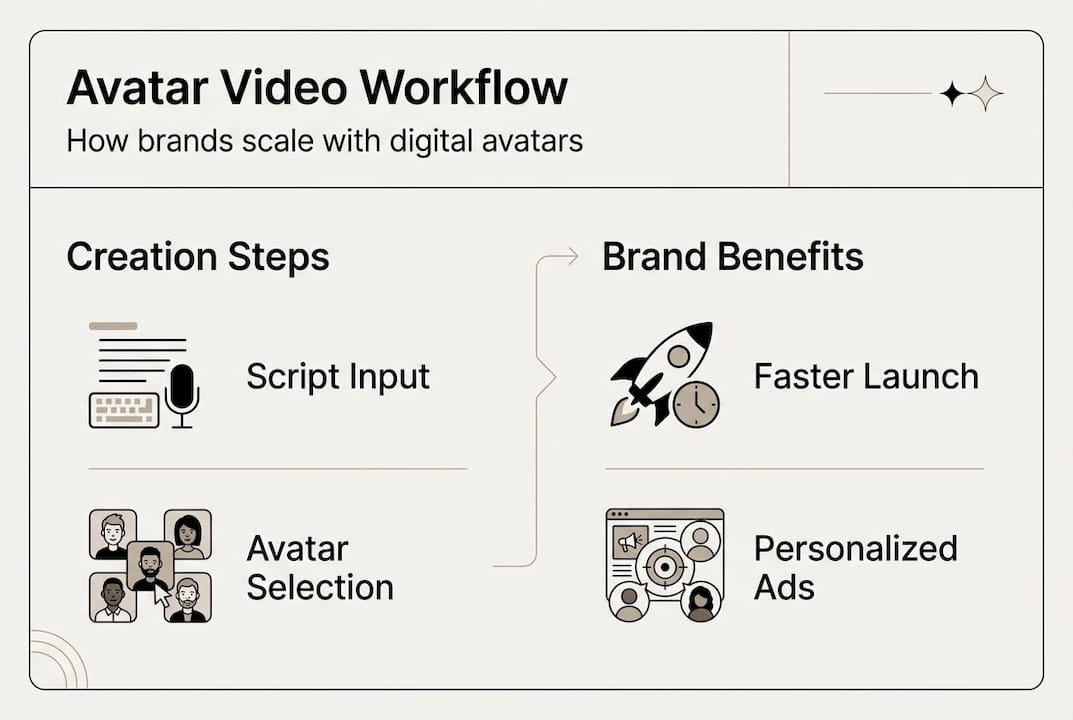
- Script input: You write or paste your ad script into the platform. The quality of this script directly shapes how natural the avatar sounds and feels.
- Text-to-speech (TTS): The platform converts your script into an emotional, human-like voice using neural voice cloning. Tone, pacing, and emphasis are all modeled.
- Lip-sync mapping: AI maps the audio waveform to the avatar’s mouth movements frame by frame, achieving near-perfect synchronization.
- Micro-expression modeling: The system applies facial expressions, eye blinks, and subtle head movements that match the emotional context of the script.
- Background rendering: A brand-appropriate environment is applied, whether a lifestyle setting, product backdrop, or branded studio look.
- Final video output: The platform renders the complete video, typically in 2K or 4K, ready for upload to TikTok, Instagram, or Facebook.
Leading platforms like Synthesia, HeyGen, and D-ID each handle this pipeline with slightly different strengths. You can see a detailed
Pro Tip: Write your scripts the way a real person would speak, using contractions, pauses, and natural phrasing. Stiff, formal copy produces stiff, formal avatars. Human-sounding input produces human-sounding output.
Stock avatars vs. custom avatars: Which should you choose?
Understanding the mechanics is crucial, but you also need to choose the right style of avatar for your brand. So how do you decide between stock and custom avatars?
Custom avatars require at least 30 seconds of personal video input but deliver greater authenticity and brand alignment. Stock avatars are faster and easier to deploy, making them ideal for high-volume campaigns where speed matters more than uniqueness.

| Factor | Stock avatars | Custom avatars |
|---|---|---|
| Setup time | Minutes | Hours to days |
| Brand alignment | Moderate | High |
| Authenticity | Lower | Higher |
| Scalability | Very high | High |
| Anti-deepfake security | Platform-level | Enhanced (personal consent) |
| Best for | Volume testing, launches | Brand storytelling, loyalty |
Pro Tip: Start with stock avatars to test messaging and creative angles quickly. Once you identify your top-performing scripts, invest in a custom avatar to reinforce brand identity at scale. You can learn more about how to customize video avatars and review the full breakdown of AI avatars vs. real creators to make a confident decision.
Addressing the uncanny valley: Common pitfalls and how to avoid them
Now that you’ve chosen your avatar type, make sure it’s as believable and effective as possible by sidestepping the uncanny valley. Here’s what most marketers miss.
The uncanny valley refers to the discomfort viewers feel when a digital human looks almost real but not quite. It’s a real conversion killer. The good news is that prompt engineering and emotion-specific scripting can mitigate this effect, and new tools now achieve 98%+ lip-sync accuracy with over 200 micro-expressions available.
The most common pitfalls include:
- Mismatched emotion: The avatar’s facial expression doesn’t match the tone of the script. A cheerful voice paired with a neutral face reads as robotic.
- Overused gestures: Repetitive hand movements or head nods that appear in every sentence break the illusion of natural behavior.
- Generic backgrounds: A plain white wall or stock office setting signals low production value and reduces viewer trust.
- Flat, formal scripts: Copy written for print ads doesn’t translate well to spoken avatar delivery.
“The difference between an avatar that converts and one that doesn’t often comes down to the script. Emotion-driven, conversational copy is the single biggest lever you control.”
Practical fixes are straightforward. Specify the emotional tone in your prompt, for example, ‘enthusiastic but calm’ or ‘warm and reassuring.’ Choose backgrounds that match your product’s lifestyle context. Review the video content best practices to align your avatar ads with proven creative frameworks.
Why brands embrace realistic avatar videos in 2026
Successful implementation is more than avoiding pitfalls. Here’s why top brands are leaning into this new wave of video marketing and the measurable results they’re seeing.
The avatar video market is projected at $9.5B by 2026, with HeyGen and Synthesia leading adoption among e-commerce brands scaling ads, testing variants, and boosting customer lifetime value efficiently.
Here’s what brands are actually doing with this technology:
- Rapid ad variant testing: Produce 20 to 50 script variations in a single day to identify top performers before scaling spend
- Personalized product messaging: Tailor avatar scripts by audience segment, geography, or funnel stage without reshooting
- Multi-language campaigns: Launch the same ad in 10 or more languages simultaneously using the same avatar and visual assets
- Always-on content: Maintain a consistent posting cadence on TikTok and Instagram without relying on creator availability
- Cost reduction: Cut video production costs by up to 90% compared to traditional studio shoots
The avatar video marketing workflow used by leading brands integrates avatar creation directly into their paid social pipeline. Pair this with the video ads optimization guide and the case for automation for video ads becomes impossible to ignore.
Getting started: Steps to create your first realistic avatar video
Ready to take action? Here’s a field-tested workflow you can use to produce and deploy high-quality avatar video ads this quarter.
Platforms like Synthesia and HeyGen let brands rapidly prototype and launch avatar videos for e-commerce ads with built-in anti-deepfake measures, making them a safe and scalable starting point.
- Choose your platform: Evaluate Synthesia, HeyGen, or HotUGC based on your budget, language needs, and avatar customization requirements.
- Select your avatar type: Start with a stock avatar for speed, or upload 30 seconds of footage to create a custom avatar for brand-specific campaigns.
- Write a conversion-focused script: Keep it under 60 seconds, open with a strong hook, address one core pain point, and close with a clear call to action. Write it the way you’d say it out loud.
- Generate and review your video: Run the first render and check lip-sync accuracy, emotional tone, and background fit. Most platforms allow instant revisions.
- Test and measure: Launch two to three variants with different hooks or CTAs. Track click-through rate, watch time, and conversion rate to identify your winner.
- Iterate at scale: Use your top-performing script as a template and produce localized or segmented versions to expand reach without additional production cost.
The full video ad workflow steps guide provides a detailed checklist for each stage, including platform settings and measurement benchmarks.
Pro Tip: Always A/B test your avatar’s opening hook before scaling. The first three seconds determine whether viewers keep watching, and a small change in phrasing can double your completion rate.
Drive results with ultra-realistic avatar video ads
For brands serious about scaling personalized video content, the right platform makes all the difference. You now have the framework to understand, build, and optimize realistic avatar video ads. The next step is putting it into practice with a tool built specifically for this purpose.

HotUGC gives e-commerce marketing managers and brand owners everything they need to produce UGC-style avatar video ads in minutes, not weeks. The platform handles script generation, avatar selection, multi-language output, and commercial licensing in one streamlined workflow. No filming, no editing, no creator coordination. Whether you’re launching a new product or scaling a proven campaign, HotUGC lets you move fast, test often, and grow your ad library without growing your production budget.
Frequently asked questions
How realistic can AI avatar videos get compared to real humans?
Current avatar technology achieves 80-90% naturalness in facial expressions, voice, and gestures, making them nearly indistinguishable from real presenters in short-form ad formats.
What platforms are best for creating realistic avatar videos in 2026?
Synthesia and HeyGen lead the field in realism, security, and adoption for branded video ads, with D-ID offering strong options for specialized use cases.
Are custom avatars better than stock avatars for brand ads?
Custom avatars offer greater authenticity and brand fit but require personal input footage, while stock avatars are the faster choice for large-scale, lower-touch campaigns.
How do I avoid the uncanny valley in my avatar videos?
Write conversational, emotion-driven scripts, specify the avatar’s tone in your prompt, and choose backgrounds that match your product’s lifestyle context. Prompt engineering is the most effective tool for closing the realism gap.


