
Master scriptwriting for video ads: boost conversions
HotUGC
March 26, 2026 · 11 min read
Master scriptwriting for video ads: boost conversions

Writing video ad scripts that actually convert feels like hitting a moving target. You craft what seems like the perfect message, but engagement falls flat and sales don’t follow. The challenge isn’t just finding the right words, it’s understanding what makes viewers stop scrolling, watch through, and click that buy button. This guide reveals proven scriptwriting techniques powered by AI innovation that transform how e-commerce marketers create high-converting video ads. You’ll discover actionable strategies to craft compelling scripts, leverage cutting-edge AI tools, and avoid common pitfalls that sink conversion rates.
Table of Contents
- Key takeaways
- Understanding scriptwriting essentials for video ads
- Preparing your scriptwriting toolkit with AI-powered solutions
- Step-by-step process to craft high-converting video ad scripts
- Common pitfalls and verification methods for video ad scripts
- Explore HotUGC’s AI video ad solutions
- Frequently asked questions about scriptwriting for video ads
Key Takeaways
| Point | Details |
|---|---|
| Clear objectives | Define the exact action you want viewers to take before drafting the script. |
| Precise audience | Know the audience pain points and motivations to tailor messages. |
| Lead with benefits | Prioritize the strongest benefit first and include authentic social proof to build trust. |
| Urgent call to action | End with a direct call to action and include specific, quantifiable claims when possible. |
| AI driven efficiency | AI tools analyze high performing ads to generate tailored scripts and enable rapid iteration. |
Understanding scriptwriting essentials for video ads
Successful video ad scripts start with crystal clear objectives. You need to know exactly what action you want viewers to take, whether that’s making a purchase, signing up for emails, or exploring your product catalog. Without this foundation, even the most creative scripts miss their mark.
Defining your target audience goes beyond basic demographics. You must understand their specific pain points, shopping behaviors, and what motivates them to make purchasing decisions. A script that resonates with busy parents looks completely different from one targeting tech enthusiasts or fashion-forward millennials.
Message clarity separates winning scripts from forgettable ones. E-commerce shoppers scroll fast and decide faster. Your script must communicate the core value proposition within the first three seconds or risk losing attention forever. Improving script effectiveness directly impacts your ability to capture and convert viewers.
Storytelling elements create emotional connections that pure product descriptions can’t match. Viewers remember stories about how products solve real problems or improve daily life. These narratives transform generic advertisements into relatable content that builds trust and drives action.
Prioritizing key product benefits early ensures your strongest selling points land before viewer attention drops. Consider these essential scriptwriting elements:
- Lead with the most compelling benefit that addresses your audience’s primary pain point
- Use specific, quantifiable claims rather than vague promises about quality or value
- Include authentic social proof elements that demonstrate real customer satisfaction
- Create urgency through limited-time offers or scarcity messaging when appropriate
- End with an unmistakable call to action that tells viewers exactly what to do next
The structure you choose impacts how effectively your message lands. Short-form video ads need tighter pacing and faster benefit delivery compared to longer educational content. Match your script structure to platform requirements and audience expectations for maximum video ad conversion optimization.

Preparing your scriptwriting toolkit with AI-powered solutions
AI platforms revolutionize how marketers approach video ad scriptwriting. These tools analyze thousands of high-performing ads to identify patterns that drive conversions, then apply those insights to generate scripts tailored to your specific products and audience. The technology eliminates guesswork and accelerates the creative process dramatically.
Audience engagement data becomes actionable through AI analysis. Instead of relying on intuition about what messaging might work, you can leverage machine learning algorithms that process viewer behavior, engagement metrics, and conversion patterns. This data-driven approach produces scripts optimized for your exact target demographic.
Workflow efficiency improves substantially when AI handles repetitive scriptwriting tasks. You can generate multiple script variations in minutes, test different hooks and calls to action, and iterate based on performance data without starting from scratch each time. This speed advantage lets you stay ahead of market trends and competitor messaging.
Budget savings from AI-generated UGC videos cutting costs by up to 90% while increasing CTR by 5x make the technology accessible even for smaller e-commerce operations. Traditional video production requires significant investment in creators, filming, and editing. AI eliminates these expenses while maintaining professional quality.
Integrating AI early in your planning process maximizes creative options and strategic flexibility. Consider these implementation strategies:
- Start with AI-generated script templates that match your campaign objectives and refine them with brand-specific messaging
- Use AI tools to analyze competitor video ads and identify gaps in their messaging you can exploit
- Generate multiple script versions targeting different customer segments simultaneously for A/B testing
- Leverage AI sentiment analysis to predict how audiences will respond to specific messaging approaches
- Combine AI scriptwriting with automated video generation for complete end-to-end production
Pro Tip: Feed your AI tools with your best-performing historical ad data to train them on what works specifically for your brand and audience. This customization produces better results than generic templates.
The right HotUGC AI solutions provide not just script generation but complete video ad creation with realistic avatars, optimized hooks, and conversion-focused structures. This comprehensive approach ensures every element of your video ad works together to drive results.
Step-by-step process to craft high-converting video ad scripts
Your hook determines whether viewers watch or scroll past. The first three seconds must grab attention with a provocative question, surprising statistic, or bold claim that speaks directly to your audience’s desires or pain points. Generic openings like “Check out our product” fail instantly.
Developing the body requires focusing relentlessly on product benefits rather than features. Viewers don’t care about technical specifications until you’ve shown how those specs improve their lives. Layer in social proof through customer testimonials, user counts, or impressive results to build credibility and overcome skepticism.
Your call to action needs absolute clarity. Tell viewers exactly what to do next using specific action verbs and removing any friction from the conversion process. “Shop now and get 20% off” outperforms vague endings like “Learn more” because it creates urgency and clear next steps.
AI feedback loops accelerate optimization by analyzing script performance and suggesting improvements based on engagement data. You can test variations systematically rather than guessing what changes might improve results. This video ad workflow for e-commerce success delivers consistent improvement over time.
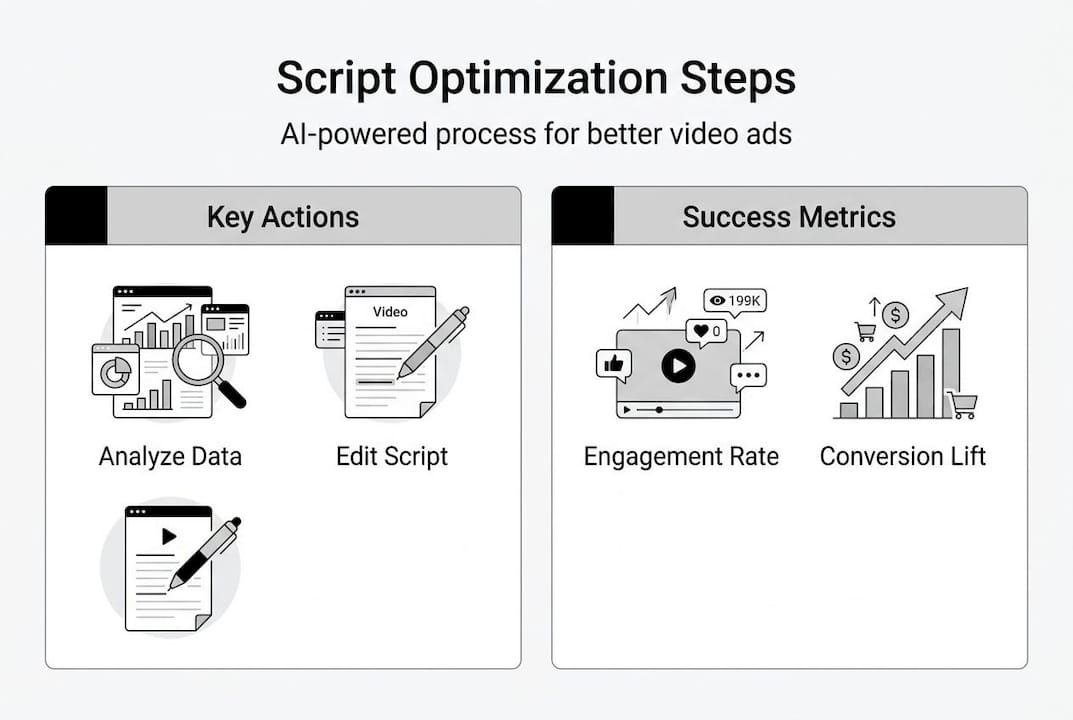
| Step | Timeline | Key Tasks | Success Metrics |
|---|---|---|---|
| Research & Planning | Day 1-2 | Analyze audience data, review competitor ads, define objectives | Clear target audience profile and conversion goal |
| Hook Development | Day 2-3 | Create 5-10 attention-grabbing opening options, test with sample audience | Hook that stops scroll within 1 second |
| Body Scripting | Day 3-5 | Write benefit-focused content, integrate social proof, structure for platform | Script maintains engagement through entire duration |
| CTA Optimization | Day 5-6 | Test multiple call-to-action variations, ensure clarity and urgency | Clear next step with minimal conversion friction |
| AI Review & Iteration | Day 6-7 | Run scripts through AI analysis, implement data-driven improvements | Predicted engagement scores above benchmark |
| Final Testing | Day 7-8 | A/B test top script versions with small audience sample | Identify winning script based on actual conversion data |
Pro Tip: Create separate script versions for cold audiences who’ve never heard of your brand versus warm audiences already familiar with your products. The messaging strategy differs significantly between these groups.
Testing multiple script versions targeting different customer segments reveals insights about what messaging resonates most powerfully. You might discover that emphasizing convenience converts better than price savings, or that emotional storytelling outperforms logical benefit lists. Let data guide your creative decisions rather than assumptions.
Common pitfalls and verification methods for video ad scripts
Information overload kills conversions faster than almost any other mistake. Marketers often try cramming every product feature, benefit, and selling point into a single script. Viewers tune out when overwhelmed. Focus on one core message and support it powerfully rather than diluting impact with scattered claims.
Call to action clarity suffers when scripts end ambiguously or offer too many options. “Visit our website, follow us on social media, or check out our blog” confuses viewers about what action matters most. Single, specific CTAs convert significantly better than multiple competing requests.
Brand voice consistency ensures your video ads feel authentic and aligned with your overall marketing presence. Scripts that sound generic or mismatched with your brand personality create disconnect and erode trust. Your video ad voice should match the tone customers experience across your website, emails, and other touchpoints.
AI analytics tools review script engagement predictions before you invest in full production. These platforms simulate how audiences will likely respond based on linguistic patterns, emotional triggers, and structural elements proven to drive conversions. This video ads optimization approach prevents expensive mistakes.
| Verification Method | Manual Approach | AI-Driven Approach |
|---|---|---|
| Script Review Time | 2-3 hours per script | 5-10 minutes per script |
| Engagement Prediction | Based on intuition and past experience | Data analysis of thousands of similar ads |
| Optimization Suggestions | Limited to reviewer’s knowledge | Comprehensive recommendations from pattern recognition |
| Cost | Internal time or consultant fees | Automated platform subscription |
| Accuracy | Variable, depends on reviewer expertise | Consistent, improves with more data |
| Scalability | Difficult to review many variations | Easily handles dozens of script versions |
Critical testing steps before publishing ensure your scripts perform as expected:
- Read scripts aloud to catch awkward phrasing or unnatural language that looks fine written but sounds wrong spoken
- Test scripts with a small sample audience representing your target demographic to gather qualitative feedback
- Verify all claims are accurate and supportable to avoid credibility issues or legal problems
- Check script timing against platform requirements to ensure it fits within optimal length parameters
- Confirm the call to action links to the correct landing page and that page is optimized for conversions
- Review scripts for inclusive language that doesn’t accidentally alienate segments of your audience
Verification catches problems before they waste advertising budget. A script that tests poorly in review will perform poorly in market. Investing time in thorough validation saves money and protects your brand reputation.
Explore HotUGC’s AI video ad solutions
After mastering scriptwriting fundamentals and optimization strategies, you need tools that turn knowledge into action efficiently. HotUGC’s AI-generated UGC videos automate the entire video ad creation process from script development through final production. The platform generates professional product review videos featuring realistic avatars and conversion-optimized scripts in minutes rather than weeks.
E-commerce marketers using HotUGC eliminate traditional production bottlenecks that slow campaign launches and limit testing capacity. You can create dozens of video ad variations tailored to different audience segments, products, or promotional angles without the cost and complexity of hiring creators or managing filming schedules. The AI handles scriptwriting, avatar selection, and video assembly while you focus on strategy and optimization. This approach delivers the authentic UGC style that performs exceptionally well on social platforms while maintaining complete creative control and commercial rights for all your marketing campaigns.
Frequently asked questions about scriptwriting for video ads
What is the ideal length for video ad scripts?
Video ad script length depends on platform and campaign objective. For social media platforms like TikTok and Instagram, scripts should support 15-30 second videos that deliver your core message quickly. Longer 60-90 second scripts work for YouTube or Facebook when you need more time to explain complex products or build emotional narratives. The key is matching script length to viewer attention spans on each platform rather than forcing a one-size-fits-all approach.
How can AI improve video ad scriptwriting?
AI analyzes thousands of high-performing video ads to identify linguistic patterns, emotional triggers, and structural elements that drive conversions. It generates scripts optimized for your specific audience and product based on this data rather than guesswork. AI also accelerates iteration by producing multiple script variations instantly and predicting which versions will perform best before you spend money on production or advertising.
What are key elements to include in video ad scripts?
Every effective video ad script needs a hook that grabs attention in the first three seconds, a body focused on specific product benefits rather than features, authentic social proof that builds credibility, and a clear call to action telling viewers exactly what to do next. The script should speak directly to your target audience’s pain points and desires using conversational language that feels natural when spoken by your video talent or avatar.
How often should scripts be tested and optimized?
Test new script variations whenever you launch campaigns for different products, target new audience segments, or notice declining performance from existing ads. Continuous optimization means reviewing engagement metrics weekly and making data-driven adjustments to hooks, benefit messaging, or calls to action based on what the numbers reveal. Markets and audience preferences shift constantly, so scripts that worked brilliantly six months ago may need refreshing to maintain peak performance.
Are UGC-style scripts more effective for e-commerce?
UGC-style scripts consistently outperform traditional advertising scripts for e-commerce because they feel authentic rather than salesy. Viewers trust content that looks like real customer reviews more than polished corporate messaging. These scripts use conversational language, focus on genuine product experiences, and create relatable scenarios that help potential customers envision themselves using and benefiting from your products. The authentic approach reduces skepticism and increases conversion rates across most e-commerce categories.

