
Multi-language video ads: Why ecommerce managers need them
HotUGC
March 24, 2026 · 12 min read
Multi-language video ads: Why ecommerce managers need them

Global ecommerce brands often assume English video ads reach everyone effectively. Research proves otherwise: localized video ads outperform English-only content by massive margins in non-English markets, delivering up to 4.5 times higher conversion rates. Multi-language video ads adapt messaging culturally and linguistically, transforming how international audiences engage with your products. This guide reveals how these ads work, their proven impact on ecommerce metrics, cultural challenges to navigate, and actionable strategies to implement them successfully using scalable AI tools.
Table of Contents
- Key takeaways
- What are multi-language video ads and how do they work?
- The impact of multi-language video ads on ecommerce performance
- Navigating cultural nuances and challenges in multilingual video ads
- Applying multi-language video ads for maximum ecommerce impact
- Explore HotUGC’s AI tools to scale your multi-language video ads
- Frequently asked questions about multi-language video ads
Key Takeaways
| Point | Details |
|---|---|
| Localized ads outperform English | Localized multi language video ads deliver substantially higher conversions and engagement in non English markets. |
| AI enables scalable production | Artificial intelligence speeds up translation, voiceover generation, subtitling, and visual adaptation while quality is safeguarded by human review. |
| Final native quality gate | Always include native speaker review as the final quality gate even when using AI. |
| Start with high potential markets | Businesses should begin deploying these ads in markets with the greatest growth potential to maximize impact. |
What are multi-language video ads and how do they work?
Multi-language video ads combine translation, dubbing, subtitles, and cultural localization to reach global audiences and increase ecommerce conversions. Unlike simple translation, these ads require deep adaptation of messaging, visual elements, and delivery formats to resonate authentically with diverse cultural contexts. For ecommerce marketing managers, understanding this distinction separates campaigns that feel foreign from those that drive genuine engagement.
The mechanics involve several coordinated stages. The creation process includes base video production, script translation or transcreation, voiceover and subtitle generation, visual adaptation, and quality assurance by native speakers. Each stage requires careful attention to maintain brand consistency while honoring local preferences. Modern AI video ads streamline this workflow dramatically, reducing production timelines from weeks to hours.
Here’s how the production process unfolds:
- Create your base video with clear messaging and strong visual storytelling that translates across cultures
- Transcreate the script rather than translate literally, adapting idioms, humor, and emotional appeals for each target market
- Generate culturally appropriate voiceovers using native speakers or advanced AI voices that match regional accents and speech patterns
- Add subtitles formatted correctly for reading speed and text direction, especially for right-to-left languages
- Adapt visual elements including on-screen text, graphics, and even product positioning to align with cultural norms
- Conduct thorough quality assurance with native speakers who understand both language nuances and cultural sensitivities
AI technologies accelerate each stage while maintaining quality standards. Platforms can generate AI avatars for UGC videos that represent diverse demographics authentically. Neural machine translation handles initial script conversion, while text-to-speech engines produce natural voiceovers in dozens of languages. Computer vision tools identify and replace text within video frames automatically.
Pro Tip: Always include native speaker review as your final quality gate, even when using advanced AI tools. Cultural consultants catch subtle missteps that algorithms miss, like unintended double meanings or gestures that carry negative connotations in specific regions.
The investment pays off through dramatically improved engagement. When viewers encounter ads in their native language with culturally relevant messaging, they process information faster, trust brands more readily, and convert at significantly higher rates. The technical complexity becomes manageable when you leverage the right AI video ad localization tools combined with human cultural expertise.
The impact of multi-language video ads on ecommerce performance
The performance data tells a compelling story. Tree Hut’s bilingual ads achieved 2.5x branded search lift, 3x detail page views, and 1.75x purchase rate compared to English-only campaigns targeting the same demographics. These aren’t marginal gains. They represent transformational improvements that directly impact revenue and market share in competitive ecommerce environments.
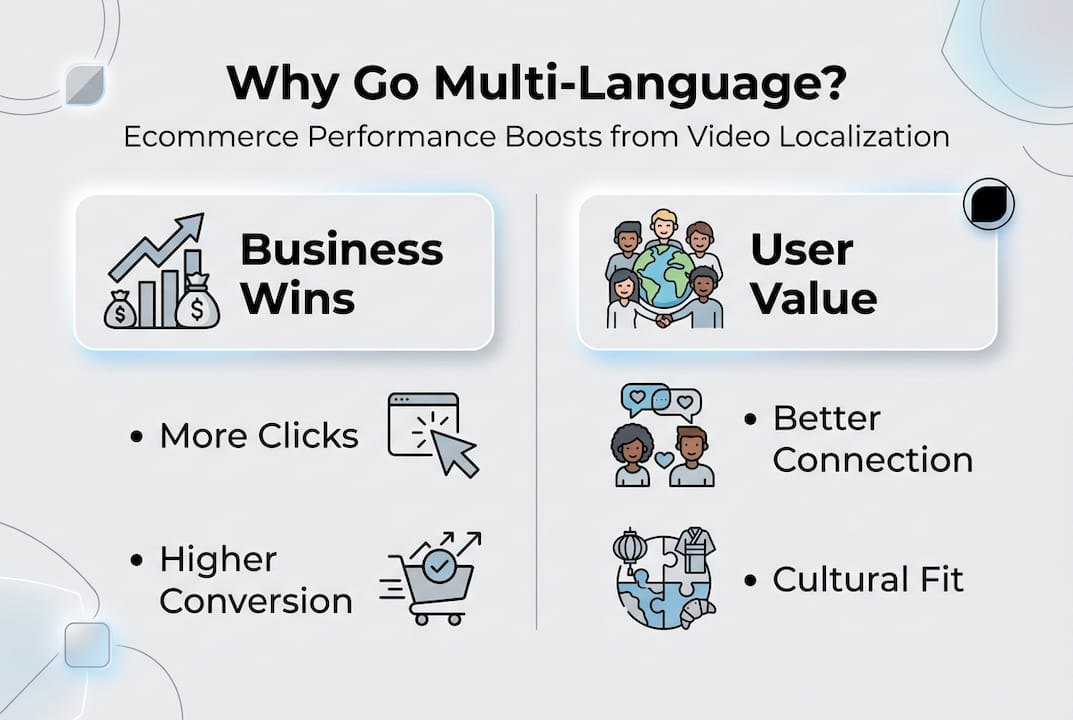
Another striking example comes from language learning. Rosetta Stone localized ads delivered 13% higher click-through rate, 9% sales increase, and 5x return on ad spend across international markets. The pattern repeats across industries: native language content dramatically outperforms English alternatives in non-English markets, even among audiences with strong English proficiency.
Consider these proven performance improvements:
- Conversion rates increase up to 4.5 times when ecommerce sites offer native language experiences
- Customer acquisition costs drop 30 to 40 percent due to higher engagement and lower bounce rates
- Average order values rise 20 percent as customers feel more confident making purchase decisions
- Return rates decrease when product information communicates clearly in the buyer’s native language
- Brand recall improves 65 percent compared to English-only advertising in multilingual markets
| Metric | English-Only Performance | Localized Performance | Improvement |
|---|---|---|---|
| Click-through rate | Baseline | +13% to +25% | Significant lift |
| Conversion rate | Baseline | +75% to +350% | Transformational |
| Return on ad spend | Baseline | +400% to +500% | Exceptional ROI |
| Customer lifetime value | Baseline | +35% to +50% | Long-term gains |
The underlying psychology explains these numbers. Seventy-six percent of online shoppers prefer purchasing products with information in their native language. Sixty percent rarely or never buy from English-only websites when alternatives exist in their language. This preference intensifies for complex products requiring detailed specifications or instructions.
“Customers are six times more likely to purchase from websites in their native language, even if they speak English fluently. Language shapes trust and confidence in ways that transcend pure comprehension.”
For video ads in ecommerce, localization amplifies the medium’s inherent advantages. Video already boosts conversion rates significantly. When you combine video’s visual storytelling power with native language narration and culturally adapted messaging, you create an unstoppable engagement engine. The video ad engagement results speak clearly: localized video content generates 80 percent more shares and 120 percent longer viewing times than English equivalents in international markets.
Smart ecommerce managers recognize these numbers represent competitive advantages. While competitors stick with English-only campaigns, localized video ads capture market share, build brand loyalty, and establish authentic connections with global audiences hungry for content that speaks directly to them.
Navigating cultural nuances and challenges in multilingual video ads
Successful localization requires far more than accurate translation. Literal translation often fails because transcreation ensures cultural fit and avoids pitfalls like humor mismatches and taboo subjects. What works brilliantly in one market can offend or confuse in another. Cultural intelligence separates effective campaigns from expensive mistakes.

Consider color symbolism. White represents purity in Western markets but signifies mourning in many Asian cultures. Red conveys excitement in the United States but carries political connotations in other regions. Hand gestures pose similar risks: a thumbs-up seems universally positive until you discover it’s offensive in parts of the Middle East and Latin America. These details matter enormously in video content best practices.
Humor presents particularly tricky challenges. Wordplay, sarcasm, and cultural references rarely translate effectively. A joke that kills in English might land flat or cause confusion when adapted literally. Successful transcreation reimagines the emotional intent rather than preserving the exact words, creating equivalent impact through culturally appropriate means.
Regional preferences for content delivery vary significantly:
- Dubbing dominates in Germany, Spain, Italy, and France where audiences expect full audio localization
- Subtitles work better in Scandinavian countries, Netherlands, and Portugal where viewers prefer original audio
- Latin American markets split between dubbing preference in larger countries and subtitle acceptance in smaller markets
- Asian markets show mixed preferences, with Japan and South Korea favoring dubbing while Singapore accepts subtitles
| Region | Preferred Format | Cultural Reason | Production Consideration |
|---|---|---|---|
| Western Europe | Dubbing | Strong dubbing tradition in media | Invest in quality voice actors |
| Northern Europe | Subtitles | High English proficiency, prefer authenticity | Focus on subtitle timing and readability |
| Latin America | Dubbing | Expect localized audio experience | Use regional Spanish/Portuguese variants |
| Middle East | Dubbing + RTL layout | Right-to-left text requires layout changes | Mirror visual elements appropriately |
Right-to-left languages like Arabic and Hebrew require complete visual restructuring. Text overlays, graphic elements, and even the direction of visual movement need reversal to feel natural. Failing to adapt these elements creates jarring experiences that undermine your message’s credibility.
Legal compliance adds another complexity layer. Advertising regulations vary by region, with some countries restricting comparative claims, others requiring specific disclaimers, and many enforcing strict rules around health, beauty, or child-related products. What’s permissible advertising in the United States might violate regulations in the European Union or Australia.
Pro Tip: Involve native cultural consultants during the creative concepting phase, not just during final review. Early input prevents costly redesigns and ensures your core concept will resonate across all target markets before you invest in full production.
The good news? Automating video ads with AI tools handles many technical localization challenges efficiently, freeing your team to focus on strategic cultural decisions that truly differentiate your campaigns. The technology manages subtitle synchronization, voice matching, and visual adaptations while humans ensure cultural authenticity and regulatory compliance.
Applying multi-language video ads for maximum ecommerce impact
Implementing multi-language video ads strategically requires a measured approach that balances ambition with practical resource constraints. Ecommerce managers should prioritize AI-powered scalable production to reduce costs by 75%, start with high-potential markets, and include native quality assurance. This framework ensures you invest wisely while building organizational capabilities for global expansion.
Follow this implementation roadmap:
- Analyze your customer data to identify markets with highest growth potential, considering both current revenue and untapped opportunity
- Select two to three priority languages representing your most valuable international segments rather than attempting broad coverage initially
- Audit existing video assets to determine which campaigns justify localization investment based on performance and evergreen relevance
- Partner with AI localization platforms that offer end-to-end workflows from translation through native speaker review
- Create localized versions systematically, testing different approaches like dubbing versus subtitles to learn market preferences
- Launch campaigns with robust tracking across the full funnel, measuring not just clicks but engagement depth, conversion rates, and customer lifetime value
- Iterate based on performance data, expanding to additional languages as you prove ROI and refine your localization process
Timing matters enormously. Localizing early in the creative process delivers best return on investment because you can design core creative concepts with cultural adaptation in mind. When localization becomes an afterthought, you often discover your original concept doesn’t translate effectively, forcing expensive rework or compromised results.
AI technology makes scalable production realistic for mid-market ecommerce brands, not just enterprise giants. Modern platforms automate video ads to cut costs while maintaining quality standards that rival traditional production. You can generate multiple language variants from a single base video, test different cultural adaptations quickly, and optimize based on real performance data rather than assumptions.
Avoid these common implementation pitfalls:
- Treating localization as pure translation without cultural adaptation
- Skipping native speaker review to save costs, only to launch culturally tone-deaf campaigns
- Localizing low-performing English content instead of your proven winners
- Measuring only vanity metrics like views rather than business outcomes like video ad conversion optimization
- Attempting too many languages simultaneously before proving your localization process works
- Ignoring regional platform preferences, like WeChat in China or LINE in Japan
- Using identical creative concepts across markets without testing cultural resonance
Measurement requires comprehensive thinking. Track metrics across the entire customer journey: initial engagement through effective video ad hooks, mid-funnel consideration behaviors, conversion events, and post-purchase satisfaction. Localized content should improve performance at every stage, not just drive more clicks.
Pro Tip: In some markets, maintaining English in your ads carries symbolic value signaling premium quality or international credibility. Test both fully localized and hybrid approaches where English brand names or taglines remain while product descriptions use native language. Data will reveal which strategy resonates with your specific audience.
The competitive landscape rewards early movers. As more ecommerce brands recognize localization’s impact, costs for quality native talent and premium AI tools will likely rise. Managers who build localization capabilities now gain experience advantages and market positioning that become increasingly difficult for competitors to match. Start with manageable scope, learn systematically, and scale based on proven results rather than assumptions.
Explore HotUGC’s AI tools to scale your multi-language video ads
Creating culturally authentic video ads for multiple markets no longer requires massive production budgets or months of timeline. HotUGC’s AI-generated UGC videos deliver professional multi-language video ads in minutes, not weeks. The platform combines realistic avatars, conversion-optimized scripts, and native language support to help ecommerce marketing managers scale global campaigns efficiently.
You can generate videos featuring diverse avatars that represent your target demographics authentically, with scripts automatically adapted for cultural relevance and persuasive impact. The platform handles technical localization challenges while you focus on strategic decisions about market prioritization and messaging. Commercial rights come standard, so you own every video for unlimited use across TikTok, Instagram, Facebook, and other channels.
Explore the complete AI video ads guide for 2026 to discover how leading ecommerce brands leverage AI to compete globally without enterprise budgets. Whether you’re testing your first international market or scaling to dozens of languages, HotUGC provides the tools and workflows to execute confidently.
Frequently asked questions about multi-language video ads
What exactly are multi-language video ads?
Multi-language video ads are marketing videos adapted for different linguistic and cultural markets through translation, dubbing, subtitles, and cultural localization. They go beyond simple translation to ensure messaging resonates authentically with each target audience while maintaining brand consistency.
How much do multi-language video ads typically cost?
Traditional localization costs $50 to $200 per minute of video content per language, but AI-powered platforms reduce costs by 75 percent or more. Total investment depends on video length, number of languages, whether you use dubbing or subtitles, and quality assurance requirements.
Can AI really handle cultural nuances in video localization?
AI excels at technical tasks like translation, subtitle synchronization, and voice generation but requires human oversight for cultural adaptation. The most effective approach combines AI efficiency for scalable production with native speaker review to catch cultural nuances and ensure authentic resonance.
Which languages should ecommerce brands prioritize first?
Prioritize languages based on your customer data showing highest growth potential and revenue opportunity. Spanish, Mandarin, French, German, and Japanese typically offer strong returns for U.S.-based ecommerce brands, but your specific customer base should drive decisions.
How do I measure ROI from multi-language video ad campaigns?
Track full-funnel metrics including click-through rates, engagement depth, conversion rates, average order value, customer acquisition cost, and lifetime value by language segment. Compare localized campaign performance against English-only benchmarks in the same markets to calculate incremental lift and return on investment.


