
UGC terminology guide for e-commerce success in 2026
HotUGC
April 14, 2026 · 11 min read
UGC terminology guide for e-commerce success in 2026

TL;DR:
- Precise UGC terminology is essential to prevent legal issues, inefficiencies, and campaign delays.
- Understanding the differences between organic and paid UGC helps optimize trust-building and scalable advertising strategies.
- Shared vocabulary enhances operational clarity, improves collaboration, and boosts overall campaign performance.
Many e-commerce teams treat “UGC” as a catch-all buzzword, but that habit quietly drains budgets and creates legal headaches. When your creative team says “UGC” and your legal team hears something different, campaigns stall, rights get mishandled, and ad spend gets wasted on content you cannot actually use. Precise vocabulary is not a minor detail. It is the operational backbone that keeps your sourcing, approval, and deployment processes moving in sync. This guide breaks down every key term, category, and methodology you need to speak UGC fluently, so your video ad strategy runs faster and performs better.
Table of Contents
- What is UGC? Definitions, scope, and key types
- UGC categories and how they impact strategy
- Key UGC terminology e-commerce marketers must know
- How UGC terminology shapes e-commerce video ad results
- Why mastering UGC terminology is a competitive advantage
- How HotUGC powers smart UGC for video ads
- Frequently asked questions
Key Takeaways
| Point | Details |
|---|---|
| UGC means user-created content | Content from real users or customers holds more authenticity and trust than brand-created material. |
| Organic vs. paid UGC | Recognizing the difference helps you choose the right mix of trust, control, and scalability for your campaigns. |
| Clarity in terminology avoids mistakes | Using the correct industry terms prevents rights issues and strengthens cross-team collaboration. |
| Terminology powers better results | Accurate language guides collection, rights management, and successful use of UGC in video ads. |
What is UGC? Definitions, scope, and key types
Before your team can build a scalable video ad strategy, everyone needs to agree on what UGC actually means. UGC stands for User-Generated Content, defined as any brand-related content such as images, videos, reviews, testimonials, or social media posts created by customers, fans, or users rather than the brand itself. That definition sounds simple, but the boundary gets blurry fast in practice.
Not all content that looks like UGC qualifies. A polished video produced by a paid agency, even if it mimics a customer testimonial, is not technically UGC. The origin matters. Authentic UGC comes from real users acting on their own motivation, not from a production brief.
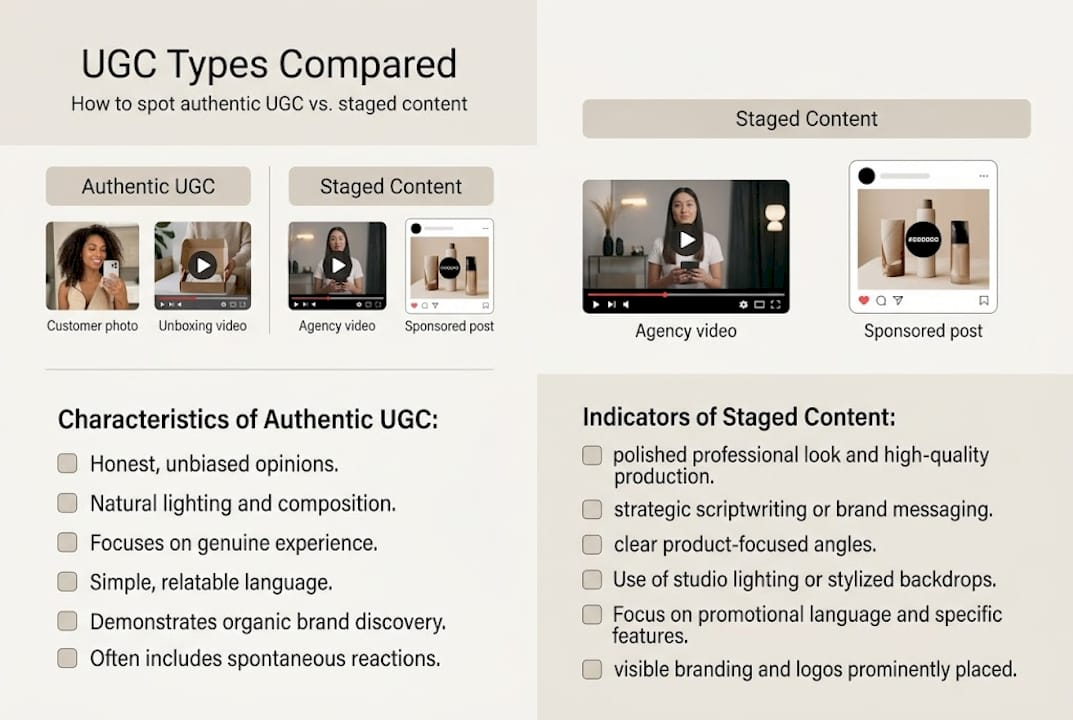
Key types of UGC include reviews and testimonials, photos, videos, social media posts, blog posts, unboxing videos, tutorials, and ratings. Here is how those formats break down by use case:
| UGC format | Primary use in e-commerce ads | Trust signal strength |
|---|---|---|
| Product reviews | PDPs, retargeting ads | Very high |
| Unboxing videos | TikTok, Instagram Reels | High |
| Tutorials | YouTube, Facebook ads | High |
| Customer photos | Email, carousel ads | Medium |
| Ratings | Google Shopping, PDPs | Medium |
| Social media posts | Story ads, social proof | Medium |
Two terms you will encounter constantly are brand-owned UGC and user-owned UGC. Brand-owned means the brand has secured full commercial rights to the content. User-owned means the original creator retains rights, and you need explicit permission before using it in paid advertising. Mixing these up is one of the most common and costly mistakes in e-commerce marketing.
For a deeper foundation on UGC video basics, understanding format differences early will save you significant rework later.
- Creators: Individuals who produce UGC, either organically or through a paid arrangement
- Users: Everyday customers who post about a brand without any formal agreement
- Influencers: Creators with an established audience, whose content may or may not qualify as UGC depending on the arrangement
Pro Tip: Always ask for explicit written permission before featuring any customer content in paid ads. A simple DM confirmation is not enough for commercial use.
UGC categories and how they impact strategy
With the formats mapped, it is crucial to understand the key categories shaping your tactical choices. UGC is categorized into Organic UGC (unpaid, authentic customer shares) and Paid UGC (commissioned from creators, styled to look organic, with defined usage rights). Each category carries a different risk profile, cost structure, and strategic role.
Organic UGC is what most people picture when they hear the term. A customer buys your product, loves it, and posts about it. You did not ask. You did not pay. That authenticity is exactly what makes it powerful for building trust. The downside is that you cannot predict volume, quality, or timing.

Paid UGC flips that equation. You commission creators to produce content that mimics the organic feel, but you control the brief, the timeline, and the usage rights. It scales. It is consistent. And when done well, audiences cannot tell the difference.
| Factor | Organic UGC | Paid UGC |
|---|---|---|
| Cost | Low to zero | Medium to high |
| Control | Low | High |
| Trust signal | Very high | High |
| Scalability | Unpredictable | Fully scalable |
| Usage rights | Requires permission | Defined by contract |
| Brand alignment | Variable | Controlled |
Brands that combine both categories consistently outperform those relying on a single approach. A hybrid strategy lets you use organic content for social proof while deploying paid UGC for structured ad campaigns. The organic content feeds credibility. The paid content feeds the media plan.
For a closer look at UGC trends for engagement in 2026, hybrid approaches are increasingly the standard among top-performing e-commerce brands. You can also explore the UGC advertising benefits that come from structuring your mix intentionally.
- Organic UGC works best for brand awareness, social proof, and community building
- Paid UGC works best for performance campaigns, A/B testing, and scaling winning creatives
- Hybrid strategies maximize both trust and control across the full funnel
Key UGC terminology e-commerce marketers must know
Now that categories are clear, a closer look at the actual language used will sharpen your team’s communications. Misusing even one term in a brief or contract can lead to rights violations, creator disputes, or wasted creative budget. Here are the essential terms every e-commerce marketer needs to own:
- UGC Creator: A person hired specifically to produce content that looks and feels organic, without promoting it to their own audience. They are paid for the content asset, not for reach.
- Organic UGC: Unpaid content created voluntarily by real customers. High trust, low control.
- Paid/Commissioned UGC: Content produced under a formal agreement, with a defined brief and usage rights. The gold standard for scalable video ad campaigns.
- Moderation: The process of reviewing and approving UGC before it appears in brand channels or ads. Includes checking for brand safety, accuracy, and legal compliance.
- Commercial Rights: The legal permission to use content in paid advertising. Without this, you cannot run a creator’s video as a paid ad, even if they gave you verbal approval.
- Whitelist: An arrangement where a creator grants a brand permission to run paid ads directly from the creator’s social account. This preserves the organic look while enabling paid distribution.
- Influencer Content vs. UGC: This distinction trips up a lot of teams. UGC focuses on authenticity without leveraging an influencer’s audience or reach. Influencer marketing pays for both the content and the distribution to that influencer’s following.
“UGC focuses on authenticity without leveraging the influencer’s audience or reach. Influencer marketing pays for reach and content.”
Understanding UGC commercial rights in detail is non-negotiable before you launch any paid campaign. Similarly, knowing your UGC video formats helps you match the right content type to the right placement.
Pro Tip: Before deploying any UGC in a paid ad, confirm in writing that you hold commercial rights. “Posted publicly” does not mean “available for advertising.”
How UGC terminology shapes e-commerce video ad results
You now speak the language. Here is how those definitions turn into real business results when applied intentionally. Terminology is not just academic. It maps directly to actions, workflows, and outcomes in your ad program.
Mislabeling content creates cascading problems. Calling paid creator content “organic UGC” in a brief confuses your media buyer about trust signals. Skipping the moderation step because a piece “looks fine” exposes you to brand safety issues. Using content without confirming commercial rights can result in takedown requests mid-campaign.
Here is how the core UGC workflow terms connect to real outcomes:
| Terminology | Action step | Business outcome |
|---|---|---|
| Hashtag campaign | Launch a branded hashtag to collect UGC | Scalable organic content pipeline |
| Seeding | Send product to creators for organic posting | Authentic content without a paid brief |
| Moderation | Review content for brand safety and accuracy | Legal protection, brand consistency |
| Whitelisting | Run ads from creator’s account | Higher trust, lower CPMs |
| Commercial rights | Confirm usage in paid ads | No takedowns, full campaign control |
| Full-funnel MER | Measure media efficiency ratio over ROAS | Accurate ROI picture across channels |
Collect via hashtags and seeding, curate with rights management and moderation, deploy on product pages, social, and ads, then measure full-funnel media efficiency ratio rather than relying solely on ROAS. That methodology is how leading e-commerce brands structure their UGC programs.
Three scenarios where precise terminology made or broke campaign results:
- Scenario 1: A brand ran a hashtag campaign but skipped moderation. Off-brand content appeared in their ad rotation, triggering a brand safety flag and pausing the campaign for five days.
- Scenario 2: A team confused “whitelisting” with “commercial rights.” They had whitelisting access but not full commercial rights, resulting in a creator dispute and a pulled ad set.
- Scenario 3: A brand tracked ROAS only, ignoring full-funnel MER. They cut their best-performing UGC ad because last-click attribution undervalued it, losing a 3x return on that creative.
For teams building out their UGC production workflow, these scenarios are avoidable with the right vocabulary in place from day one. Strong effective video ads with UGC start with teams that share a precise, consistent language.
Why mastering UGC terminology is a competitive advantage
Most marketers focus on content quality as the primary driver of UGC performance. Better hooks, better lighting, better scripts. That matters. But there is a less visible advantage that consistently separates high-performing teams from the rest: operational clarity through shared vocabulary.
When everyone on your team uses the same definitions, content approval cycles shrink. Legal reviews move faster because the rights questions are already answered in the brief. Creator relationships stay clean because contracts use precise terms, not vague language that invites disputes later.
The brands winning with UGC in 2026 are not just producing more content. They are running tighter operations. A shared language removes the friction that slows campaigns down at every stage, from sourcing to deployment to measurement. That video ad conversion impact compounds over time when your team is not constantly re-explaining what “commercial rights” means or debating whether a piece of content needs moderation.
Pro Tip: Review your team’s UGC terminology glossary quarterly. New ad formats, platform policies, and regulations shift what terms mean in practice.
Language precision also builds trust with creators and stakeholders. When you brief a creator using accurate terminology, they know you are a professional partner. When you present a UGC strategy to leadership using the right vocabulary, you signal operational maturity. That credibility accelerates approvals and budget decisions.
How HotUGC powers smart UGC for video ads
For teams ready to move from theory to practice, here is how to make UGC work with less friction and more ROI.
Understanding UGC terminology gives your team a strong foundation, but executing at scale still requires the right tools. Rights management, moderation, creator sourcing, and rapid iteration are all easier when your platform is built for them.
HotUGC for AI-generated UGC videos eliminates the sourcing, contracting, and production bottlenecks that slow most e-commerce teams down. The platform generates high-performing, UGC-style video ads with realistic avatars, conversion-optimized scripts, and commercial rights included, so you skip the terminology headaches around rights clearance entirely. Whether you are running campaigns on TikTok, Instagram, or Facebook, HotUGC lets you produce compliant, on-brand video ads in minutes, not weeks. It is the fastest way to apply everything you have learned here.
Frequently asked questions
What is the main difference between UGC and influencer content?
UGC focuses on authenticity without leveraging an influencer’s audience or reach, while influencer content is commissioned from individuals specifically for distribution to their following. UGC is about the content itself; influencer marketing pays for both content and reach.
Why does UGC terminology matter in e-commerce video ads?
Precise terms align your legal, creative, and media teams from the start, preventing rights violations, budget waste, and off-brand content from derailing campaigns mid-flight.
How is paid UGC different from organic UGC?
Paid UGC is commissioned with a defined brief and usage rights, while organic UGC is created voluntarily by real customers without compensation, making it authentic but harder to predict or control.
What are the top types of UGC used in e-commerce ads?
Common formats include product reviews, unboxing videos, tutorials, customer photos, and social media mentions, each serving a different role across the funnel from awareness to conversion.


